
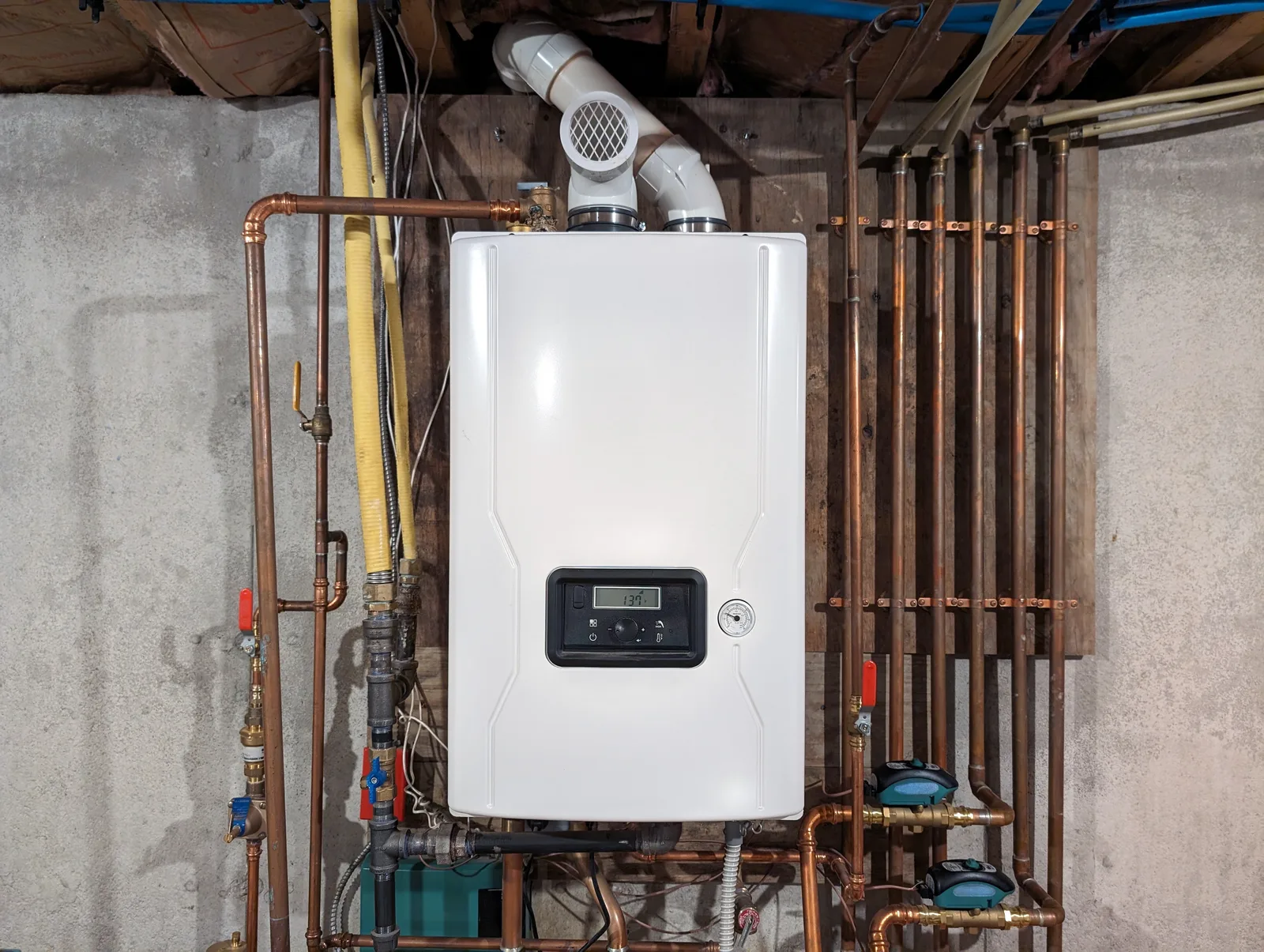
Navien puts the code on the front panel display of the unit itself, so you can read it without opening anything or owning an accessory controller. Note the number and note whether it appeared while someone was drawing hot water or while the unit sat idle — that single detail separates several faults that share a number range, and it is the first thing we ask on the phone.
Read the groups rather than memorising thirty numbers. The E000s are combustion and flame. The E100s are the fan and the air pressure path. The E400s cover water sensors, valves and configuration. The E500s are the main control board and its settings. A code that returns the instant you reset is a real fault; one that stays away for weeks was a passing condition.
Codes vary by model and generation, and the label inside the front cover of your own unit is the authority rather than this page — even the temperature threshold behind a single code moved between the original NPE and the current NPE-2. One more caution: Navien's boiler products use their own numbering, and boiler code lists rank well in search, so check you are reading a water heater table before acting on it. Navien lines and warranty detail sit on the Navien tankless repair page, the other common make is on the Rinnai code guide, and on-demand work generally is under tankless water heater service.
Navien tankless water heater codes, decoded
| Code | What it means | Safe? | Try first | When to call |
|---|---|---|---|---|
E003 | Ignition failure — the burner tried to light and did not. | turn it off | Confirm the gas is on and other gas appliances work. Reset once, no more. | Call if it fails again. Repeated ignition attempts are not worth forcing. |
E004 | False flame detection — flame is seen when there should be none. | call now | Shut the unit off and close the gas isolation valve if you can reach it safely. | Call immediately. A flame signal with no call for heat is a gas-side fault. |
E012 | Flame loss — the burner lit and then went out. | turn it off | Note whether another large gas appliance fired at the same moment. | Call. Flame loss under load points at gas supply, venting or the flame rod. |
E016 | Overheating of the heat exchanger. | turn it off | Turn the unit off and let it cool. Do not keep resetting to get hot water back. | Call. Overheating usually means scale in the exchanger or restricted flow. |
E030 | Exhaust overheating — the unit shuts down when flue temperature climbs too high. | call now | Shut it down. Check the outdoor vent terminal for snow, ice, a nest or leaves. | Call immediately — a restricted flue is a combustion-products problem. |
E031 | Overheating of the burner. | call now | Turn the unit off and leave it off rather than clearing the fault. | Call immediately. Burner overheat faults are licensed-technician work. |
E046 | Abnormal operation of the limit control. | turn it off | No homeowner fix. Power the unit down and note the code. | Call. A limit control that misbehaves is a safety device out of action. |
E047 | Exhaust thermostat — thermistor open or short circuit. | turn it off | Turn it off. Nothing inside the cabinet is a homeowner job. | Call. The unit cannot monitor flue temperature with this sensor down. |
E109 | Abnormal operation of the fan motor. | turn it off | Power the unit down and leave the cover on. | Call — the unit will not fire safely without the correct combustion air. |
E110 | Abnormal air pressure. | call now | Check the outside terminal for ice, snow or an obstruction, and shut the unit off. | Call immediately if the terminal is clear — that moves the fault inside. |
E407 | Hot water outlet thermistor open or short circuit. | turn it off | Turn it off. Without a valid outlet reading, scald protection is compromised. | Call. Sensor replacement is a straightforward visit once diagnosed. |
E421 | Cold water inlet thermistor open or short circuit. | turn it off | Nothing to try. Shut the unit down and note the code. | Call — the unit modulates gas against inlet temperature, so output will wander. |
E434 | Abnormal operation of the water adjustment valve. | turn it off | Shut the unit down to avoid temperature swings at the tap. | Call — an erratic mixing valve can deliver water hotter than you set. |
E439 | Abnormal operation of the flow sensor. | turn it off | Turn the unit off and note whether flow had dropped off at every hot tap. | Call. The inlet screen and the flow sensor both get checked with the water isolated. |
E515 | Abnormal operation of the PCB — the main control board. | turn it off | One power cycle is reasonable. If E515 returns, leave the unit off. | Call. A board failing its self-check is replaced, not reset. |
E517 | Abnormal DIP switch setting — the unit is configured incorrectly. | turn it off | Do not open the cover to change switches. This normally follows recent service. | Call whoever last worked on it. Configuration must match the installation. |
E760 | Flushing and service alarm — the unit is asking to be descaled. | keep running | Book a descale flush. The unit will usually keep making hot water meanwhile. | Call to schedule maintenance; this is a deadline, not an emergency. |
E762 | Vent pipe not properly inserted. | call now | Shut the unit down. Do not attempt to reseat vent piping yourself. | Call immediately — a vent joint that is not sealed vents where it should not. |
E773 | Using the wrong gas — the unit is set for a different fuel than it is receiving. | call now | Shut the unit off and close the gas isolation valve to the appliance. | Call immediately. Running an appliance on the wrong fuel is dangerous. |
The codes that usually mean a real repair
E760 and E016 — scale, and the overheat that follows it
Halton and Hamilton water is hard, and hard water is the biggest enemy a tankless heat exchanger has. E760 is the polite warning: the unit is asking to be flushed. Ignore it long enough and scale insulates the exchanger walls until the burner drives internal temperature past the limit and you get E016 instead. A descale flush is $150–$300 and takes well under a morning — the local water chemistry is set out in hard water and tankless heaters.
E003 and E012 — ignition failures and the gas line behind them
When a Navien lights fine on its own but drops out the moment the furnace or the range fires, the appliance is usually not the problem — the gas line is. Tankless heaters draw far more gas at once than the tank they replaced, and a run sized for that old tank sags under load. Upsizing it adds $400–$1,200 to a conversion and is the fix that actually cures the fault. Repairs on the appliance side typically fall in the $150–$800 range.
E030, E110 and E762 — the venting, not the heater
All three send us to the vent before we open the cabinet. Ice, a wasp nest, drifted snow, a terminal set too close to grade, or a vent joint that was never properly seated will each restrict or misdirect combustion products, and Ontario winters supply plenty of the first three. Clearing a terminal or correcting its height is often a modest visit. What makes these urgent rather than inconvenient is what they are venting; if you smell anything at the same time, treat it as a gas emergency.
Licensed technicians, a written price before the repair, no overtime charges.
Common questions
Where does a Navien display its error code?
On the front panel display of the unit, which also shows operating status and lets you set the water temperature. You do not need to open the cabinet or own an accessory controller to read it. Note the code and whether anyone was running hot water at the time — that detail matters more than most people expect.
How many times can I reset a Navien error code?
Once. A single reset is a reasonable test of whether the fault was a passing condition. If the same number comes straight back, you have confirmed a real failure, and forcing repeated ignition or restart attempts on a gas appliance is the wrong instinct. Write the number down and book service instead.
Which Navien codes are genuine emergencies?
E004, E030, E031, E110, E762 and E773 — a false flame signal, an exhaust or burner overheat, an abnormal air pressure reading, an unseated vent pipe and the wrong fuel. All of them involve gas or combustion products. Shut the unit down, close the gas isolation valve to the appliance if you can reach it safely, and call. If you smell gas, leave the house first and call from outside.
Why do I only get error codes in the middle of winter?
Two reasons, both seasonal. Incoming water is far colder, so the unit works much harder to reach the same tap temperature and marginal faults surface under that load. And vent terminals ice up. A Navien that behaved perfectly in August and started throwing codes in January is one of the most common calls we take.
Is it worth repairing an older Navien or replacing it?
It depends on the part and the age. Sensors, fans and flow devices are ordinary repairs in the $150–$800 range and worth doing on a unit with life left in it. A failed heat exchanger on a scaled-up older unit is a different conversation, since a full tankless replacement runs $3,500–$6,500 installed. We will give you both numbers before you decide — get in touch with the model number and the code.