
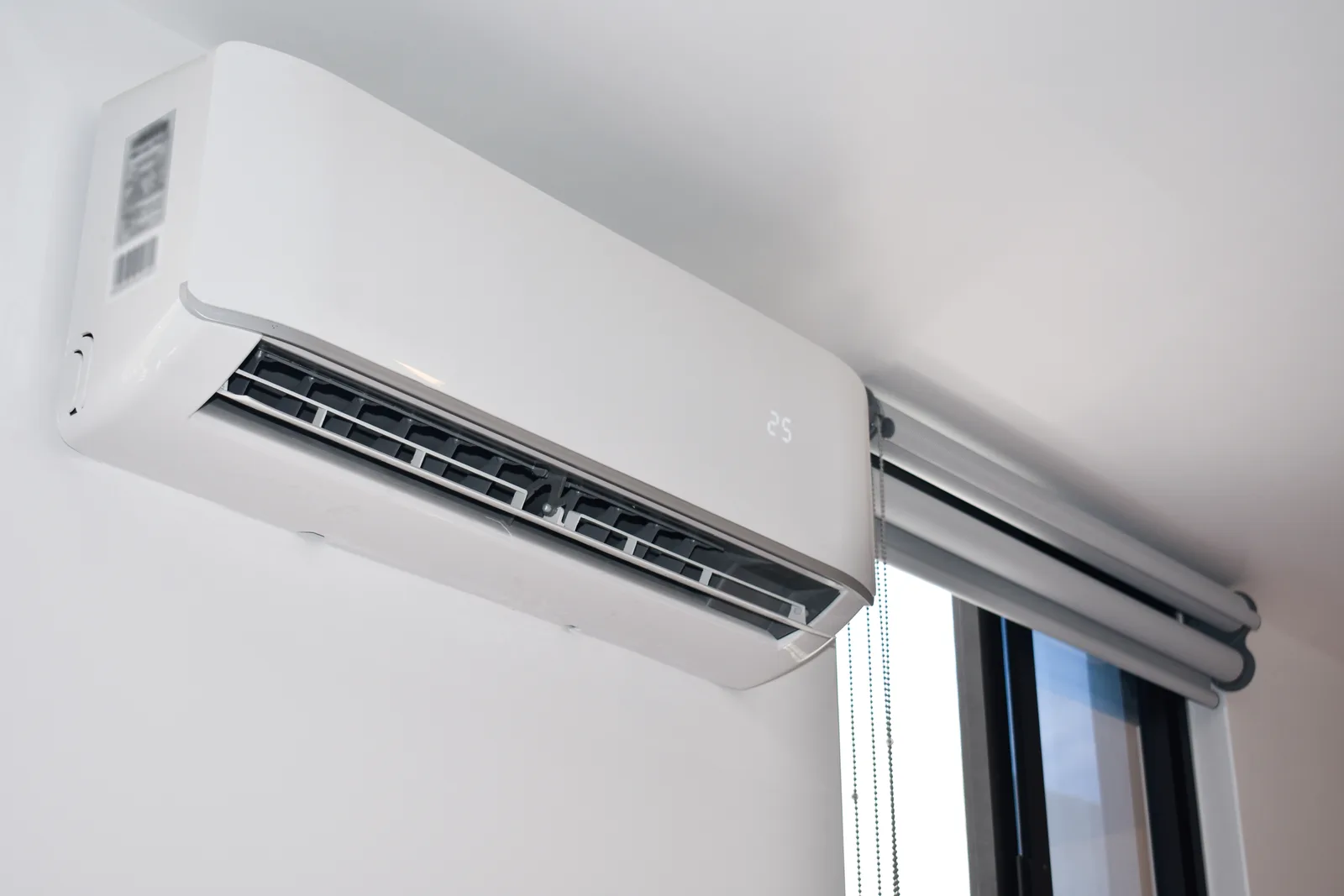
How you read a Mitsubishi fault depends entirely on what is on your wall, and this catches people out. With a wired controller, an MHK2 thermostat or kumo cloud, the two-character code appears on the display and you simply write it down. On a bare M-Series head with an infrared remote there is no alphanumeric code at all — the operation indicator lamp blinks a counted pattern, half a second on with a two-and-a-half second gap, repeating. Mitsubishi's service manual tells technicians to watch at least two full cycles before acting on a count.
Those blink counts have their own meanings, and they are not the letter codes translated. On M-Series indoor units two blinks is an indoor coil or room temperature thermistor fault, three is missing indoor fan motor feedback, four is indoor board memory, five is the compressor stopping on overcurrent or start-up protection, six is outdoor thermistors, seven is inverter or outdoor board memory, and a lamp lit steadily means an outdoor control system fault. Confusingly, the separate failure-mode recall procedure uses different counts again, so a count is only meaningful once you know which of the two you are reading.
Codes vary by model and by series — the letter codes below are the wired-controller and Mr. Slim diagnostic set, and a P-Series does not always use a code the way an M-Series does. Let the diagnostic label inside your own unit's panel settle any disagreement with this page. Full service detail sits on the Mitsubishi repair page, the equivalent list for another common ductless make is the Fujitsu code guide, and if you are weighing ductless in the first place, is a ductless mini-split worth it is the honest version.
Mitsubishi Electric heat pump & mini-split codes, decoded
| Code | What it means | Safe? | Try first | When to call |
|---|---|---|---|---|
P1 | Intake sensor error — the room temperature thermistor is abnormal. | keep running | No homeowner fix. The head may overshoot or undershoot the set temperature. | Book a visit — this is a small, inexpensive sensor. |
P2 | Pipe sensor error on the indoor coil. | keep running | Nothing to do at home. Expect output to fall off as the coil loses supervision. | Book a visit; the unit loses its ability to protect the coil without it. |
P4 | Drain sensor error or float switch connector open. | turn it off | Turn the head off before it spills, and check the wall below it for water. | Call — a blocked condensate path on a wall head means water down drywall. |
P5 | Drain pump error — drain overflow protection is working. | turn it off | Shut the unit down and put a towel underneath while you wait. | Call the same day if water is already appearing below the head. |
P6 | Freezing or overheating protection operation. | turn it off | Turn it off and check the indoor filters — clogged filters are the usual trigger. | Call if the filters were clean, or if you can see ice on the indoor coil. |
P8 | Pipe temperature error. | turn it off | Shut it down. Note whether it happened in heating or in cooling. | Call — this often accompanies a charge problem or a stuck reversing valve. |
PA | Forced compressor stop due to a water leakage abnormality. | turn it off | Turn the system off and look for water around the indoor unit. | Call the same day. The system has stopped itself for a reason worth finding. |
E0 / E3 | Remote controller transmission error. | keep running | Try the controller from closer, and replace its batteries if it is wireless. | Call if it repeats with fresh batteries and a clear line of sight. |
E6 / E7 | Indoor and outdoor unit communication error. | keep running | Inspect the interconnecting cable where it passes through the exterior wall. | Call. This is frequently wiring or a terminal rather than a failed board. |
EA | Indoor and outdoor connector miswiring, or too many units connected. | turn it off | Nothing to try. This normally follows an installation or a recent alteration. | Call whoever wired it — the fault is in how the system was put together. |
F3 / F5 / F9 | Pressure switch connector open — low, high, or both circuits open. | turn it off | No user-side fix. Power the system down rather than letting it retry. | Call. The unit has lost the protection that stops it damaging itself. |
U1 / Ud | Abnormal high pressure, or overheating protection operating. | turn it off | Turn it off and clear anything blocking airflow at the outdoor unit. | Call. High-pressure trips are airflow, overcharge or a failing fan. |
U2 | Abnormal high discharge temperature, or insufficient refrigerant. | turn it off | Leave it off and look for oily residue at the outdoor flare joints. | Call. Running a low-charge system hot is the fastest way to lose a compressor. |
U3 | Outdoor discharge thermistor open or short circuit. | turn it off | No homeowner fix — power it down rather than leaving it to retry. | Call. This sensor is the compressor's overheat protection. |
U5 | Abnormal heatsink temperature on the outdoor drive. | turn it off | Turn it off and check nothing is packed against the outdoor cabinet. | Call if it recurs after the unit has cooled down. |
U6 | Compressor overcurrent interruption, or an abnormal power module. | turn it off | Leave the system off; repeated restarts put the compressor at risk. | Call the same day — this is a drive or compressor fault under load. |
U8 | Outdoor unit fan protection stop. | turn it off | Shut it down and look for ice, debris or a jammed blade outdoors. | Call. No outdoor airflow means the compressor overheats quickly. |
U9 / UH | Overvoltage or voltage shortage, abnormal synchronous signal, or a current sensor error. | turn it off | Check the breaker and whether the rest of the house saw a dip. | Call if it repeats on a calm day rather than during a storm. |
UF | Compressor overcurrent interruption with the compressor locked. | turn it off | Leave it off between attempts. Repeated starts stress a locked compressor. | Call. Start-up current faults need measurement, not repeated attempts. |
UL | Abnormal low pressure — the low-pressure switch has operated. | turn it off | Shut it off and check the line set for frost and the valves for oil stains. | Call. Low pressure on a sealed system points at a leak. |
The codes that usually mean a real repair
P4 and P5 — the condensate that has nowhere to go
Wall-mounted heads drain by gravity through a small hose run inside or behind the wall, and that hose collects biofilm year after year. When it blocks, the pan fills, the float trips, and you get P4 or P5 — often with a stain appearing on the wall below the head before anyone reads a code at all. Clearing and flushing the drain is usually a straightforward visit in the $150–$450 range. Left alone it becomes a drywall repair as well as an HVAC one.
U2 — high discharge temperature and a shortage of refrigerant
U2 is the code that most often turns into a real bill on this brand, because high discharge temperature usually means the charge is low, and low charge means a leak somewhere in the line set or at a flare. Locating it, repairing it and recharging by weight typically lands between $300–$800. It is worth acting on quickly rather than nursing the system through a hot week and hoping.
U1 — high pressure in a system that cannot breathe
Before anyone reaches for gauges on a U1, we look at what the outdoor unit is trying to breathe through. Fences built tight to the cabinet, planters, stacked deck storage and a coil furred with cottonwood all raise head pressure. When the coil really is clean, the outdoor fan motor comes next at $300–$700 fitted, and only after that do we measure the charge. How these systems behave in our winters is covered in the cold-climate heat pump guide.
Licensed technicians, a written price before the repair, no overtime charges.
Common questions
My Mitsubishi head has no screen — how do I read the error?
You count blinks of the operation indicator lamp. The blinks run half a second on with a two-and-a-half second gap, repeating, and the service manual tells technicians to watch at least two full cycles before trusting a count. Write down the number of blinks rather than trying to translate it — the same count means different things in different diagnostic modes.
What is the difference between a P code and a U code?
P codes come from the indoor unit's protective devices: thermistors, drain protection, freeze and overheat protection. U codes come from the outdoor unit and cover pressure, discharge temperature, supply voltage and compressor current. As a rule of thumb the U family is the more urgent one, and more of its members mean stop.
Do the blink counts mean the same thing as the letter codes?
No, and assuming they do is the most common mistake we see. The blink counts on an M-Series head are their own scheme — two blinks for an indoor thermistor, five for compressor overcurrent or start-up protection, a steady lamp for an outdoor control fault. Mitsubishi also publishes a separate failure-mode recall procedure whose counts differ again.
Why does my mini-split only show a code in winter?
Because heating loads the system differently. Defrost, outdoor thermistors and discharge temperature all matter far more in heating mode, so a marginal sensor or a slightly low charge can pass all summer and fail in January. In the pre-war brick homes around Bronte and Kerr Village where ductless carries the whole heating load, that first hard cold snap is when marginal faults surface.
Should I keep resetting a U6 or UF code?
No. Both are compressor overcurrent faults, and every forced restart is another hard start against something already struggling. Shut the system off, leave it off, and book a technician. The difference between calling on the first trip and the tenth is often the difference between a repair and a new outdoor unit.