
Lennox says alert rather than error, and it separates a moderate alert, which lets the system keep operating, from a critical one that locks equipment out. Read that line on the screen before you read the number — it tells you immediately whether you are dealing with an inconvenience or a shutdown. The alert also names the device it came from, which saves a great deal of guessing.
The numbering is grouped by where the fault lives, and getting the group right matters more than memorising codes. Numbers under 200 cover the thermostat, the communication bus and control hardware. The 180s are outdoor sensors and transducers. The 400s are the outdoor unit proper: the compressor, its pressure switches, its contactor and its inverter. Codes in the 200s and 300s belong to the furnace, air handler or blower, so an outdoor problem should not be diagnosed from that part of the list.
Codes vary by model and by control generation — first-generation iComfort Wi-Fi thermostats used a different scheme than the S30 and S40, and mixing the two sends you down the wrong path entirely. The label inside your own unit's panel outranks this page. Lennox furnace faults sit on the Lennox furnace error code guide, model and warranty detail on the Lennox repair page, and cooling work generally under air conditioning service.
Lennox AC & heat pump codes, decoded
| Code | What it means | Safe? | Try first | When to call |
|---|---|---|---|---|
10 | Unknown device detected — something has been added since the system was configured. | keep running | Nothing to try. This usually follows a part being replaced. | Call whoever last worked on the system so the configuration can be completed. |
105 | Wiring issue or communication problem between system components. | keep running | Check that nothing has disturbed the low-voltage cable at the furnace or air handler. | Call — repeated 105s usually trace to a loose terminal or a damaged run. |
120 | Unresponsive device — commonly the outdoor unit is slow to answer the thermostat. | keep running | Give it several minutes. A one-off 120 after a power blip is not unusual. | Call if the system never comes back or the alert repeats daily. |
124 | The thermostat lost communication with a component for more than three minutes. | keep running | Confirm the thermostat display is awake and the furnace switch is still on. | Call if the alert survives a reset — the link or a board has failed. |
125 | Control hardware problem on a system component. | turn it off | Shut the system down. There is no homeowner-side fix for a failed control. | Call. We confirm the board part number off the rating plate before ordering. |
180 | Outdoor temperature sensor problem. | keep running | Nothing to do from indoors. Expect odd staging or defrost behaviour meanwhile. | Book it before heating season — heat pumps lean on this sensor to time defrost. |
400 | The compressor's internal overload has tripped. | turn it off | Leave it off and let it cool. Do not keep restarting to see whether it holds. | Call the same day. Repeated overload trips shorten compressor life quickly. |
402 | System pressure trip — discharge or suction pressure out of limits, or an overloaded compressor. | turn it off | Turn it off, then clear debris and anything crowding the outdoor cabinet. | Call. Pressure out of limits is airflow, charge or a failing fan. |
403 | Compressor short-cycling — it ran under three minutes to satisfy a demand. | keep running | Note how often it happens. Short-cycling is a symptom, not a fault in itself. | Call if it is constant — oversizing, charge and control wiring all cause this. |
404 | Compressor rotor locked — a shorted run capacitor, seized bearings or liquid refrigerant. | turn it off | Shut it down. Forcing starts against a locked rotor does real damage. | Call the same day. A capacitor is cheap; a seized compressor is not. |
408 | Compressor contactor welded — the compressor is running continuously. | call now | Set the thermostat to off, then switch the outdoor unit's breaker off in the panel. | Call immediately. A welded contactor means the compressor cannot be stopped normally. |
409 | Outdoor control board low 24 V — secondary voltage has fallen below limit. | turn it off | Turn the system off. Do not start swapping fuses at the disconnect. | Call. Low secondary voltage points at the transformer or a short in the circuit. |
410 | Open low pressure switch — pressure is below the required limit. | turn it off | Shut it off and look for frost on the line set or oil stains near the valves. | Call. Sealed systems do not consume refrigerant, so low pressure means a leak. |
411 | Low pressure switch opened five times in one demand — the unit is locked out. | turn it off | Leave it off rather than clearing the lockout to buy an afternoon of cooling. | Call. Five strikes in one cycle is a confirmed charge or restriction problem. |
412 | Open high pressure switch — pressure is above the upper limit. | turn it off | Turn it off and check the coil and the clearance around the cabinet. | Call if the coil is clean — the fan motor and the charge come next. |
413 | High pressure switch opened five times in one cooling demand — lockout. | turn it off | Do not clear and retry. The switch has done its job five times over. | Call the same day; sustained high head pressure is hard on a compressor. |
414 | High discharge line temperature — above the recommended upper limit. | turn it off | Shut it down and leave it off. This is the compressor running far too hot. | Call. High discharge temperature usually means low charge or a restriction. |
416 | Outdoor coil sensor faulty — open, shorted or out of range. | keep running | Rinse debris off the outdoor coil so the sensor reads clean air. | Book it before winter. Defrost timing depends on this sensor being accurate. |
The codes that usually mean a real repair
410 and 411 — low pressure, and the leak behind it
A single 410 is the switch doing its job; a 411 means it did that job five times inside one demand, and the unit has stopped trying. Either way the fix is finding where the charge went rather than adding more. We pressure-test, trace the leak, seal it and recharge to the nameplate weight, which generally falls in the $300–$800 band. Topping up a leaking system is the shortcut we will not sell — it fails again the same season.
404 and 408 — the compressor circuit and its contactor
These two look similar from the driveway and are very different underneath. A 404 locked rotor is often a failed run capacitor, and capacitor replacement runs $150–$350 in a single visit. A 408 welded contactor is more urgent, because the compressor cannot be switched off normally and will keep running whatever the thermostat wants. Contactor replacement sits in the same $150–$350 range; what makes it a same-day call is that leaving it welded is hard on the equipment.
125 — a control board at the end of its life
This one is the control reporting that its own hardware has failed, and no cleaning or adjustment helps. Board replacement typically runs $400–$800 depending on which board and which line. On communicating Lennox equipment the replacement also has to be configured to the system rather than simply bolted in, which is why a same-day parts-counter swap rarely ends well. On an older condenser we will show you the honest comparison against replacement first — the AC repair cost breakdown sets out the usual numbers.
Licensed technicians, a written price before the repair, no overtime charges.
Common questions
What is the difference between a Lennox moderate alert and a critical alert?
A moderate alert lets the equipment carry on in some reduced way, so the system still heats or cools while the number sits on the screen. A critical alert locks the equipment out until the fault clears. The screen states which you have, and that single line is often more useful than the number itself.
My alert is in the 200s. Is that my air conditioner?
Almost certainly not. Lennox puts indoor equipment in the 200s and 300s — the furnace, the air handler and the blower — while the outdoor unit lives in the 400s. Alert 200 is a rollout limit switch on a gas furnace, not a compressor fault. Chasing an outdoor problem through that part of the list wastes an afternoon.
Why does the same alert number mean something different on my older Lennox thermostat?
Because the numbering changed. First-generation iComfort Wi-Fi controls used their own scheme, and the S30, S40 and E30 use the current one. If a list you are reading does not match what your screen describes in words, you are looking at the other generation's table and should stop using it.
Does snow around the outdoor unit cause Lennox alert codes?
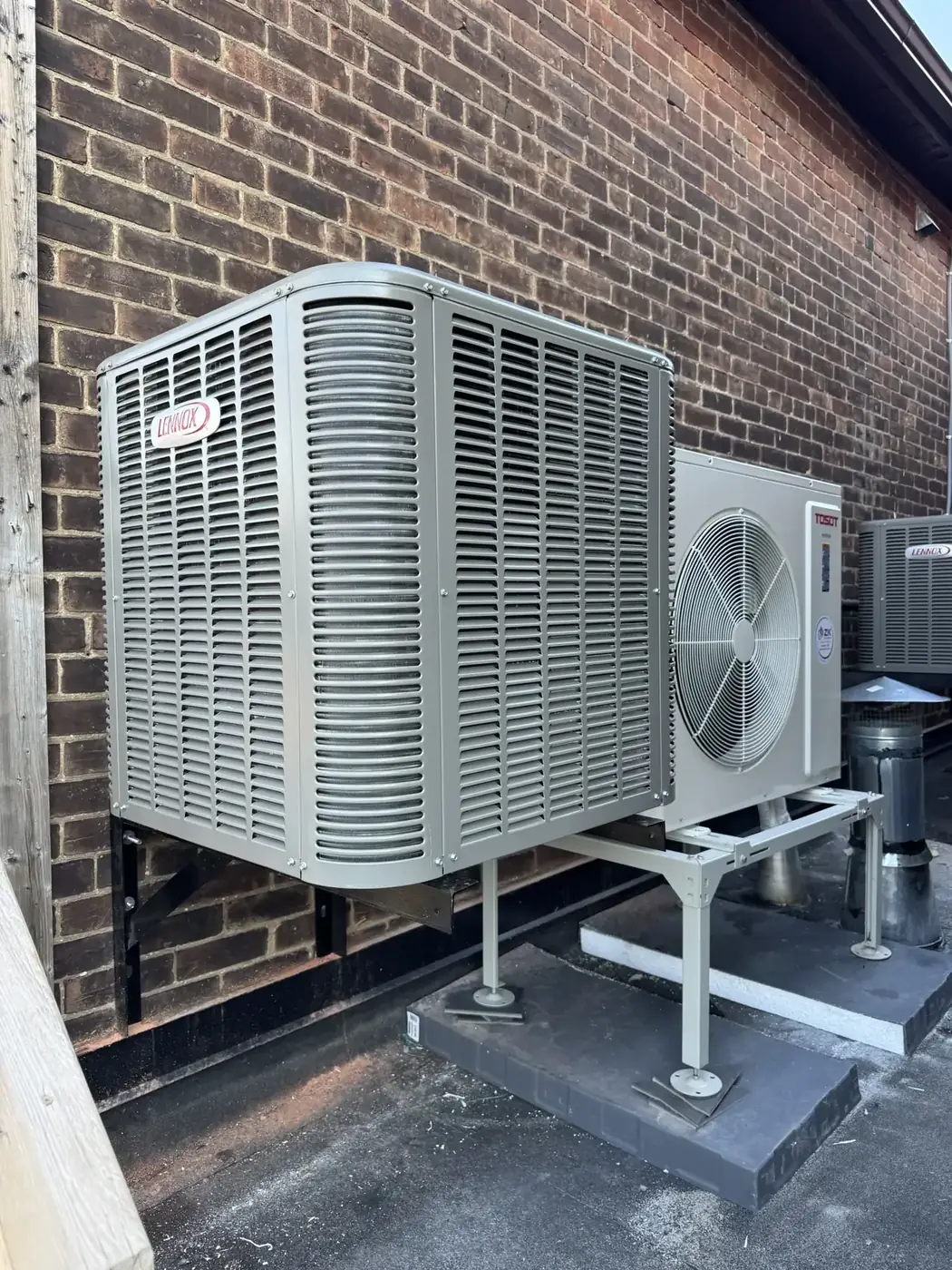
It can, and it is a real consideration here. Lennox heat pumps in Burlington and Oakville are set on elevated stands precisely so drifting and lake-effect snow off Lake Ontario does not bury the coil. A buried or iced coil starves airflow, which drives a pressure alert or leaves a heat pump stuck in defrost. Keep roughly a half-metre clear around the cabinet, and never chip ice off the coil.
Can I clear a Lennox alert myself?
Most clear on their own once the condition passes, and a single power cycle is a fair test. What you should not do is clear the same one repeatedly to keep the system limping. The pressure and overload alerts exist to protect the compressor, and overriding them is how a modest part becomes a full replacement. If an alert cleared overnight but was a 410, 412 or 400, still get in touch — a protective trip that resets itself is still a trip.