
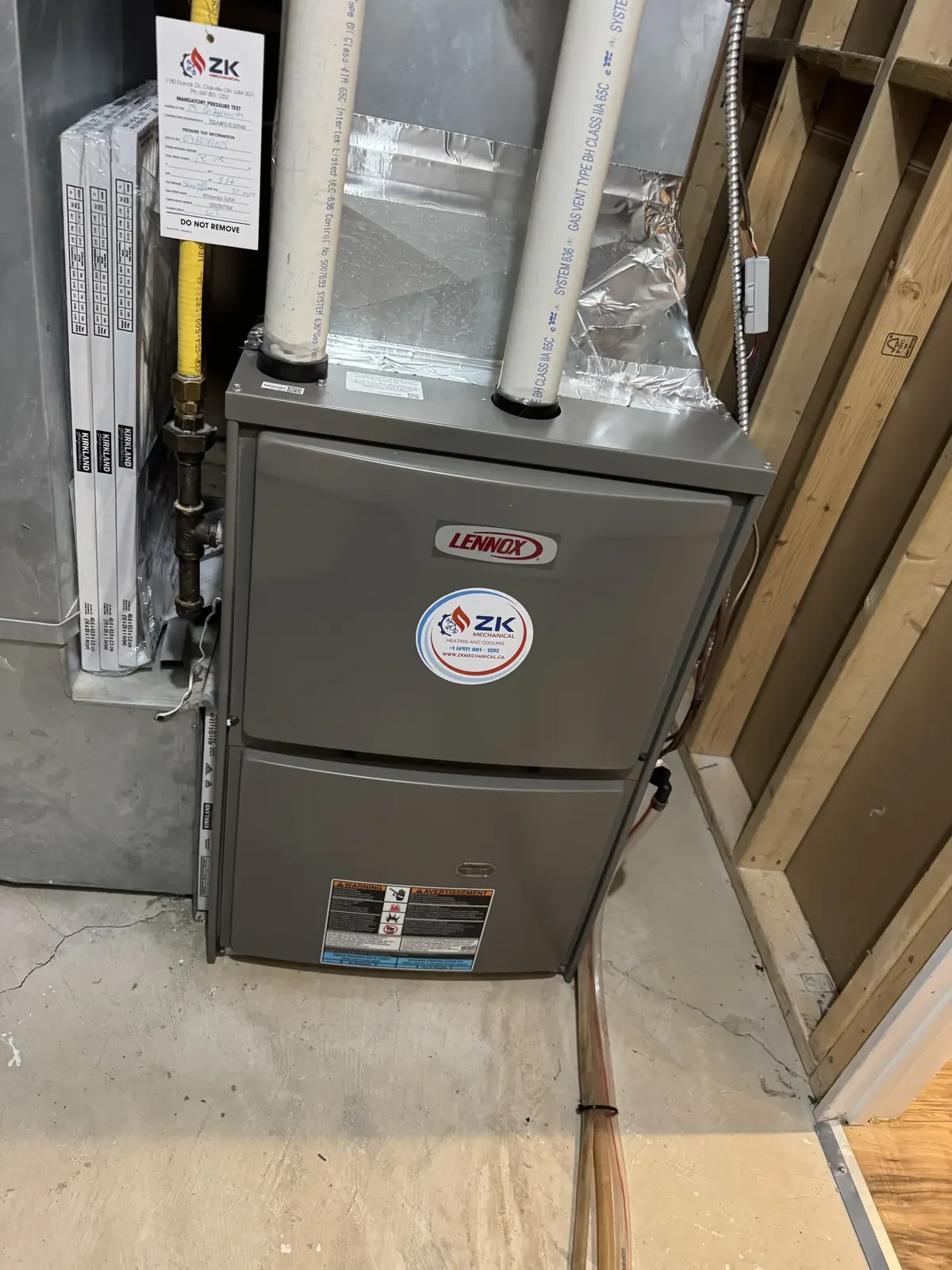
Open the lower door on a current Lennox furnace and you will find a small red seven-segment display on the integrated control, plus a diagnostic push button beside it. Pressing the button cycles the display between stored error codes, the measured flame signal and the programmed unit size, which is why the same window sometimes shows a letter instead of a number. Codes stay in memory after the fault clears, so a code on the display does not always mean the furnace is failing right now.
If the house has an iComfort S30 or S40 thermostat, the same fault appears at the wall — but without the E. The board reads E200 while the thermostat reads 200 plus a plain-English line such as a rollout limit switch being open. They are the same fault, and this is the single most common point of confusion when a homeowner reads a code off the thermostat and then cannot find it in the manual. The thermostat also adds a severity label the bare board cannot show.
Older Lennox furnaces do not use E-codes at all. On a unit like the ML196UHE the board flashes a single red LED a set number of times and a steady heartbeat flash means everything is normal. Those counts are their own scheme, they changed between board generations, and none of them map onto the E-numbers below. Lennox does not publish one master list covering every furnace it has built. Codes vary by model: the numbering is consistent across the current line, but which codes a given furnace can display, and the exact wording, depend on the control board and the hardware fitted. Always confirm against the diagnostic table printed inside the blower compartment of your own unit: where this page and that label disagree, the label wins. If you would rather not guess, our Lennox furnace repair page covers what we carry on the truck, and ZK Mechanical can read the code out with you over the phone.
Lennox furnace codes, decoded
| Code | What it means | Safe? | Try first | When to call |
|---|---|---|---|---|
E200 | Rollout circuit open, or opened at some point earlier. Flame or hot gas has escaped the burner box. | call now | Shut the furnace off at the switch. Do not reset it repeatedly. | Immediately. Rollout means combustion is escaping where it should not. |
E223 | Low pressure switch failed open — the switch never closed when the inducer started. | turn it off | Check the outside vent pipes for snow, ice or a bird nest. | If the vents are clear, or the code returns after clearing them. |
E224 | Low pressure switch failed closed — the switch was already closed before the inducer ran. | turn it off | Nothing. A stuck-closed switch defeats a venting safety. | Right away. This one is not safe to run around. |
E226 | High pressure switch failed closed — stuck closed before the inducer came up to speed. | turn it off | Nothing at home. | Right away, for the same reason as E224. |
E227 | Low pressure switch opened during the trial for ignition or while running. | turn it off | Check for a blocked condensate trap or a sagging vent pipe holding water. | If it repeats, or if you find standing water in the trap. |
E240 | Low flame current while running — the furnace can see flame, but only barely. | turn it off | Change a filthy filter. Do not sand the flame sensor yourself. | Soon. Low flame signal is the warning shot before lockout. |
E241 | Flame sensed out of sequence and flame is still present — the furnace sees fire when the gas valve should be shut. | call now | Shut the furnace off at the switch and leave it off. | Immediately. A valve passing gas is a genuine safety fault. |
E250 | Limit switch circuit open. If the limit does not close within three minutes the furnace drops into a one-hour lockout. | turn it off | Replace the filter and open every supply register in the house. | If it returns with a clean filter — the furnace is overheating. |
E252 | Discharge air temperature too high on a gas heat call. | turn it off | Same as E250: filter, registers, and check for a closed damper. | If airflow looks fine and it still overheats. |
E270 | Soft lockout after the maximum number of ignition retries. No flame current was ever sensed. | turn it off | Confirm the gas is on and the shutoff valve at the furnace is open. | Same day. This is the classic no-heat lockout. |
E271 | Soft lockout after maximum retries, with the last attempt failing because the pressure switch opened. | turn it off | Check the outside intake and exhaust terminations for blockage. | If the terminations are clear. |
E274 | Soft lockout after too many recycles caused by the limit circuit opening, or the limit staying open past three minutes. | turn it off | New filter, then wait out the one-hour lockout before restarting. | If it locks out again on a clean filter. |
E275 | Soft lockout because flame was sensed out of sequence, though the flame signal is now gone. | call now | Leave the furnace off until it has been checked. | Immediately. Treat it like E241. |
E290 | Igniter circuit fault — a failed igniter or the board circuitry that fires it. One-hour soft lockout. | turn it off | Nothing at home. | Same day if the house is cold. |
E292 | Indoor blower motor cannot start — seized bearings or a blower wheel jammed against its housing. | turn it off | Listen for a hum or a burning smell, then shut it off. | Right away. A motor drawing current but not turning gets hot. |
E294 | Combustion air inducer motor amp draw is too high — the inducer is dragging. | turn it off | Nothing at home. | Soon. An inducer pulling high current is on its way out. |
E311 | Heat rate reduced to match available blower airflow — the furnace has throttled itself back. Lennox flags this as a warning only. | keep running | Change the filter and open closed registers, then see if it clears. | If the house stops keeping up on cold nights. |
E312 | Restricted airflow in cooling or continuous fan mode. Warning only. | keep running | Filter, registers, and check the return grille is not blocked by furniture. | If it persists after clearing the obvious restrictions. |
The codes that usually mean a real repair
E270 or E290 — the igniter and flame sensor pair
The two parts behind most Lennox no-heat lockouts are the hot surface igniter and the flame sensor, and the code tells you which one to suspect. E290 points at the igniter circuit; E240 followed by E270 points at a flame sensor that has gone dirty enough that the board stops trusting it. Flame sensor cleaning or replacement runs $150–$300 and a hot surface igniter is $200–$450. Both are stocked parts and both are usually a single-visit fix — see what furnace repair costs in the GTA for how a diagnostic folds into the price.
E223, E227 or E271 — pressure switch, vent or condensate trap
On a 90-plus Lennox the pressure switch codes are usually reporting a plumbing problem rather than a failed switch. The condensate trap under the furnace blocks with sediment, the drain line backs up, or the vent pipe out through the side wall picks up ice in a Lake Ontario freeze-thaw week. Clearing a blocked trap or replacing it runs $150–$350; a pressure switch itself falls in the $250–$500 band. Get it diagnosed before replacing parts, because a new switch on a blocked vent fails again the same week.
E290, E292 or E294 — motors and the control board
These are the codes that turn into larger repairs. E292 means the indoor blower is not turning, E294 means the inducer is drawing too much current, and E290 can be the igniter circuit on the board rather than the igniter itself. A draft inducer motor is $400–$900, a blower motor $500–$1,500 depending on whether it is a standard motor or a variable-speed ECM, and a control board $500–$1,200. On a Lennox past fifteen years old it is worth pricing the repair against a replacement before committing — our repair-versus-replace guide lays out where the line usually falls.
Licensed technicians, a written price before the repair, no overtime charges.
Common questions
How do I clear an error code on a Lennox furnace?
Most Lennox soft lockouts clear themselves. The furnace sits in a one-hour timeout and then tries again on its own, so if you can wait, waiting is the safest reset. Otherwise switch the furnace off at the service switch beside it, leave it for thirty seconds and switch it back on. Do not use the breaker as a routine reset, and do not reset more than once for a code involving flame, rollout or venting — the lockout is doing its job. Stored codes stay in the board's memory for a technician to read even after the furnace runs again.
What does E200 mean on a Lennox furnace?
E200 is the rollout circuit, and it is the one code on this page we would ask you to stop reading and act on. A rollout switch trips when flame or hot combustion gas comes forward out of the burner box instead of going up the vent, usually because the heat exchanger is blocked, cracked, or the venting is obstructed. Shut the furnace off at the switch and call for service. It is also worth reading whether a furnace can leak carbon monoxide and checking that you have a working CO alarm on every level.
My iComfort thermostat shows a number with no E in front of it. Is that the same code?
Yes. The furnace board displays E200 while an iComfort S30 or S40 thermostat displays 200 with a plain-English description. Lennox uses the same numbering in both places and simply drops the letter at the wall control. The thermostat adds a priority label — roughly, service urgently, service soon, or information only — which the seven-segment display on the board cannot show. If you are reading the code off the thermostat, add the E back on before looking it up.
My older Lennox just flashes a light. Where are the E-codes?
There are none on that board. Lennox used flash counts before moving to the seven-segment display, and on a unit like the ML196UHE a single red LED flashes a number of times with a pause between repeats. Count the flashes across several cycles, then read that count off the legend printed inside the blower door rather than off any table you find online, this page included. The flash meanings changed between board generations, so a list from the wrong model year will send you after the wrong part.
Is it safe to keep resetting a Lennox furnace that keeps locking out?
Once, to get through a night, on a code that does not involve flame or venting. Not repeatedly. A lockout is the control board refusing to keep trying something that failed five times, and resetting past it puts unburned gas through a furnace that has already told you something is wrong. Codes E200, E241 and E275 should not be reset at all. If your heat has quit in a Burlington or Oakville cold snap, close off unused rooms, keep a trickle running at taps on exterior walls, and book the call — our furnace repair service runs a 24/7 line with no overtime surcharge.