
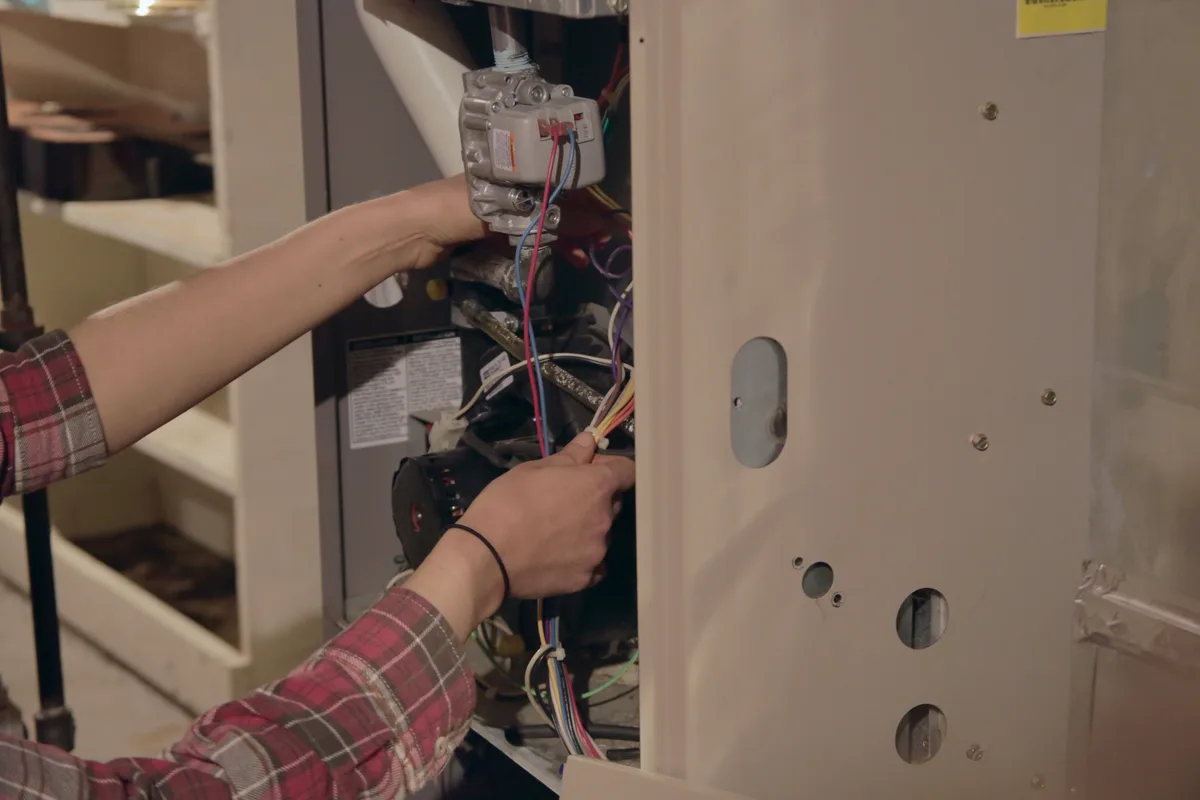
American Standard and Trane furnaces are the same equipment under two badges, and the paperwork shows it. The installer's guides print model numbers with a blank first letter and a note that it may be A or T: an AUH1 is the American Standard, a TUH1 is the Trane, and the flash code table is one table. Current S-series furnaces go further and share the model number outright, so an S9X1 or S8X1 is the same furnace whichever logo is on the door. Our Trane furnace error code guide covers the sister brand.
On the flash-count controls, read the rhythm first. An even slow flash means the control is idle with no call for heat, and an even fast flash means it is heating normally. A fault shows as a group of flashes, a two-second gap, then the same group again. Two-stage and variable-speed controls split the job between a green status light for slow and fast and a red light that flashes only when there is a fault, and on power-up that red light replays the last four alerts, newest first.
One point catches people who have owned other brands. On this control a light that is on solid is not the all-clear: the legend reads Continuous ON, replace IFC, meaning the integrated furnace control has failed. Normal is a slow flash. S-series furnaces have no flash counting at all; their display shows IdL when idle and an E-number when something is wrong, and a menu holds the last six faults.
Codes vary by model, and American Standard has used several control platforms across single-stage, two-stage, communicating and S-series furnaces. The diagnostic legend on the label inside your own furnace is the authority, so if it disagrees with the table below, the label wins. For how we work on these furnaces see our American Standard furnace repair page, or get in touch and read the code out to us.
American Standard furnace codes, decoded
| Code | What it means | Safe? | Try first | When to call |
|---|---|---|---|---|
Flashing slow | Normal. The control is powered and there is no call for heat. | keep running | Nothing. If you expected heat, check the thermostat is calling. | Only if the furnace never responds to the thermostat. |
Flashing fast | Normal. The control has a call for heat and is running its heating sequence. | keep running | Nothing to do. | Not needed. |
Continuous on | The legend's instruction is to replace the IFC, the integrated furnace control. A solid light is a board fault on this platform, not a healthy sign. | turn it off | Switch power off for a minute and back on once to see whether it returns to a slow flash. | If it stays solid. |
Continuous off | Check power. Nothing is reaching the control. | turn it off | Check the furnace switch, the breaker and that the blower door is properly in place. | If those are fine and the LED is still dark. |
2 flashes | System lockout. The number of ignition retries or recycles has been exceeded. | turn it off | One reset at the furnace switch, after confirming the gas supply is on. | If the lockout comes back. |
3 flashes | Draft pressure error. The guide lists three possibilities: a venting problem, a pressure switch problem or an inducer problem. | turn it off | Go outside and clear snow, ice or leaves from the vent and intake terminations. | If the pipes are clear and the count is still three. |
4 flashes | Open temperature limit circuit. The furnace has run hotter than its limit allows. | turn it off | Put in a clean filter and open any closed supply registers. | If the limit opens again with good airflow. |
5 flashes | Flame sensed when no flame should be present. | call now | Turn the furnace off at its switch and do not restart it. | Immediately. Either gas is burning unasked or the sensing circuit is wrong, and both need a technician. |
6 flashes | 115-volt power reversed, poor grounding or system voltage too low. | turn it off | None at the furnace. Mention any recent electrical work when you call. | Yes. The supply has to be corrected before the furnace is. |
7 flashes | Gas valve circuit error. | call now | Keep the furnace off. Do not test or jumper anything at the gas valve. | Immediately. This is TSSA-licensed work. |
8 flashes | Low flame sense signal. The furnace still runs, but the flame signal is close to the drop-out point. | keep running | Book a service visit while it is still heating. | Soon, before it becomes a 2-flash lockout. |
9 flashes | Check the igniter circuit and the voltage between line neutral and 24-volt common. The guide flags a possible grounding problem. | turn it off | Nothing safe to try at home. | Yes. The igniter and the grounding both need a meter. |
10 flashes | On communicating variable-speed models: communication fault between the control, the blower or inducer motor and the wall control. | turn it off | Cycle power to the furnace once. | If the fault returns. The wall control may hold the system off until it clears. |
E2.1 | S-series display: retries exceeded. Flame was never sensed in three tries, and the control locks out for one hour. | turn it off | Confirm the gas is on. Allow the hour or reset once. | If E2.1 appears again. |
E2.2 | S-series display: recycles exceeded. Flame was sensed and then lost ten times in one call for heat, followed by a one-hour lockout. | turn it off | Replace a dirty filter and check the vent terminations. | Yes. Losing an established flame repeatedly needs a combustion check. |
E3.1 | S-series display: first-stage pressure switch shorted, reading closed when it should be open. | turn it off | None. | Yes. A draft safety that reads closed at rest must be tested, not bypassed. |
E3.2 | S-series display: first-stage pressure switch open. | turn it off | Check for a blocked vent or intake outdoors. | If E3.2 persists with clear pipes. |
E04 | S-series display: open limit. The main thermal limit, a rollout switch or the reverse airflow switch has opened. | turn it off | Change the filter. If a rollout switch has tripped, leave it tripped. | If E04 repeats, and straight away for a rollout switch. |
E05 | S-series display: flame detected when it should not be present. | call now | Shut the furnace off and close the gas valve on the supply pipe. | Immediately, the same as 5 flashes. |
E08 | S-series display: flame current is low but still strong enough to allow operation. | keep running | Arrange a tune-up before the heating season gets busy. | Soon. This is the cheap moment to deal with it. |
The codes that usually mean a real repair
2 flashes, 9 flashes or E2.1: ignition lockout
A lockout means the control tried and could not prove flame, and the count tells you where to look. Two flashes with 8 flashes in the history points at a flame sensor losing its signal; 9 flashes points at the igniter circuit or a grounding fault. Flame sensor cleaning or replacement runs $150–$300 and a hot surface igniter $200–$450. On an S-series furnace the display separates a flame that never lit (E2.1) from one that lit and dropped out (E2.2), which saves a lot of guessing.
3 flashes or E3.2: draft pressure
The installer's guide lists the causes in the order worth checking: venting, then the pressure switch, then the inducer. Venting includes the condensate side on a high-efficiency furnace, because a trap full of water stops the switch from closing. Clearing or replacing a trap runs $150–$350, a pressure switch is in the $250–$500 band and a draft inducer motor is $400–$900. The diagnostic visit is $90–$150 and comes off the repair if you proceed.
Continuous on or 7 flashes: control board and gas valve
These are the expensive rows, so they deserve proof. A solid light calls for a new integrated furnace control, which runs $500–$1,200, and a confirmed gas valve fault means a valve at $500–$1,000. Before either is ordered we check supply voltage, polarity and ground, because 6 flashes and 9 flashes both trace back to wiring that can make a good board misbehave. Book through our furnace repair service and the price is in writing before work begins.
Licensed technicians, a written price before the repair, no overtime charges.
Common questions
Do American Standard and Trane furnaces use the same error codes?
Yes. The furnaces are built together and documented together, with model numbers that differ only in the first letter on older units and not at all on the S-series. A flash code chart for a Trane TUH1 is the chart for an American Standard AUH1. Charts from other manufacturers do not carry over, so start from the right family in our brand guides.
The light on my American Standard furnace is on solid. Is that normal?
Not on the single-LED flash-count control. Its legend reads Continuous ON, replace IFC, and the healthy state is a slow flash. Check which light you are looking at, though. Communicating variable-speed boards carry extra LEDs, including a green one that is solid whenever the control is powered. If the status light itself is solid and the furnace will not run, book a diagnosis.
My furnace flashed a code when the power came back on. Is it faulting now?
Probably not. On two-stage and variable-speed controls the red light replays up to the last four alerts at power-up, newest first, with a two-second gap between them. That is history, not a live fault. Watch what the lights do once the replay ends: a slow green flash is normal, and a red count that keeps repeating is current.
How do I read fault history on an S-series furnace?
With the display showing idle, press the Menu key until L6F, the last six faults menu, appears, then press Option to step through them. Read and write them down, but leave the clearing to the technician: holding Option for five seconds erases the list. For what a 3-flash draft fault involves, see our Trane 3 flashes answer.
Is 8 flashes or E08 an emergency?
No. Both mean the flame signal is weak but the furnace is allowed to keep running. It is the most useful warning on the list because it arrives before the heat stops. A flame sensor cleaning during a scheduled visit usually restores the signal. Ignore it through a cold stretch and the usual next step is a 2-flash or E2.2 lockout.