
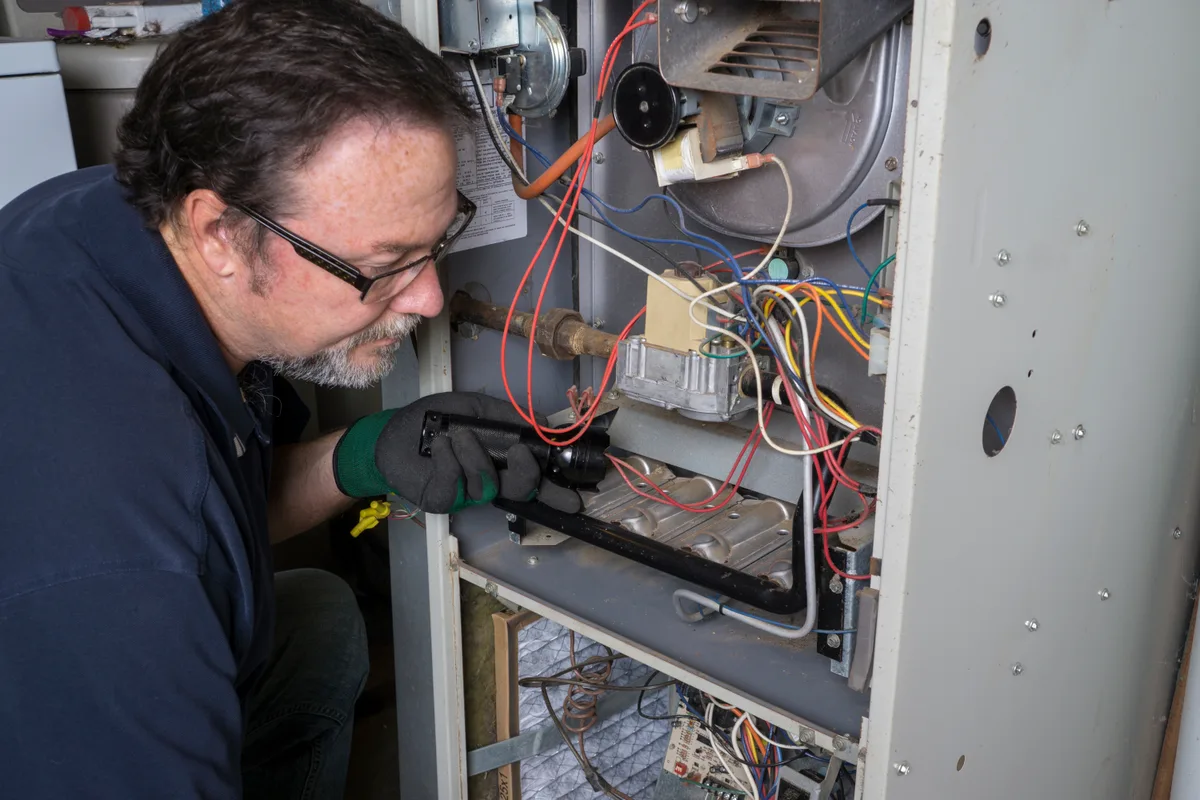
Count the flashes before you touch the door. The control sits in the blower compartment, and lifting the blower door releases an interlock switch that cuts power to the whole furnace, so the live code disappears the moment the panel comes off. An error code flashes at half-second intervals, goes dark for two to three seconds, then repeats. The heartbeat is slower and never pauses, and on current boards a quick, even flash while the burners are lit is simply the control saying it has a call for heat.
Armstrong boards remember more than most. The last ten error codes stay in memory even with the power shut off, and a short press and release of the button beside the LED plays them back, most recent first. Holding that button for more than five seconds wipes the history, which is the one thing not to do before a service visit. So a power cut does not erase the evidence on these controls, but it does end the live display a technician would rather watch.
Armstrong Air is built by Allied Air Enterprises, a Lennox International company, and Allied prints one manual for several badges. The A95UH1E instructions also cover the 95G1UHE, which is the same furnace sold as a Ducane, and AirEase uses the same A-series model numbers. The overlap with Lennox is narrower than people assume: the flash counts below are Allied's own, while the two-stage and variable-speed A96 boards use the same E-number scheme as a current Lennox. For the full E-list, use our Lennox furnace error code guide.
Codes vary by model and by board revision, and Allied has changed its legends over the years. The wiring diagram label fixed inside the furnace, normally on the back of the blower door, carries the legend for the board actually fitted, and where it disagrees with this page the label wins. Our Armstrong Air furnace repair page covers the models we see most, and ZK Mechanical picks up the phone around the clock.
Armstrong Air furnace codes, decoded
| Code | What it means | Safe? | Try first | When to call |
|---|---|---|---|---|
Slow flash (heartbeat) | Normal. One second on, one second off, with no pause between groups. The control is powered and has no error to report. | keep running | Nothing. If the house is cold with a healthy heartbeat, check the thermostat and its batteries. | Only if there is a heartbeat but no heat on a call from the thermostat. |
Fast steady flash | Normal on current single-stage controls. A continuous rapid flash, with no pause to count, means a call for heat is under way. | keep running | Nothing. Only flashes that arrive in groups separated by a dark gap are error codes. | Not needed. |
LED off | No power to the control, or the control has detected a hardware fault in itself. | turn it off | Check the furnace switch and breaker, and that the blower door is fully seated on its interlock switch. | If power is confirmed and the LED stays dark. |
1 flash | Reverse line voltage polarity. Hot and neutral are swapped on the 120-volt supply to the furnace. | turn it off | Nothing safe at home. This is supply wiring, not a furnace part. | Yes. Polarity has to be corrected before the flame sensing circuit can be trusted. |
2 flashes | Improper earth ground. The furnace cabinet is not properly grounded. | turn it off | None. Do not run the furnace on an extension cord or an ungrounded receptacle. | Yes. Flame sensing uses the ground path, so a bad ground causes ignition faults too. |
3 flashes | Burner failed to light, or lost flame during a heat demand. The control is still inside its allowed retries. | turn it off | Confirm the gas shutoff at the furnace is open and that other gas appliances are working. | If it repeats or escalates to 5 flashes. |
4 flashes | Low flame signal. The burners are lit, but the flame sensor is reading weakly. | keep running | Change a dirty filter and book a visit. Leave the flame sensor to the technician. | Soon. This is the early warning before 3 and 5 flashes start appearing. |
5 flashes | Watchguard. The burner failed to light and the control has used up its retries or recycles, so it has locked out for an hour. | turn it off | One reset at the furnace switch is reasonable. Do not keep cycling it. | If it locks out a second time. |
7 flashes | Primary or secondary limit open, or Watchguard because the limit stayed open longer than three minutes. The furnace overheated. | turn it off | Fit a clean filter and open every supply and return grille in the house. | If 7 flashes return with a clean filter. |
8 flashes | Rollout switch open. Flame or hot gas has reached a manual-reset switch at the burner box. | call now | Switch the furnace off and leave the reset button alone. | Immediately. Something pushed flame out of the heat exchanger and it has to be found. |
9 flashes | Pressure switch failed to close, or opened during a heat demand. The control is not seeing proof of draft. | turn it off | Check the intake and exhaust terminations outside for snow, ice or a nest. | If the pipes are clear. The trap, hose, inducer or switch needs testing. |
10 flashes | Watchguard. The pressure switch opened five times during one heat demand. | turn it off | Look at the vent terminations again and check the condensate drain is not backed up. | Yes. Five drops in one cycle is a draft problem, not a fluke. |
11 flashes | Pressure switch stuck closed before the combustion air inducer started. | turn it off | Nothing at home. Never tap or jumper a pressure switch. | Yes. The control refuses to start because a draft safety is reading falsely. |
12 flashes | Flame sensed without the gas valve energized. The control sees fire when it has not asked for any. | call now | Turn the furnace off at the switch and close the gas shutoff beside it. | Immediately. A gas valve that passes gas when closed is a safety fault. |
13 flashes | Low line voltage at the furnace. | turn it off | Notice whether lights dim elsewhere in the house, and report a wider problem to your hydro utility. | If the voltage problem is only at the furnace circuit. |
E200 | On two-stage and variable-speed boards: hard lockout because the rollout circuit is open or was open earlier. | call now | Power the furnace down at its switch and do not reset the rollout switch yourself. | Immediately, exactly as for 8 flashes on an LED board. |
E223 | On two-stage and variable-speed boards: low pressure switch failed open. | turn it off | Clear snow or ice from the vent pipes where they leave the house. | If the code is still there once the pipes are clear. |
E250 | On two-stage and variable-speed boards: limit switch circuit open. If it stays open for three minutes the furnace goes into a one-hour soft lockout. | turn it off | Replace the filter and uncover any blocked registers. | If E250 comes back once airflow is restored. |
E270 | On two-stage and variable-speed boards: soft lockout after the maximum number of ignition retries with no flame current sensed. | turn it off | Check the gas supply is on, then allow a single reset. | If the lockout repeats. |
The codes that usually mean a real repair
3, 4 or 5 flashes: flame sensor, igniter or gas supply
These three counts are one story told at different stages. Four flashes says the flame signal is weak, three says a light-off failed, and five says the control gave up after five trials and parked itself in Watchguard. The usual culprit is an oxidized flame sensor, and cleaning or replacing one runs $150–$300. Armstrong's single-stage furnaces light with a nitride hot surface igniter, and a replacement igniter is $200–$450. Low gas pressure is the third possibility and needs a manometer, which is licensed work.
9, 10 or 11 flashes: pressure switch, vent or condensate
A pressure switch code on a condensing Armstrong is more often plumbing than a failed switch. Water held in a blocked condensate trap, a sagging vent run or frost on a side-wall termination after a Lake Ontario freeze-thaw week will all stop the switch from proving draft. Clearing or replacing a trap runs $150–$350, the pressure switch itself sits in the $250–$500 band, and a draft inducer motor is $400–$900. We test the draft with a gauge before quoting, because a new switch on a restricted vent fails again within days.
7 flashes: an overheating furnace, not usually a bad limit
The limit switch is doing its job when it opens. What trips it is too little air across the heat exchanger: a plugged filter, closed registers, a dirty blower wheel or a blower motor that is slowing down. We measure temperature rise against the range on the rating plate first. If the motor is the cause, a blower motor replacement runs $500–$1,500 depending on the motor type, and you see that price in writing before work starts through our furnace repair service.
Licensed technicians, a written price before the repair, no overtime charges.
Common questions
Will switching the power off erase the code on my Armstrong Air furnace?
Not from memory. Current Armstrong controls keep the last ten error codes even with the power off, and a quick press and release of the recall button beside the LED replays them, newest first. What you lose by cutting power is the live flash. Do not hold the button down: more than five seconds clears the stored history a technician would want to read.
My Armstrong furnace seems to flash six times. What does that mean?
Six is listed as not used on the single-stage control, so recount. Watch three full cycles and count only the flashes between dark gaps of two to three seconds. A miscount of one is easy when you start mid-group, and five or seven flashes are both real codes with very different causes: an ignition lockout and an open limit.
What is Watchguard on an Armstrong Air furnace?
Watchguard is the control's automatic time-out. After five failed ignition trials it stops trying, waits sixty minutes and then starts the sequence again by itself, which is why some furnaces seem to fix themselves every hour. It is a retry feature, not a repair. See how long a furnace lockout lasts for what the waiting periods mean on different makes.
Does this chart apply to AirEase and Ducane furnaces?
For matching models, yes. Allied Air builds all three, and its installation manuals name the Armstrong Air and Ducane model numbers together on the cover, with AirEase sharing the Armstrong numbering. What matters is the control board, not the badge. Compare your model number with the one on the rating plate, then read the legend on your own wiring diagram. Other makes are listed in our brand guides.
Why does my Armstrong Air show E-numbers when this page lists flash counts?
You have a two-stage or variable-speed furnace. Those models use a control with a small seven-segment display and a diagnostic push button, and they report faults as an E followed by three digits. The numbering is the scheme Lennox uses, so E250 is an open limit circuit and E270 an ignition lockout on both. Flash-count tables do not apply to that board.