
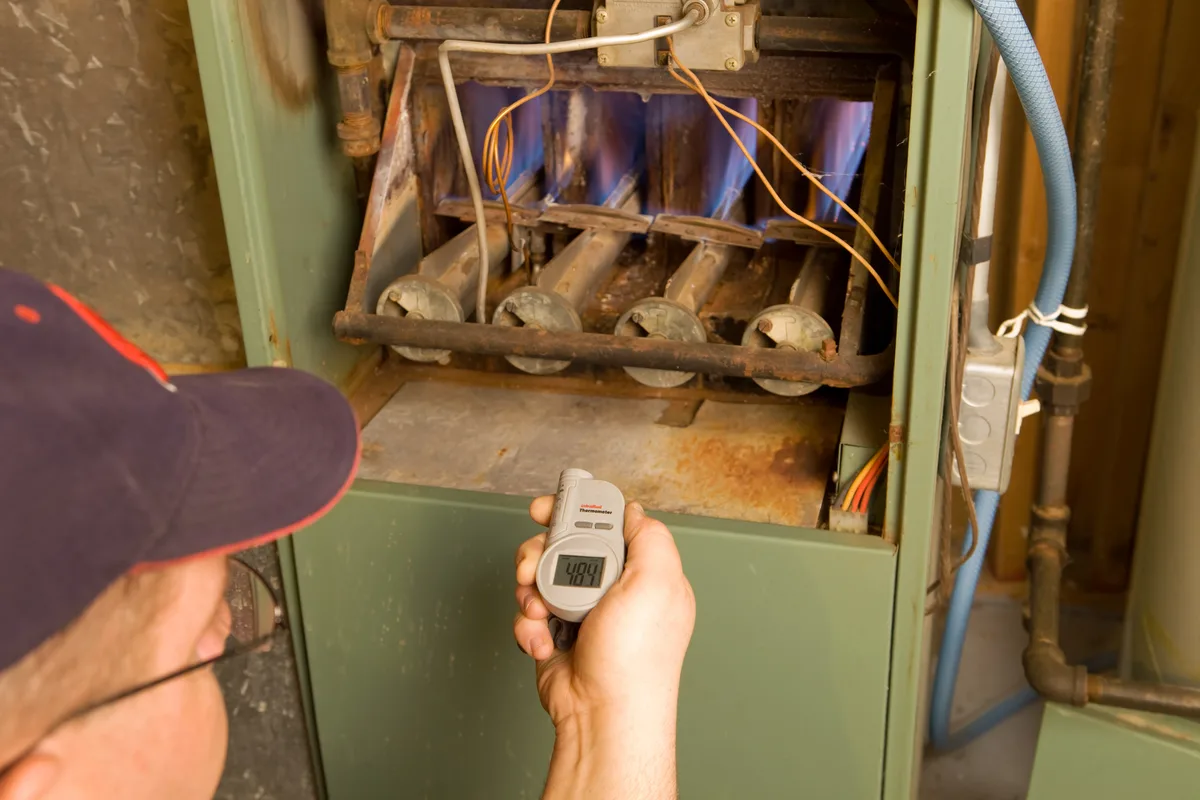
Armstrong Air is one of the brands Allied Air Enterprises builds, and Allied Air is owned by Lennox International. The sister badges are Ducane, AirEase and Concord. That does not make an Armstrong Air furnace a relabelled Lennox: it has its own model numbers, its own parts list and its own warranty documents. Parts reach contractors through Allied Air's distributors.
Every current Armstrong Air furnace is described by the manufacturer as built with EHX Technology, its name for the heat exchanger design. Armstrong Air says the design makes the heat exchanger more durable and puts more air in contact with its surface. The heat exchanger is the part that separates flame and flue gas from the air you breathe, which is why it has the longest warranty term on the furnace and why a failed one takes the furnace out of service.
The current range on Armstrong Air's website runs from the A98MVK modulating furnace at 98% AFUE through the two-stage A972VK and A972EK at 97% to the single-stage A961EK at 96%. All are condensing furnaces, so they make water, and the faults we expect first on them involve the condensate drain and the pressure switch that watches the draft. Ignition parts are the second group and the inducer motor the third.
We service Armstrong Air as an independent contractor with no dealer relationship to declare. When you call, have the model and serial number from the rating plate and, if you can find it, the warranty registration confirmation. Those two things tell us whether a part is covered before we price the repair.
Armstrong Air lines we install and service
The top of the range: 98% AFUE with a modulating gas valve and a variable-speed blower. It runs long, low cycles and holds temperature closely. Its valve, inducer and board are model-specific parts that we order against the serial number.
Both are 97% AFUE two-stage furnaces. The VK has a variable-speed blower and the EK a constant-torque motor, which is the simpler and cheaper of the two to replace. A two-stage furnace has a second pressure switch for high fire, so a draft fault can appear only on the coldest days.
A 96% AFUE single-stage furnace with a constant-torque blower: one firing rate, conventional controls and the lowest parts cost in the range. It is the straightforward replacement choice for a house where the old furnace was also single-stage.
The previous generation of Armstrong Air condensing furnaces, plus Ducane, AirEase and Concord units from the same factory. Wear parts for them are still obtainable through Allied Air distribution. The 4SCU air conditioners and 4SHP heat pumps that sit outside these furnaces fail in the ordinary ways: capacitor, contactor, fan motor.
What goes wrong on Armstrong Air equipment
Pressure-switch fault from condensate on 9x% models
The furnace starts its inducer and stops there, or runs briefly and shuts down, sometimes with water on the floor. A blocked trap or drain line holds condensate in the furnace and the pressure switch opens. Condensate drain cleaning or trap replacement is $150–$350. If the home drains through a condensate pump and the pump has failed, a new pump installed is $250–$450.
Ignition lockout: flame sensor or igniter
Burners light for a few seconds and go out, or never light, and the board locks out after its retries. A flame sensor that has built up a film reads no flame even when there is one, and cleaning or replacing it is $150–$300. An igniter that has cracked or weakened is $200–$450. We also check the flame-signal reading afterward, since a weak ground gives the same symptom.
Inducer motor failure
A whine or grinding at the start of the cycle, then a furnace that will not prove draft. The inducer on a condensing furnace handles wet flue gas and its bearings wear out. Replacement is $400–$900, with the assembly ordered by model number through Allied Air's parts network.
Suspected heat exchanger crack
Signs include flame that wavers when the blower starts, soot, or a carbon monoxide alarm. A confirmed crack means the furnace is shut off and tagged under the gas code. Heat exchanger replacement on most furnaces costs $1,500–$3,000 in parts and labour; with the part covered by warranty the bill is the labour alone, and on a furnace past 15 years that money usually belongs in a replacement. See red-tag furnace repair.
Armstrong Air warranty: what to know
- Armstrong Air's website states that equipment must be registered within 60 days of installation, or within 60 days of closing on a newly built home. Registered heating equipment is eligible for a 10-year parts warranty and a limited lifetime heat exchanger warranty.
- Unregistered equipment defaults to a 5-year limited warranty on parts and a 20-year limited warranty on the heat exchanger. Registration is done online, and the confirmation is worth keeping with the furnace manual.
- What the heat exchanger warranty covers is the heat exchanger itself: Armstrong Air supplies the replacement part when the original fails from a defect inside the term.
- What it does not cover is the labour to strip the furnace and fit that part, the diagnostic visit, or parts that are past their own warranty term. Changing a heat exchanger takes several hours, so a covered claim still produces a real invoice.
- Check the certificate for who the lifetime term applies to and whether it transfers when the house is sold. Our answer on furnace warranty transfers explains what to ask for at closing.
Parts availability in the GTA
Armstrong Air parts come through Allied Air Enterprises' distribution, the same channel that supplies Ducane, AirEase and Concord. Universal wear items such as igniters, flame sensors, capacitors and contactors are on the truck, and pressure switches and inducer assemblies for current models are regular stock or a short order. Boards, modulating gas valves and heat exchangers are ordered by model and serial number, and a warranty heat exchanger is processed as a claim through the distributor. We tell you the expected wait when the part is ordered, not after.
Armstrong Air Furnace Error Codes Explained — what each one means and whether it is safe to keep running.
Common questions
Does the lifetime heat exchanger warranty mean a free repair?
No. It means the heat exchanger part is supplied at no charge if it fails from a defect and the furnace was registered on time. You pay the labour to remove the old one and install the new one, plus the diagnostic. On an older furnace that labour is often better spent toward a replacement, and we will price both for you.
I missed the 60-day registration. Is my Armstrong Air furnace still covered?
Yes, at the default terms Armstrong Air publishes: 5 years on parts and 20 years on the heat exchanger from installation. You lose the 10-year parts term and the lifetime heat exchanger term. If you are still inside 60 days, register online today; it takes the model, the serial number and the install date from your invoice.
Are Armstrong Air and Lennox furnaces the same?
They share a parent company, not a parts list. Allied Air Enterprises, which builds Armstrong Air, is a Lennox International company, but Armstrong Air furnaces have their own designs, model numbers and warranty. A Lennox-badged board or inducer should not be assumed to fit. Our Lennox furnace repair page covers that brand separately.
Where is the fault code on an Armstrong Air furnace?
On an LED on the control board, visible through the sight glass in the lower door, with the legend on the inside of the panel. Note the flash pattern before switching the power off, because some boards clear it. The patterns are explained in our Armstrong Air furnace error code guide; codes vary by model, and the label inside your panel is the authority.
How do I book a repair on an Armstrong Air furnace?
Call or use the contact form with the model and serial number, the symptom and any flash code. The diagnostic visit is $90–$150 and is credited toward the repair if you proceed. Details of what the visit includes are on our furnace repair page. If a carbon monoxide alarm is sounding, leave the house first and call from outside.