
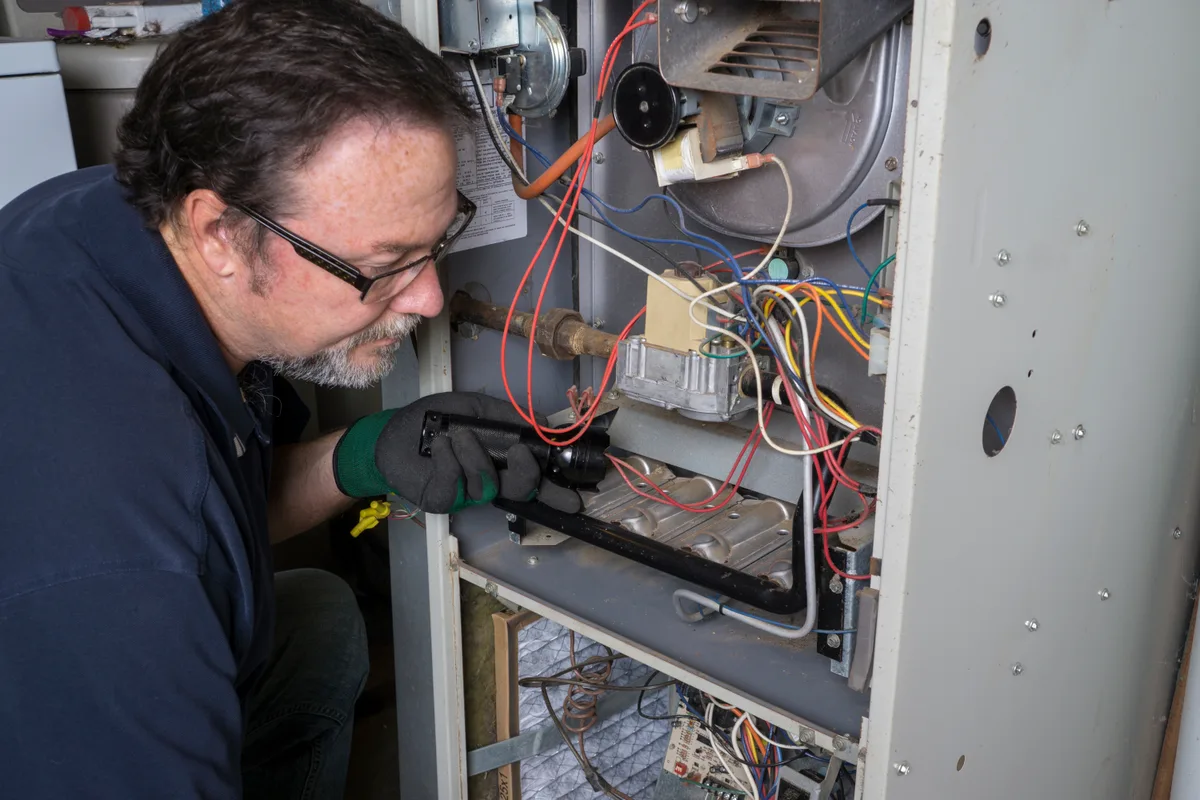
Payne is the value brand in Carrier Global's residential family, a sister to Bryant. The cabinets are plainer and the feature list is shorter, but the control board, igniter, flame sensor, inducer and gas valve come from the same parts catalogue as the Carrier and Bryant furnaces built alongside them. Payne's own website now says the brand has transitioned into Carrier's WeatherMaker family and points existing owners to their manuals and warranty cards. Nothing about that changes the furnace already in your basement.
The practical problem with Payne in this area is finding someone to service it. Few local dealers sold the brand, the original installer is often gone, and a homeowner calling around hears that a company does not work on that make. The answer is simpler than the phone calls suggest: Carrier parts fit, the wiring diagrams follow Carrier conventions, and the fault codes are Carrier's.
A Payne furnace reports faults as a two-digit status code on an LED visible through the sight glass in the blower door. Count the short flashes for the first digit and the long flashes for the second, so three short and one long is code 31. The legend is printed inside the door, and the full list sits in our Carrier furnace error code guide. Codes vary by model, so the label inside the panel wins over any general chart.
We service Payne as an independent contractor with no dealer relationship to declare. Older PG92 and 80% Payne furnaces stay legal to run and repair, but a new gas furnace installed in Canada has to meet the 95% AFUE federal minimum. When a Payne is past repair, a high-efficiency replacement installed runs $4,500–$7,500, and we will give you that number next to the repair quote so you can compare them.
Payne lines we install and service
The PG92ES and PG95ES are single-stage condensing furnaces and the PG96VTA is the two-stage, variable-speed model at the top of the range. All of them drain condensate through a trap in the cabinet and vent in plastic pipe through the wall or roof, and that trap is where a large share of their service calls begin.
The previous generation, still in service in many houses. PG9M-series furnaces are early condensing units; PG8 models are 80% furnaces that vent into a chimney or metal vent. Igniters, sensors, pressure switches and inducers for them are still ordered through Carrier-family parts channels.
Payne's outdoor units are single-stage machines with conventional controls. The parts that fail on them are the ones that fail on every condenser: the run capacitor, the contactor and, later in life, the fan motor. Capacitors and contactors are universal items carried on the truck.
Carrier now sells this value tier under the WeatherMaker name, and the WeatherMaker site lists the PG96VTA model number that Payne used. If your new furnace says WeatherMaker on the door and PG on the rating plate, the service information on this page applies to it.
What goes wrong on Payne equipment
Status code 34: ignition proving failure
The burners do not light, or they light and drop out within seconds. The two usual causes are a hot-surface igniter with a hairline crack and a flame sensor coated in oxide that can no longer prove flame to the board. Flame sensor cleaning or replacement is $150–$300 and a new igniter is $200–$450. After repeated failures the board locks out; our page on Carrier furnace code 34 explains the sequence.
Status code 31: pressure switch did not close or reopened
On a PG9 furnace this code most often traces to water: a condensate trap blocked with debris backs water into the collector box, the inducer cannot pull enough draft, and the switch never closes. Condensate drain cleaning or trap replacement runs $150–$350; if the switch itself has failed, a pressure switch is $250–$500. Snow or ice over the vent termination gives the same code, and that is the one check a homeowner can safely make from outside. See Carrier furnace code 31.
Inducer motor bearing noise
A rattle or growl for the first half minute of every heat cycle, before the burners light, is the inducer motor's bearings wearing out. It gets louder over weeks, then the motor seizes and the furnace posts a pressure-switch code and stops. A draft inducer motor replacement is $400–$900. Booked while the furnace still runs, it is a planned visit instead of a no-heat call in January.
Payne AC hums but the fan and compressor will not start
On a PA-series condenser this is nearly always the run capacitor, and sometimes a contactor with burnt points. Either repair is $150–$350. Turn the system off at the thermostat while you wait, because a compressor trying to start against a dead capacitor overheats.
Payne warranty: what to know
- Payne's limited warranty card for its condensing gas furnaces gives a 10-year parts limited warranty when the furnace is registered within 90 days of installation. Unregistered, the parts term on that card is 5 years.
- The same card lists the heat exchanger at 20 years. Read your own card for the exact term, because coverage differs between models and model years.
- These are parts warranties. The diagnostic visit and the labour to fit a covered part are billed to the owner unless the installer sold you a separate labour plan in writing.
- The longer registered term is written for the original purchasing owner. If you bought the house with the furnace in it, read the conditions on the card and look up the furnace by serial number before assuming the 10-year term applies to you.
- Payne's website still hosts owner's manuals and warranty cards after the move to WeatherMaker and tells owners to contact the installing dealer. If that dealer no longer exists, send us the model and serial and we will tell you what the paperwork supports before any part is ordered.
Parts availability in the GTA
Carrier parts fit Payne furnaces and air conditioners, and that is the whole parts story. Igniters, flame sensors, pressure switches, inducer assemblies, gas valves and control boards are ordered by the Carrier-family part number printed on the component or listed for the Payne model, and GTA wholesalers that stock Carrier and Bryant parts stock them. Igniters, flame sensors, capacitors and contactors ride on the truck. A control board for a specific PG model is the usual order-in item, and we read the full model and serial number off the rating plate before ordering it.
Carrier Furnace Error Codes Explained — what each one means and whether it is safe to keep running.
Common questions
Can Carrier parts be used on a Payne furnace?
Yes. Payne furnaces are built by Carrier and use Carrier-family control boards, igniters, flame sensors, pressure switches, inducers and gas valves. The correct part is found by the Payne model number or the part number on the failed component. A contractor does not need to be a Payne dealer to buy them, which is why a Payne should never be written off for lack of parts.
Payne is now WeatherMaker. Is my furnace an orphan?
No. The name on new equipment changed; the manufacturer did not. Carrier still supports the parts, and Payne's website still carries manuals and warranty cards for existing units. Service a Payne on the same schedule as any gas furnace, and judge it on its age and condition, not on the badge having been retired.
Is it safe to keep resetting a Payne furnace that shows code 31 or 34?
Reset it once by switching the furnace power off for a minute, and check that the vent pipes outside are clear of snow. If the code returns, stop. Repeated resets on an ignition or draft fault put unburnt gas and water where they should not be, and they do not fix the cause. Leave it off and book a furnace repair visit.
Is a Payne furnace worth repairing?
Usually, yes. A flame sensor, igniter, pressure switch or inducer on a Payne under 15 years old is a sound repair. Replace it when a single repair passes half the cost of a new furnace on a unit over 12 years old, or when the heat exchanger has failed. The reasoning is laid out in our furnace repair vs. replacement cost guide.
What happens if my Payne furnace needs replacing?
You get a written quote for a furnace at 95% AFUE or better, with the venting, condensate drain and any gas-line changes listed as separate lines. An old 80% Payne that vents into a chimney needs new plastic venting through a wall or the roof, and that work is part of the price. To start, ask for a written quote and include a photo of the rating plate.