
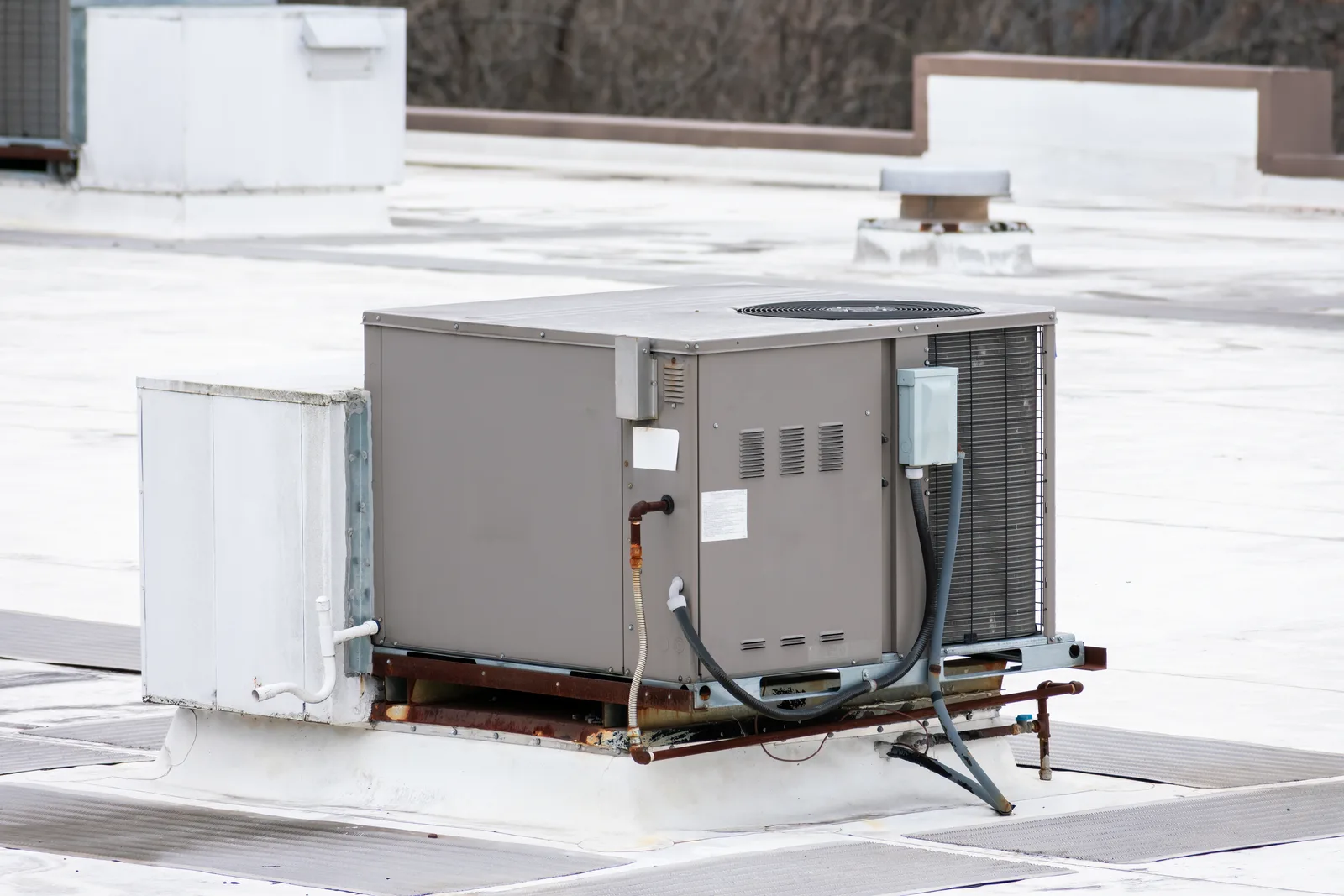
Lennox has sold several rooftop families, and the name on the cabinet tells us how the unit is controlled. Energence and the high-efficiency Strategos run on the Prodigy unit controller. The older L Series used an earlier Lennox board, and the Landmark is the simpler contractor-grade line. Lennox's current catalogue lists Model L, Enlight, Xion, Raider and Strategos, but Energence and Landmark are the names on many of the Lennox units already on GTA roofs.
This page is for commercial owners, managers and tenants. If you have a Lennox furnace in a basement, our Lennox furnace repair page is the one you want. The commercial side shares one trait with the residential side: Lennox moves its parts through its own stores, so the part number has to be right before anyone drives to pick it up.
The Lennox rooftops we service sit on retail plazas, restaurants and small offices, and the pattern of faults follows the use. Restaurants foul coils and filters fast and run their units every hour of the day. Retail and office units sit idle on weekends and then fail on the first cold Monday, when the inducer has seized or the igniter has cracked.
The fix for most of that is a schedule, not a repair. A commercial maintenance contract puts a technician on the roof before each season to read the alarm history, change belts and filters, test the economizer and check combustion. We are an independent contractor and not a Lennox sales outlet; when a unit is past saving, the replacement quote compares makes.
Lennox lines we install and service
Lennox's main commercial line for more than a decade, with model numbers beginning LGH for gas heat and LCH for cooling only. Earlier Energence units carry the Prodigy M2 controller and later ones the M3, also called Prodigy 2.0. The controller stores alarms with a code, which makes an Energence quicker to diagnose than most rooftops of its age.
The value line, with model numbers beginning KG, KC and KH. It is a straightforward thermostat-driven unit, and where a Landmark has no unit controller, diagnosis starts at the ignition control and a meter instead of an alarm list. Parts are simpler and so are the repairs.
The L Series is the generation before Energence, and many are still heating and cooling GTA buildings. Strategos is the high-efficiency family, and Lennox's Prodigy M2 documentation covers it together with Energence. On an L Series, age is the issue: we check the heat exchanger and the cabinet floor before recommending money be spent on controls.
The current Lennox rooftop families. Model L and Enlight are built around the CORE unit controller, which a technician reads through Lennox's CORE Service app as well as at the unit, and Lennox lists a CORE Lite controller for its lighter-duty lines. We service these; on a unit still under warranty we confirm what the certificate covers before replacing a part.
What goes wrong on Lennox equipment
Gas heat will not light: spark electrode and flame sensor
Lennox rooftop burners light by direct spark, and the two parts that wear are the spark electrode and the flame sensor beside it. A cracked ceramic, a gap that has drifted or a sensor coated in oxide gives the same result: the burner tries, fails to prove flame, retries and locks out with an alarm. We clean or replace the parts, check the ground and the gas pressure, and confirm the flame signal. A unit that lights after a reset and fails again the next morning has not been fixed.
Combustion air inducer and its pressure switch
Before the gas valve opens, the combustion air inducer has to run and its pressure switch has to prove draft. Seized inducer bearings, a cracked or water-filled sensing tube, a blocked vent hood or a bird's nest in the flue all keep that switch open, and the burner never gets its turn. We test the switch with a manometer before replacing it, because the switch is usually reporting a real problem.
Economizer actuator and damper faults
The controller checks the economizer and raises an alarm when the damper does not follow its command. The cause is a failed actuator, seized linkage or blades, or an outdoor-air sensor that has drifted. Stuck open in January, the unit cannot keep the space warm; stuck shut, it runs the compressors when outdoor air would have cooled the building at no cost. We stroke the damper through its range and verify the minimum-position setting after any repair.
Blower VFD and belt problems on MSAV units
MSAV is Lennox's Multi-Stage Air Volume option: a variable frequency drive changes the supply fan speed in steps to match the stage of heating or cooling. The drive can fault on overcurrent, phase loss or heat, and it stores that fault. The belt is the other weak point, because a belt that slips unnoticed at low speed fails outright at high speed, and the loss of airflow shows up as a limit trip or an iced coil. We read the drive's fault log and check belt tension and sheave alignment on every visit.
Lennox warranty: what to know
- Lennox commercial warranty terms are set out on the certificate for the unit and vary by component and by the options ordered. Check the certificate; residential Lennox terms do not apply to a rooftop unit.
- The warranty period is tied to the installation or start-up date, so the start-up report is the document to keep. Without it, the date of manufacture may be all there is to go on.
- A warranty part is supplied through Lennox's own parts channel against the serial number. Labour, refrigerant and crane time are usually not included.
- Controllers and drives are sensitive to power problems. If a board or VFD fails more than once, have the supply voltage checked, because repeated electrical damage is not a manufacturing defect.
- Keep maintenance reports for every unit on the roof. They support a claim and they show a buyer or a landlord that the equipment was looked after.
Parts availability in the GTA
Lennox commercial parts come from Lennox's own parts stores and not from the general wholesalers that carry most other makes. For stocked items, such as spark electrodes, flame sensors, pressure switches, belts, contactors and common motors, that is a same-day pickup in the GTA. Unit controllers, VFDs, inducer assemblies and compressors are more often ordered against the serial number, and parts for L Series units are harder to find each year. We confirm availability before quoting so the tenant hears a real date.
Common questions
Where are the alarm codes on a Lennox rooftop unit?
On the unit controller inside the control compartment. A Prodigy controller shows active and stored alarms on its own display, and a CORE controller can also be read with Lennox's service app. The compartment contains line voltage, so reading it is a job for a technician. What helps from the ground is the time the unit stopped and what the thermostat was asking for.
Energence is no longer in the Lennox catalogue. Can ours still be repaired?
Yes. Most faults on an installed Energence are spark electrodes, sensors, motors, belts and actuators, and those parts are still obtainable through Lennox. The decision changes when a compressor or heat exchanger fails on a unit past 15 years, or when the repair is more than half the price of a replacement. At that point we quote both and you choose.
What is MSAV, and why does our Lennox unit have a drive on the blower?
MSAV stands for Multi-Stage Air Volume. The drive slows the supply fan when the unit is on a low stage or only ventilating, which saves fan energy and improves humidity control. It also adds a part that can fault. If the fan will not start or surges, the drive's stored fault code tells us whether the problem is the drive, the motor or the incoming power.
Who pays for a Lennox rooftop repair, the landlord or the tenant?
The lease decides. Many commercial leases make the tenant responsible for maintenance and repairs and the landlord for replacement, but the wording varies and capital items are often disputed. Read the HVAC clause before authorizing work. Our answer on who is responsible for HVAC in a commercial lease in Ontario explains the common arrangements.
How often should a Lennox rooftop unit be serviced?
At least twice a year: a cooling check in spring and a heating check in fall, with filters changed between visits as the building needs. Restaurants and dusty industrial spaces need quarterly visits because coils and filters load up faster. Each visit should leave a written report per unit. Our rooftop unit service page lists what is checked.