
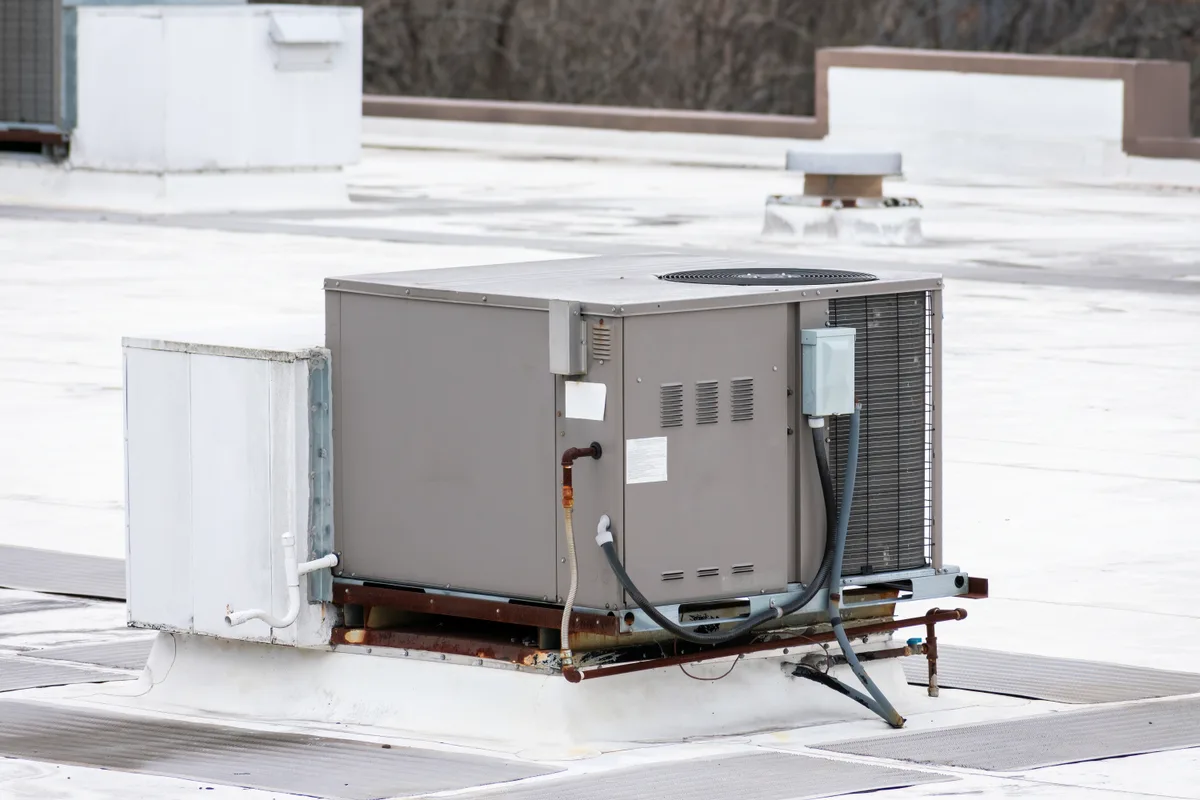
If you manage a plaza, an office or an industrial unit, the Carrier on the roof is not the Carrier in a house. Our Carrier furnace repair page is for homeowners; this one is for the person who gets the tenant's call. In Carrier's numbering, a 48 is a gas heat and electric cooling unit and a 50 is electric cooling or a heat pump. The letters that follow give the generation and the efficiency tier.
Carrier is one of the most common names on low-rise commercial roofs between Hamilton and Mississauga. The TC generation makes up most of what is up there, with a growing number of FC and GC replacements. Older 48TJ, 48TF and 48HJ units are still running too, many of them on R-22. Those can be kept alive for a while, but a refrigerant-side failure on one is a replacement conversation.
Urgency depends on the code and the season. A rollout code means the burner flame went where it should not: leave the heat off and call. A unit that will not cool a server room or a kitchen in July is a same-day problem for the tenant. A damper stuck open in winter can wait a few days but not a month, because it heats the outdoors on your gas bill.
Most of what fails on a rooftop unit is preventable, which is why property managers put these on a contract. A commercial maintenance contract covers filters, belts, coil cleaning, an economizer check in spring and a combustion check in fall. ZK Mechanical is an independent contractor that services Carrier commercial equipment; we are not part of Carrier's sales channel, so a replacement quote from us can include other makes.
Carrier lines we install and service
The standard-efficiency workhorse and the Carrier rooftop unit we service most. It runs on Puron (R-410A) and uses a belt-driven supply fan with an adjustable-pitch motor pulley, so belt wear and pulley alignment are routine checks. Gas heat on the 48TC is run by the IGC board in the control box.
The higher-efficiency sibling of the TC, built on the same service layout. A technician who knows one knows the other, and most heating-side parts and procedures carry over. More of these were ordered with factory economizers and optional controls, so there is more to check on the air side.
The newer generation that replaced the TC and HC. The main service difference is the indoor fan: a direct-drive vane-axial design Carrier calls EcoBlue, with no belt or pulleys to adjust. Fan speed is set at the control instead of at a pulley, and some units carry Carrier's SystemVu controller with its own display and alarm history.
The generations before the TC. Their gas heat is also IGC-controlled and the flash codes read the same way, but many were charged with R-22 and their cabinets are now old enough for rusted heat exchangers and base pans. We service them and tell you plainly when the next repair is the one that should not be made.
What goes wrong on Carrier equipment
Reading the IGC: what the LED flashes mean
On the IGC a steady LED is normal operation and a dark LED points to a hardware or power problem at the board. The flash counts in Carrier's service literature are: 2 for a limit switch fault, 3 for a flame sense fault, 4 for four consecutive limit trips, 5 for ignition lockout, 6 for an induced-draft motor fault, 7 for a rollout switch lockout, 8 for an internal control fault and 9 for a software lockout. The legend on the unit's own label takes priority over any list, including this one.
Limit trips and flame rollout (2, 4 and 7 flashes)
A limit switch opens when the heat exchanger gets too hot, and the usual reason is airflow: plugged filters, a slipping or broken belt, a dirty evaporator coil or closed dampers downstream. Four trips in a row lock the heat out. Rollout is more serious, because flame has left the burner box; the causes include a blocked or cracked heat exchanger and a failed inducer. We do not reset a rollout switch and leave, and the unit stays off until the heat exchanger and venting are inspected.
Inducer fault and ignition lockout (6 and 5 flashes)
The IGC confirms the induced-draft motor is turning through a hall-effect sensor on the motor, so six flashes can mean a dead motor, a failed sensor or a bad connection at the three-wire sensor plug. We check voltage and the plug before pricing a motor. Five flashes means the burners did not light or did not hold: a cracked spark igniter, a dirty flame sensor, low gas pressure or a gas valve. After either repair the unit is fired and checked with a combustion analyzer.
EconoMi$er and summer failures: actuator, condenser fan, contactor
Carrier's EconoMi$er brings in outdoor air for free cooling, and its actuator and damper linkage seize after years on a roof. Stuck open, the unit cannot hold temperature in January; stuck shut, the building loses its ventilation air and its free cooling. In summer the common no-cool calls are a failed condenser fan motor and a burnt contactor, both found with a meter in minutes. The damper side is covered on our RTU economizer repair page.
Carrier warranty: what to know
- Carrier's commercial warranty terms are printed on the warranty certificate for the unit and differ by component: the compressor, the heat exchanger and the remaining parts each have their own term. Read the certificate; do not rely on a residential Carrier brochure.
- The first four digits of a Carrier serial number give the week and year of manufacture. We read the plate on the first visit so you know whether a claim is worth pursuing.
- Heat exchanger coverage can depend on the option ordered, such as a stainless steel heat exchanger. The model number on the plate tells us which one you have.
- A parts warranty covers the part only. Labour, refrigerant and a crane for a compressor are normally the owner's cost.
- Keep the start-up report and maintenance records with the lease file. A unit with a documented service history is an easier claim and an easier sale of the building.
Parts availability in the GTA
Carrier is among the easiest rooftop brands to get parts for in the GTA. Carrier's commercial distribution has branches in the region, and IGC boards, spark igniters, flame sensors, inducer assemblies, contactors, capacitors, belts and fan motors for the TC and HC generations are normally same-day or next-day items. Compressors, economizer controllers and coils take longer, and parts for the 48TJ and 48HJ generations are thinning out. We take the full model and serial number from the plate before ordering, because a single digit changes the heat section or the voltage.
Common questions
What does a flashing LED on my Carrier rooftop unit mean?
The LED is on the IGC board in the control box and it counts out a heating fault: two flashes for a limit switch, three for flame sense, five for ignition lockout, six for the inducer and seven for rollout. It tells a technician where to start. Opening the control box exposes live voltage, so leave the reading to whoever services the unit.
The tenant has no heat and the unit keeps restarting. Is it safe to leave it running?
If it is cycling on a limit, it is protecting itself but something is restricting airflow, and running it that way stresses the heat exchanger. If there is any smell of gas or exhaust in the space, shut it down at the thermostat and call. Otherwise check the filters, set the thermostat to hold and book a visit before the lockout becomes permanent.
Do you offer service contracts on Carrier rooftop units?
Yes. A contract sets the number of visits per year by building type, usually spring and fall with filter changes between, and lists what is done at each: belts, coils, drains, economizer operation, electrical readings and combustion. You get a written report per unit with the model, serial number and condition. Our property management page explains how we handle multi-site portfolios.
Should we repair or replace a 20-year-old Carrier rooftop unit?
Replace it if the compressor or the heat exchanger has failed, if it runs on R-22, or if the repair is more than half the cost of a new unit. Repair it if the fault is a board, a motor, an igniter or a contactor and the cabinet is solid. We price both in writing; see what a commercial rooftop unit costs.
Will a new Carrier unit sit on our existing Carrier curb?
Often. Carrier has kept many small and mid-tonnage footprints consistent from one generation to the next, so a like-for-like swap frequently lands on the old curb without an adapter. We do not promise it from the office: we measure the curb, compare it with the submittal for the new model and confirm the duct openings line up before the crane is booked.