
Quick answer
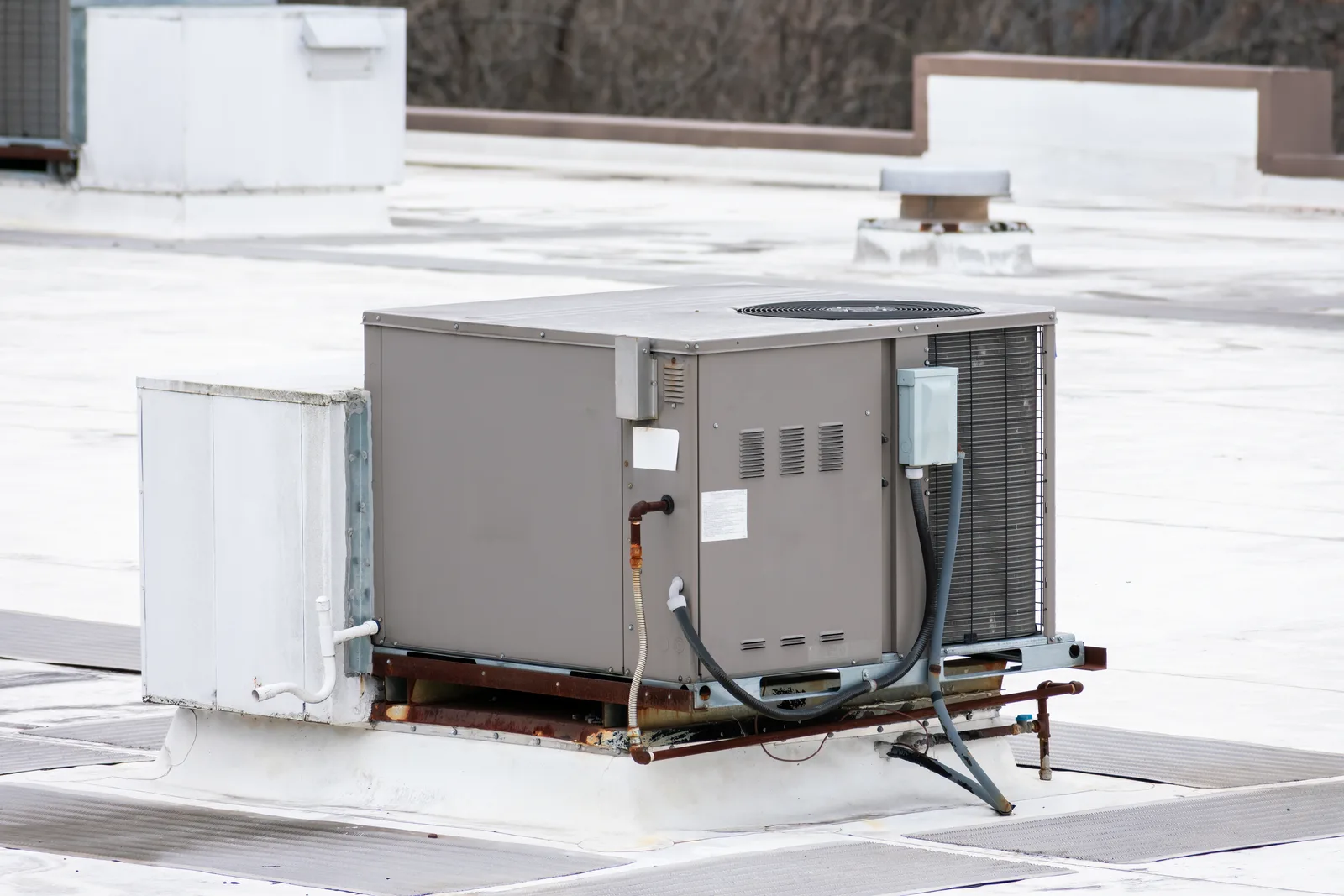
A commercial rooftop unit is quoted per unit, and the equipment is often the smaller half of the number. Tonnage, whether it carries a gas heat section, a curb adapter versus a new curb, crane access and rigging, roof membrane tie-in, controls and after-hours scheduling all move the price. ZK Mechanical prices RTU replacements after a roof survey, not over the phone.
A commercial rooftop unit costs what the equipment costs plus what it takes to land it on the roof and connect it — and on most Burlington and Hamilton buildings the second half is the bigger variable. We do not publish an RTU price, because a small cooling-only unit set by a compact crane onto an existing curb in an industrial park and a large gas/electric unit craned into a Kerr Village storefront with a lane closure are not the same job.
What goes into an RTU replacement quote
- The unit — tonnage, whether it includes a gas heat section, efficiency tier, and the options: economizer, power exhaust, hail guards, factory controls.
- Curb — a matching curb between manufacturers is rare, so most swaps use an adapter fabricated for the old footprint and the new unit. That is engineered and built to order.
- Rigging — crane size, where it can set up, and how long it sits there. A building with parking beside it is cheaper to serve than one needing a lane closure and traffic control.
- Roofing — cutting in, flashing and warranting the membrane around the curb, normally by the building's own roofer so the roof warranty survives.
- Gas and electrical — the rooftop gas piping, the disconnect, and whether the existing feeder can carry the new unit.
- Controls — thermostat wiring or building automation point mapping, plus commissioning and a startup report.
- Disposal — the old unit comes down on the same crane and has to be handled and recycled.
- Timing — after-hours or weekend work so a tenant does not lose a trading day.
Why the crane is often the swing factor
Rigging is priced by access, not by tonnage. An industrial building on the North Service Road or in the Aldershot employment lands has open asphalt on three sides, so a compact crane sets up, lifts, and is gone by lunchtime. A retail unit in Kerr Village or downtown Burlington may need a larger crane reaching over the building, a road occupancy permit, traffic control, and a start before the shops open.
This is also why replacing several units in one visit is far cheaper per unit than replacing them one at a time. If a property has four aging rooftops and two are terminal, price all four. The crane and the setup are the expensive part and they are only paid for once.
The refrigerant change matters for units bought now
New rooftop equipment is shipping with A2L refrigerants — R-32 and R-454B — as the industry moves off R-410A. For a property manager that means service procedures, leak detection and parts stock for the new unit differ from the one it replaces, and the technicians looking after it need to be set up for A2L work. What the A2L transition means is the short version.
It changes the repair-or-replace call on older equipment too. Where a rooftop still runs R-22, that refrigerant is scarce and expensive, and any significant leak repair is money spent on a machine with a fixed horizon.
Repair, replace, or plan it
Replace when the compressor or the heat exchanger has failed on a unit past its useful life, when the cabinet and base rails have rusted through, or when a tenant fit-out has changed the load the unit was originally selected for. Repair when the failure is a contactor, a fan motor, a board or a belt on an otherwise sound machine.
Plan when neither is urgent yet. Rooftops tend to fail in the first heat wave of June and the first hard cold of November, which is precisely when crane availability and equipment lead times are at their worst. Properties with known end-of-life units should have replacements specified and budgeted in the shoulder season — our property manager guide to RTU replacement covers the process, and RTU vs. split system explains when a rooftop is not the right answer at all.
Common questions from property managers
- Do you arrange the crane? Yes — rigging is coordinated and priced as part of the job, including permits where a street is involved.
- Can the building stay open? Usually. Most swaps are scheduled after hours or on a weekend for exactly that reason — the old unit is disconnected at close, the new one is craned at first light and running before the doors open. A restaurant's kitchen exhaust and make-up air are the one pairing that needs the tenant on site.
- What happens to the roof warranty? The roofer who holds it does the membrane work, and we schedule around them.
- Can you match the existing controls? Generally yes, and where the unit ties into a building automation system we map the points during commissioning.
- Do you service what you install? Yes — a commercial maintenance contract covers filter changes, belt and contactor checks and a spring and fall inspection, which is what keeps a new rooftop out of the June and November failure queue.
ZK Mechanical handles rooftop replacement and service for offices, retail, restaurants and industrial buildings across Burlington, Oakville and Hamilton. See commercial HVAC and rooftop unit service. For a roof survey and a written price, call (647) 801-1252 or get in touch.