
Quick answer
HVAC for a new build prices in two halves. The equipment has published ranges — $4,500–$7,500 for a high-efficiency gas furnace, $7,500–$11,500 with air conditioning, $9,500–$15,000 for a cold-climate heat pump — while the ductwork, the HRV the Building Code requires and the permit are priced off your drawings. Storeys, where the mechanical room sits and whether you choose a heat pump move the total most.
HVAC cost for a new build is settled on the drawings, not on move-in day. Everything a retrofit has to work around — where the trunk runs, how the exhaust gets to a wall, which circuit the condenser lands on — is still an open decision, which makes the mechanical package far cheaper to do properly and much more expensive to fix afterward. What you pay depends on whether you are buying a builder's house with the system already priced into the purchase, or hiring the mechanical contractor yourself for a custom build, an addition or a gut renovation.
What a new-build mechanical package includes
- Supply and return ductwork fabricated and hung at rough-in, plus boots, registers and balancing dampers for every room
- A heating appliance — most often a condensing gas furnace, or a heat pump with backup heat behind it
- Cooling, either as a matched coil and condenser or as the heat pump doing both jobs
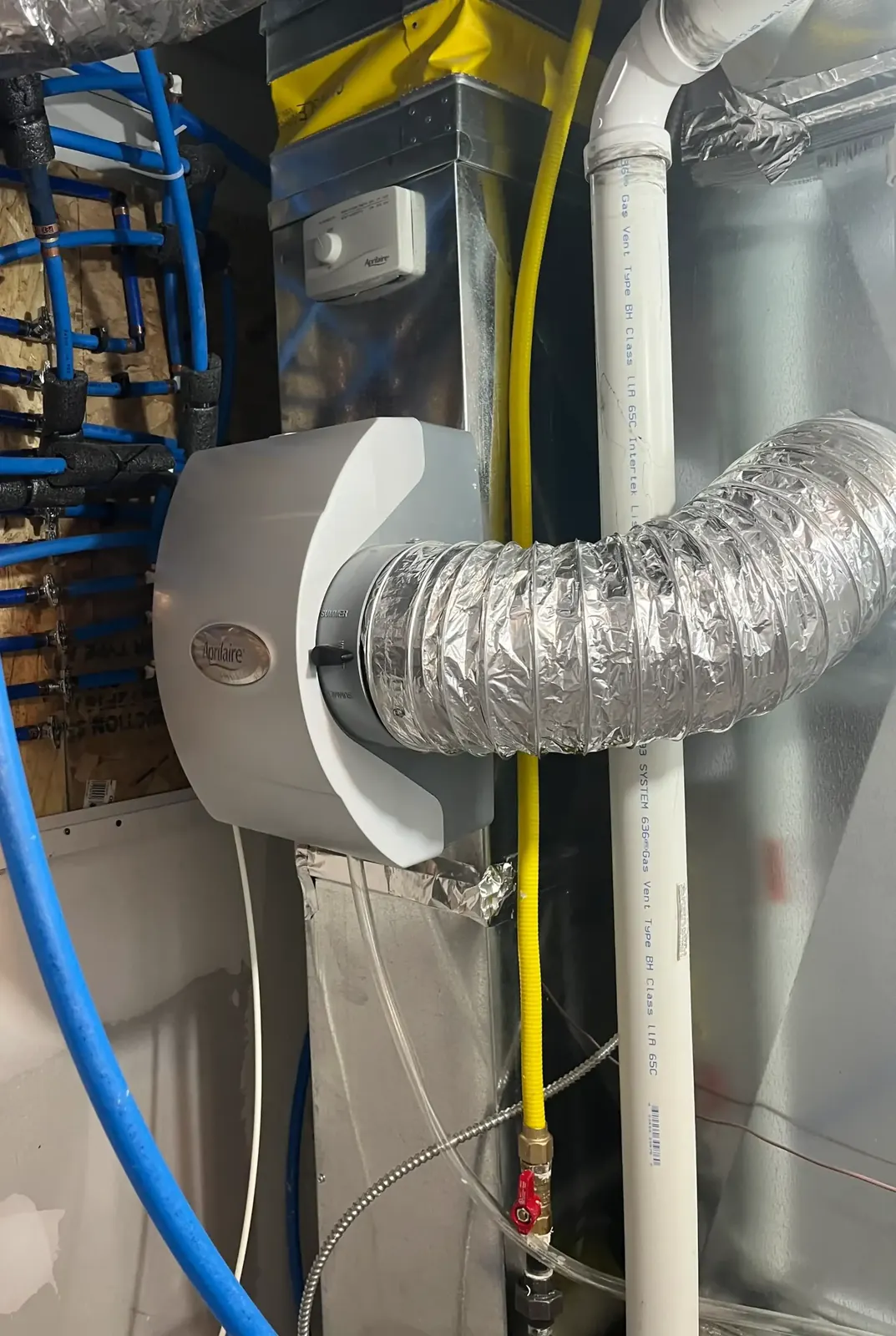
- Venting and services: PVC intake and exhaust through a side wall, a condensate drain and trap, and a gas line sized for the run from the meter
- Balanced ventilation — a heat recovery ventilator is standard equipment in a new Ontario house, and how it is ducted changes the price (what an HRV costs installed)
- The trim-out: thermostat, filter rack, humidifier in most new houses, and a commissioning report
What has a price, and what has to be quoted
The appliances have published ranges. A high-efficiency gas furnace installs for $4,500–$7,500, a furnace and air conditioner together land at $7,500–$11,500, and a three-ton cold-climate heat pump runs $9,500–$15,000 before rebates. The sheet metal is the part nobody can quote from a phone call: a new-build duct system is fabricated for one specific floor plan, and the number of storeys, the distance to the far bedroom and whether the trunk fits inside a joist bay all move the number. Ask for ductwork, ventilation and gas line as separate lines rather than one lump sum, and see what ductwork costs for how that side is measured.
The cheapest new-build package is a bungalow or two-storey with the mechanical room on an exterior wall, an open basement ceiling and short PVC vent runs — the trunk goes in straight and the HRV hoods are a metre away. The dearest is a three-storey with the furnace in the middle of the plan, a fully ducted HRV with a pickup in every bathroom, and a heat pump that needs its own circuit and an outdoor pad.
Why rough-in is the cheapest hour of the whole project
New-build HVAC is billed in two visits — rough-in before the drywall, and finish once the floors are in. A branch duct added at rough-in costs a length of pipe and 20 minutes of a tinsmith's time. The same branch after the ceiling is closed means cutting, patching, painting and a much longer day. That is the window to oversize a return, run a chase for a future second-floor zone, put a line to the basement bathroom, or add the electrical for a heat pump you plan to install later.
Permits, drawings and the heat-loss calculation
In Ontario a new house needs a mechanical design submitted with the building permit, and the heating and cooling loads are calculated to CSA F280 — not estimated from square footage. The City of Burlington and the City of Hamilton building departments both review that design and inspect the installed work. Permit costs vary by municipality, typically $100–$300, and the contractor should be pulling it rather than asking you to. Gas work must be done by TSSA-licensed technicians; keep the licence number, the permit and the inspection sign-off with your closing documents, because a warranty claim years from now will ask for them.
Buying a builder's house? Ask this first
- The model and capacity of the furnace — builder packages in the 2000s-and-newer subdivisions of Alton Village, the Orchard and Waterdown are usually base-tier single-stage equipment sized to the minimum the code allows
- Whether air conditioning is included or an upgrade — many packages rough in the line set and leave the condenser off the pad
- Who registered the parts warranty and on what date, because an unregistered unit often drops to a shorter term (labour warranty vs parts warranty)
- Whether the water heater comes with a rental agreement attached, which is common on new builds and expensive over the tank's life
- Whether the HRV was balanced and the ducts were cleared of drywall dust before occupancy
Common questions about new-build HVAC cost
- Can the builder's package be upgraded before closing? Usually, and it is far cheaper then: a two-stage furnace, a variable-speed blower or a heat-pump-ready coil swapped at the rough-in stage costs the difference in equipment, while the same change after occupancy is a full replacement.
- Does a heat pump make sense in a new build? Often — a tight new envelope has a small heat loss, so a heat pump sized to the calculation carries the house through most of the winter. Check the program page before counting on a rebate, since new construction is treated differently from a retrofit.
- Is Tarion involved? On a builder's home, yes — the new-home warranty covers defects in the mechanical work for a set period, and what Tarion covers on HVAC explains how to file before the window closes.
If you are planning a custom build, an addition or a full renovation in Burlington, Oakville or Hamilton, send us the drawings and we will price the mechanical package line by line — ductwork, equipment, venting, ventilation, permit and the load calculation. Start at new construction HVAC, or book a plan review and we will walk the set with you before anything is ordered.