
Quick answer
An HRV's installed price is set by how it is ducted, not by the unit's rated airflow. A simplified install tied into the existing furnace returns is the cheapest new install; a fully ducted system with bathroom pickups and bedroom supplies run through a finished basement is the dearest. If your house is newer than about 2010, balancing the HRV you already own is cheaper than either.
What an HRV costs installed is driven far more by ductwork than by the box on the wall. Two identical units — same brand, same rated airflow — can be a half-day tie-in to existing returns in a 2010 Alton Village build, or a two-day fully ducted retrofit pulling stale air from three bathrooms and delivering fresh air to bedrooms in a 1960s Roseland bungalow. That is why the price follows a site visit.
What an HRV install price is made of
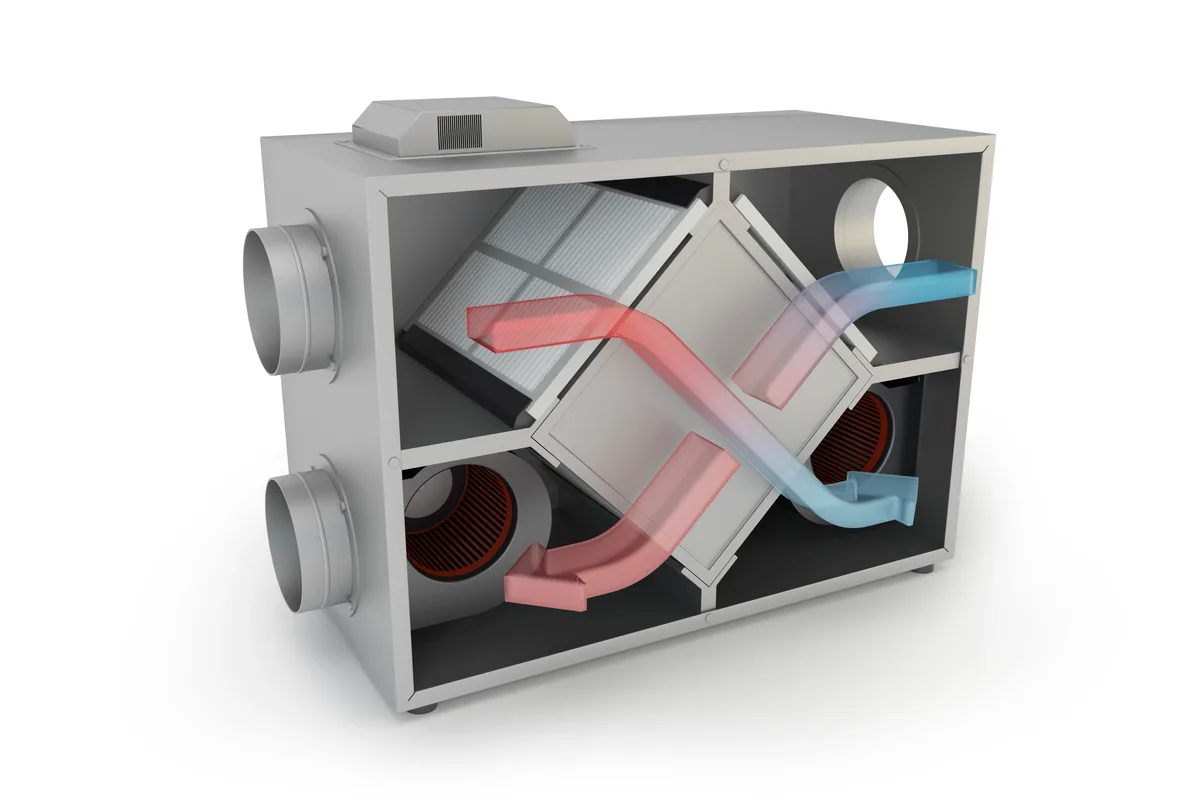
- The unit — sized by rated airflow at a given static pressure, plus the core type. An HRV moves heat only; an ERV moves some moisture as well.
- The install method — a simplified install ties supply and exhaust into the existing furnace ductwork; a fully ducted install runs dedicated stale-air pickups and fresh-air supplies.
- Two exterior hoods — insulated duct out to two wall terminations, kept far enough apart that the unit does not re-inhale its own exhaust.
- A condensate drain — the core makes water, so it needs a trapped drain to a floor drain or a condensate pump.
- Controls and interlock — a wall control plus the wiring that makes the HRV and the furnace blower work together rather than against each other.
- Balancing — measuring and setting supply and exhaust airflow so the house is neither pressurized nor depressurized.
Your new build probably already has one, unbalanced
If your house was built in the last 10 or 15 years in Alton Village, the Orchard, Waterdown or Milton, there is probably an HRV already hanging in the basement: Ontario's Building Code requires whole-house mechanical ventilation in new homes, and an HRV or ERV is how builders meet it. The usual problem is not that it is missing — it is that it was never balanced, the control is switched off, or the two hoods outside are matted with lint.
A commissioning visit on an existing unit — clean the core and filters, clear the hoods, set the control, then measure and balance the airflows — costs a fraction of a new install and frequently fixes the stuffy-bedroom complaint people were about to spend thousands on. Ask for that before you price equipment.
Choose an ERV near the lake, an HRV in an older leaky house
Think about both seasons. In Bronte, Aldershot and the streets south of Lakeshore Road, July air off Lake Ontario is warm and wet, and a plain HRV brings that moisture straight indoors; an ERV hands some of it back to the outgoing air and is usually the better fit close to the water. In winter the logic flips: a tight new house that runs dry holds onto more of its humidity with an ERV, while an older house with wet windows wants the drying effect of a plain HRV — our HRV vs. ERV comparison works through the trade-offs.
Defrost matters too. In a deep cold snap the exhaust side of the core ices, and every unit has a strategy for it: some shut down entirely below a set temperature, others run short recirculation cycles and keep going. Ask which, because the week the wind comes over the escarpment and nobody opens a window is exactly when you want it running.
What makes a retrofit cost more than a new build
- Finished basement ceilings — every duct run means opening drywall and repairing it afterward.
- Distance to an exterior wall — a furnace room in the middle of the footprint means long insulated runs to reach two terminations.
- Bathroom pickups — dedicated stale-air ducts up to second-floor bathrooms are the single biggest cost driver in a retrofit.
- Existing duct condition — a simplified install only works if the return trunk can carry the extra air. Why one room is always cold usually traces back to the same duct limitation.
- Electrical — a dedicated receptacle near the unit, which older mechanical rooms often lack.
Common questions about HRV cost
- Do I need one at all? Do I need an HRV in Ontario sets out when it is required and when it only helps.
- Will it lower my heating bill? Not by much on its own. It recovers heat from air you are already exhausting; the payoff is air quality and drier windows.
- Does it replace bathroom fans? In a fully ducted install with a pickup in each bathroom, yes — set the wall control to boost while the shower runs. In a simplified install the HRV only sees the return air, so keep the fans and their timers.
- What does it cost to run? On low speed an HRV draws roughly what a couple of old incandescent bulbs did — a small line on the hydro bill.
- What maintenance does it need? Wash or replace the filters a few times a year, rinse the core annually, and check both exterior hoods each fall — cottonwood fluff in June and lint from a nearby dryer vent are the two things that block them.
ZK Mechanical installs, commissions and balances HRVs across Burlington, Waterdown, Oakville and Hamilton. See HRV and ERV installation and indoor air quality. Call (647) 801-1252 or ask for a written price.