
Quick answer
A new boiler in Ontario has no single price. The cheapest case is a like-for-like swap on sound radiator piping; the dearest is a condensing combi in a pre-war house with rebuilt near-boiler piping, side-wall venting and a chimney liner for the orphaned water heater. Boiler type, output, venting and how much old piping stays decide it. ZK Mechanical quotes in writing after seeing the mechanical room.
A new boiler in Ontario does not have one price, and any contractor who gives you a firm one over the phone has not seen your mechanical room. The gap between a straight replacement on a sound piping system and a condensing combi with rebuilt near-boiler piping, a new vent route and an indirect tank is wide enough that a phone number is a guess. Here is what sets it, from the cheapest job to the dearest.
The five things that set the price of a boiler replacement
- Boiler type — a wall-hung condensing combi that makes domestic hot water on demand, a system boiler paired with an indirect tank, or a straight cast-iron replacement all price differently.
- Output and sizing — from a heat loss calculation, not from the badge on the old boiler. Boilers in pre-war houses were routinely oversized, often by a wide margin.
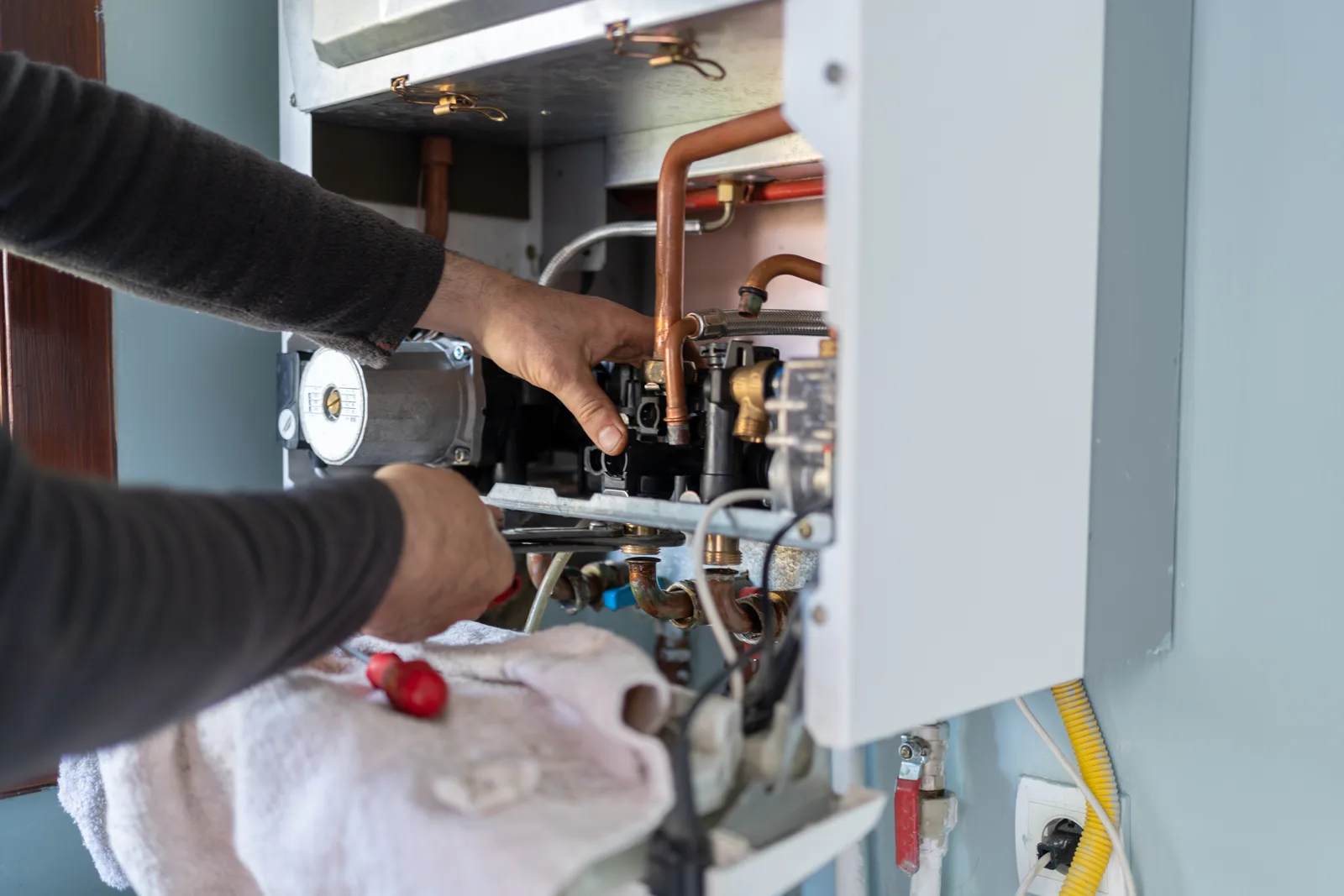
- Near-boiler piping — a condensing boiler needs its own circulator, expansion tank and air separator, often in a primary/secondary arrangement. On an old system this is most of the labour.
- Venting — condensing boilers vent in plastic through a side wall, which orphans the chimney. If a water heater still vents up that flue, it needs a liner: see chimney liners after a heating replacement.
- Controls — outdoor reset, zone valves or a circulator per zone, and a thermostat the boiler can talk to.
The cheapest job we see is a 1990s cast-iron boiler in a Millcroft or River Oaks house swapped for the same type on the same piping, vented up the existing chimney. The dearest is a Westdale century home going from an oversized gravity-era boiler to a condensing combi: new primary/secondary piping, a side-wall vent, a liner for the water heater, and zone valves that never existed.
Why Old Oakville, Westdale and Dundas boilers cost more
Pre-war brick homes in Old Oakville, Westdale and Dundas usually have gravity-era cast-iron radiators fed by oversized black iron mains that were never designed around a modern boiler's flow rate. Replacing the boiler there means rebuilding the piping at the appliance, adding proper air elimination, and often introducing zone control that never existed. That work is invisible once it is done and expensive when it is skipped.
It also decides whether the new boiler ever condenses. A condensing boiler only reaches its rated efficiency when return water comes back cool — roughly below 55 °C. Big old radiators can run at those temperatures; a loop set up for 82 °C water and never re-balanced will not. Outdoor reset control is what closes that gap, and it is a line worth asking about on the quote.
Combi or system boiler, and what Halton water does to the choice
A combi makes space heat and domestic hot water in one wall-hung unit and frees the floor space the tank occupied. The trade-off is that its domestic heat exchanger sees raw municipal water. Halton Region and Hamilton water is hard enough that a combi's plate exchanger scales the same way a tankless unit does — the same reason we push annual descaling on conversions (hard water and tankless units in Hamilton and Halton).
A system boiler with an indirect tank costs more up front but moves the scaling into a tank that is cheaper to service, and it holds up better to two bathrooms drawing at once. For most family houses on radiators, that is the better long-term answer.
Permits, licensing and what a real quote includes
Boiler work is gas work. It has to be carried out by a TSSA-licensed gas technician to the CSA B149.1 installation code, and whether a municipal permit is also needed depends on the city: Toronto and Caledon list replacing a boiler in a house as exempt, Brampton publishes a permit application package for boiler replacement, and the Burlington and Hamilton lists do not name boilers, so there we confirm with the building department. Where a permit applies, fees vary by municipality and typically run $100–$300. A written quote should name the boiler model and output, list the near-boiler components, state the vent route and say whether a permit applies and who pulls it.
If the old boiler is limping rather than dead, have it diagnosed before you price a replacement. A diagnostic visit runs $90–$150 and is credited toward the work if you proceed. Start with what boiler repair costs; a cast-iron boiler under 20 years old with a sound section block is usually worth fixing.
Common questions about new boiler pricing
- Could a heat pump replace it instead? Sometimes — can a heat pump replace a boiler covers when air-to-water works and when it does not.
- Is a boiler better than a furnace here? They are different jobs. A house with radiators and no ducts stays on a boiler; switching to forced air means building a duct system from nothing, which in a finished century home costs more than any boiler.
- Do rebates apply? Programs change; check the current rebate programs page against the specific model before you sign, and do not let a salesperson's rebate estimate stand in for the program's own product list.
- How long does the work take? A straightforward swap is a day or two. Re-piping and re-zoning a century home takes longer, and the house is without heat for that time, so we book those in the shoulder season where the calendar allows.
- Can my radiators be reused? Almost always, yes — cast-iron radiators outlast several boilers, and keeping them is what lets a condensing boiler run at low water temperature. A radiator seized at the valve or weeping at a section joint gets repaired before the new boiler is filled.
ZK Mechanical is TSSA-licensed and owner-operated, and prices boiler replacements in writing across Burlington, Oakville and Hamilton. For what the work involves end to end, see boiler repair and installation, call (647) 801-1252, or book a mechanical room visit.