
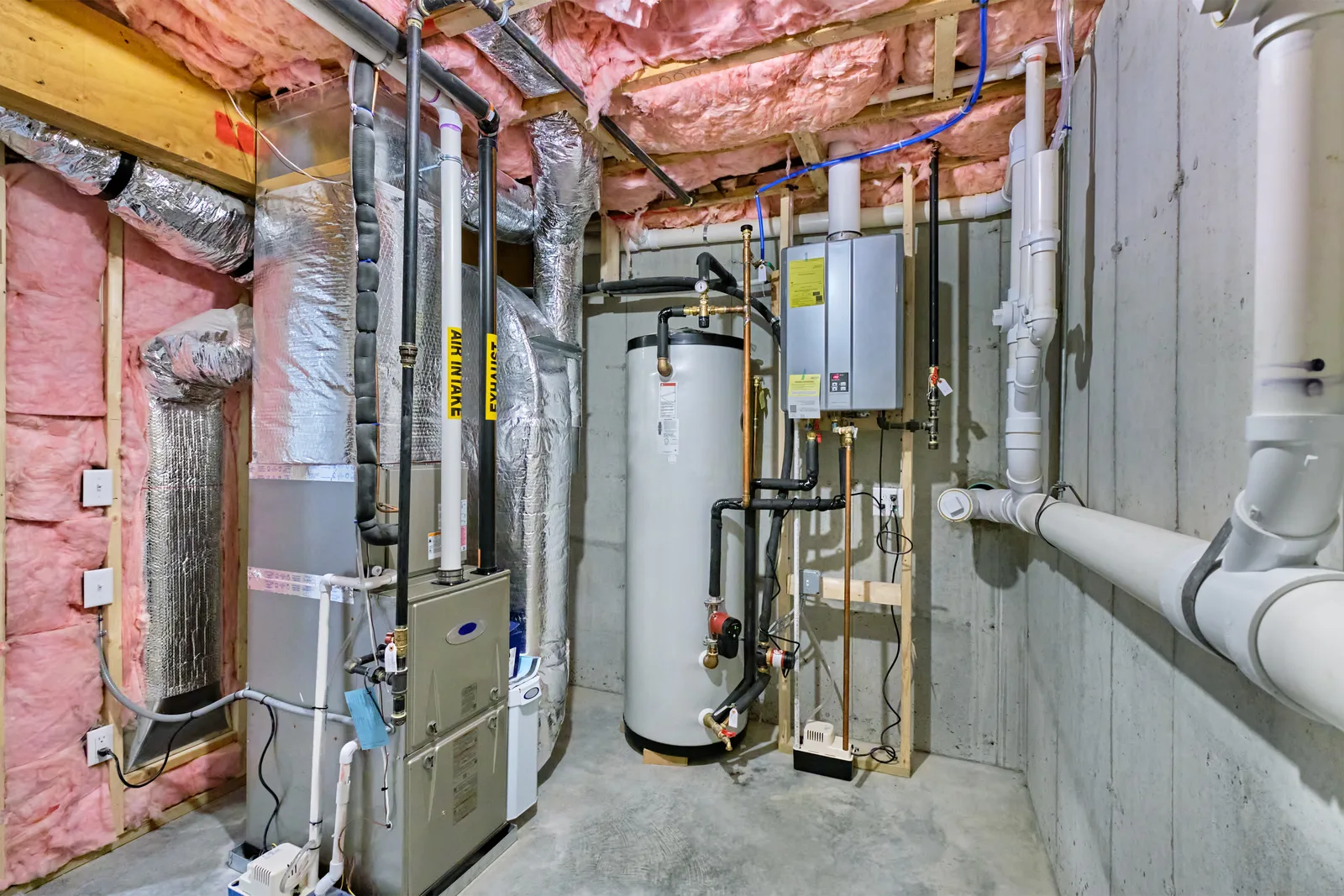
Do you need a chimney liner when replacing a furnace? Usually yes — and the liner is not for the furnace at all. A new high-efficiency furnace leaves the chimney entirely and vents out a sidewall in plastic pipe. If your gas water heater was sharing that chimney, it is suddenly venting alone into a flue that was sized for two appliances, and a tank on its own rarely makes enough heat to warm a large masonry flue and get a draft going. The consequences are condensation, corrosion and, at worst, exhaust spilling back into the basement. A correctly sized stainless liner at $400–$900 is the usual fix; a power-vent tank or a tankless conversion are the alternatives.
The Water Heater Is the Problem, Not the New Furnace
The old furnace was the engine that kept the flue warm. It fired often, for long stretches, with a big burner, and the water heater rode along on the draft it established. Take the furnace away and the tank has to establish that draft by itself, from cold, with a small burner and short firing cycles.
In an oversized, cold flue — particularly an exterior chimney climbing the gable wall of a pre-war house in Kerr Village, Old Oakville or Westdale — the exhaust cools before it reaches the top, stalls, and condenses on the tile. The visible symptom is spillage at the draft hood on a cold start. The slower damage is acidic condensate eating mortar joints and cracking clay liner tiles, which shows up as white efflorescence on the chimney breast, spalling brick outside, and rust or damp at the cleanout.
How We Decide: The Worst-Case Depressurisation Test
A proper installer does not guess at this, and neither should you accept a guess. After the furnace changeover, the water heater is tested under worst-case conditions: windows and exterior doors closed, interior doors positioned to isolate the mechanical room, the clothes dryer running, the range hood on high, and every bathroom fan going. Then the water heater is fired from cold and the draft hood is watched with a smoke source.
If exhaust spills out of the hood and does not draw within the allowed time, the venting has failed and it has to be corrected before the crew packs up. A carbon monoxide reading in the room and a flue gas reading go on the same sheet. That test is what separates a finished furnace job from one that hands you a problem. If your alarm has ever sounded, read what to do when a carbon monoxide alarm goes off before anything else.
What a Proper Liner Job Actually Includes
- A stainless flexible liner in 316L or equivalent, sized to the water heater's input on its own — commonly 3 or 4 inches, rather than the 6 or 7 inch flue that once served two appliances.
- Insulation around the liner where the chimney runs up an exterior wall, which most pre-war Halton and Hamilton chimneys do. An uninsulated liner in a cold outside chimney can condense exactly like the tile it replaced.
- A top plate and rain cap at the crown, and a tee with a cleanout at the base so the liner can be inspected later.
- A new single-wall connector from the draft hood to the thimble, pitched upward the whole way, with the required clearance to combustible framing.
- A chimney inspection before any of it: crown condition, flashing, mortar, and whether a fireplace shares the stack. An appliance vent and a solid-fuel flue must never share one flue.
- The spillage test repeated once the liner is in and the connector is made up.
The Alternatives, and When Each One Wins
Free quotes, written pricing.
- Liner: the cheapest route on the day when the chimney is structurally sound and the tank has years of life left. Budget $400–$900 for the liner work itself.
- Power-vent tank: the tank gets its own blower and vents out the wall in plastic, and the chimney is capped and abandoned. This wins when the tank is already old, when the chimney needs repointing you would rather not fund, or when a wall run is easy. A tank replacement runs $1,200–$2,500 installed — see power vent water heaters.
- Tankless conversion: removes the flue question permanently, frees the floor space and gives you continuous hot water at $3,500–$6,500, with the most common local job landing at $4,200–$5,000. Watch the gas supply, because a tankless unit draws far more gas at once than a tank and upsizing the run adds $400–$1,200.
- Doing nothing: defensible only if the water heater is already power-vented or direct-vented, or if you are replacing the tank in the same visit anyway.
If Your Water Heater Is Rented, the Order of Operations Changes
This is the local wrinkle that catches people out. If the tank is rented from Enercare or Reliance, no independent contractor can swap it — the rental company owns the equipment and has to perform the exchange, and moving to a power-vent rental normally changes your monthly rate and can restart the agreement.
That usually makes the liner the practical choice on furnace day, with the rental question handled on its own timeline afterwards. If you are weighing that up, our comparison of Enercare and Reliance rentals covers the clauses that matter and the arithmetic of buying out an agreement.
Which Local Houses Almost Always Need Something Done
- Pre-war brick with an exterior masonry chimney — Kerr Village, Old Oakville, Roseland, Westdale, Hamilton's lower city — where the flue is often unlined or running on cracked clay tile. A liner is the normal outcome, and it belongs on the written quote rather than appearing as a surprise on install day.
- 1950s and 1960s bungalows in Aldershot and on the Hamilton Mountain, where an interior chimney chase carried both appliances and the flue is far too large for a tank alone.
- 1970s to 1990s subdivisions, where the mid-efficiency furnace and the tank were common-vented into a metal B-vent stack rather than masonry. The B-vent will not rot the way brick does, but it is still oversized once the furnace leaves — the fix there is usually resizing the B-vent or moving the tank to power vent, not a stainless liner.
- Any house where the chimney also serves a wood fireplace, which forces a separate flue for the appliance and often makes power venting the simpler answer.
Verdict: Liner, Power Vent or Tankless
- Choose the liner if the chimney is sound, the tank is under roughly eight years old, and you want the lowest cost on installation day.
- Choose a power-vent tank if the water heater is near the end of its life anyway, or the masonry needs work — you cap the chimney and stop maintaining a structure you no longer use.
- Choose tankless if endless hot water and reclaimed floor space were already on your list, and budget separately for the gas line.
- Never accept a furnace quote that is silent about the chimney. Ask in writing what happens to the water heater's venting, and what the spillage test showed afterwards.
We quote the venting and the chimney as part of the furnace, not as a surprise on the day, because that is the line item that moves the price in older local housing. See our furnace installation service or ask for a quote that names the chimney plan.
Frequently asked questions
How much does a chimney liner cost with a furnace replacement?
The liner work generally falls in the $400–$900 range when it is done as part of the furnace install, because the crew, the ladder and the access are already on site. Doing it later as a standalone visit costs more for the same materials. If the chimney needs masonry repair, crown work or flashing, that is separate and belongs to a mason.
Can I just leave the water heater venting into the old chimney?
Only if it tests clean. Some flues are small enough, warm enough or interior enough that a single tank drafts properly, and the spillage test under worst-case conditions is how you find out. What you should not accept is nobody testing at all, because the failure mode is exhaust in your basement rather than an equipment fault you would notice.
What if I am replacing the water heater at the same time?
Then the liner question usually disappears. Put in a power-vent or direct-vent tank, or a tankless unit, and both appliances vent out the wall in plastic while the chimney gets capped. Doing both together saves a visit and often costs less overall than a liner plus a separate tank replacement two years later.
Does a stainless liner need maintenance?
Very little, but it is not invisible. The cleanout tee at the base should be checked during an annual service, and the cap and top plate are worth a look whenever anyone is on the roof. The bigger risk is the masonry around it — a deteriorating crown lets water into the chimney, and water is what shortens the life of everything inside it.