
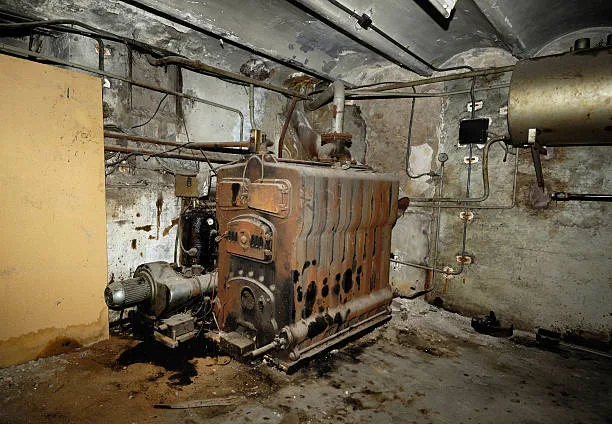
Mid-efficiency furnaces are gone from showrooms for a regulatory reason rather than a technical one, and what comes next is not a like-for-like swap. Federal efficiency rules set a 90 percent AFUE floor for residential gas furnaces manufactured from the end of 2009, and the federal minimum for a new gas furnace now stands at 95 percent AFUE. Between them those two steps retired the entire 78 to 82 percent induced-draft class. If one is still running in your basement — and plenty are across Halton and Hamilton — it is at minimum 16 years old. Its replacement vents in plastic through a wall, needs a condensate drain, and changes what happens to your chimney.
How to Tell If You Have One
- Look at the pipe leaving the top of the furnace. Round galvanised double-wall metal heading toward a chimney means mid-efficiency. White or grey plastic heading toward an outside wall means high-efficiency.
- There is no condensate drain and no plastic trap hanging off the cabinet. A condensing furnace always has both.
- The rating plate shows an AFUE in the high seventies or low eighties, and a manufacture date on or before 2009.
- There is an inducer fan on the flue outlet but only one heat exchanger — a single row of burner ports firing into steel tubes, with nothing behind them.
- Many model numbers from the period carry an 80 in them, but the plate is the reliable check. Numbers get reused; plates do not.
Why the Class Disappeared
The regulation applies to the date of manufacture rather than the date of sale, so mid-efficiency furnaces were never yanked off shelves — the stock simply ran out and nothing replaced it. The technical reason there is no middle rung is that anything much above 83 percent needs a second heat exchanger and condensing operation. The industry could not step from 80 to 85; it had to jump from 80 to 95 and up.
One consequence people miss: because the rule targets manufacturing, keeping, repairing and running an existing mid-efficiency furnace is perfectly legal. Nobody is going to make you replace a working one, and a well-maintained unit from 2005 may have several winters in it. The decision is economic and mechanical, not legal.
Parts: What Is Still Available and What Is Not
Wear items are not the problem. Hot surface igniters, flame sensors, pressure switches, capacitors, limit switches and blower motors all have aftermarket or universal equivalents, and a stocked van carries most of them. Expect a flame sensor or igniter to sit in the $150–$450 range, which is fair money on a furnace with life left.
What runs out is model-specific: integrated control boards, inducer assemblies with a particular flange pattern, and factory heat exchangers for discontinued platforms. On a furnace from the mid-1990s, a failed board can mean a two-week wait or a dead end, and that is what usually turns a January repair into a January replacement. A board is $500–$1,200 when you can get one and an inducer motor $400–$900 — see what a furnace control board costs for how that decision usually goes.
The Failure That Ends the Conversation
A mid-efficiency furnace has one heat exchanger, and decades of thermal cycling eventually crack the steel at the welds and the tight bends. The tells are sooting around the burner box, flame rollout at ignition, a flame that bends or lifts the moment the blower starts, and a carbon monoxide alarm that will not stay quiet.
Replacing the exchanger runs $1,500–$3,000 in parts and labour on most furnaces, and on a unit of this vintage that money belongs in the new equipment rather than in another season. Our answer on how to know if a heat exchanger is cracked covers how that diagnosis is properly made, and why a visual glance with a torch is not it.
Free quotes, written pricing.
What Changes When You Replace It
- The venting moves. Plastic pipe out the sidewall, normally two pipes, and the chimney is left to whatever else uses it — the options are laid out in furnace venting types.
- The water heater gets orphaned in the chimney, which is its own decision and its own line item.
- A condensate drain appears. It runs to a floor drain, a laundry standpipe, or a pump at $250–$450 installed when the drain is on the wrong side of the basement.
- The electrical gets fussier. Condensing furnaces want a clean dedicated circuit and a proper ground, because the flame-sensing circuit measures microamps and a poor ground makes it behave erratically.
- In 1990s townhouse blocks, the shared vent stack matters. Where several units' furnaces and tanks vent into a common stack, pulling one furnace off changes the sizing for everybody still connected. That work belongs to a contractor who will do the vent sizing rather than cap the tee and drive away.
The Local Housing That Still Has Them
Mid-efficiency was the standard new-build install right through the 1990s, so the 1990s phases of Waterdown, Ancaster, Dundas and Binbrook are where we still find original units. The other group is older housing where a mid-efficiency furnace replaced a gravity or oil unit in the 1990s and has been drafting into masonry ever since.
In that second group the chimney has already had 30 years of cooler exhaust working on it, which is why the liner question is usually settled before the furnace question is even opened.
Or Skip Straight Past the Furnace Decision
Because the old unit is at the end of its life anyway, this is the natural moment to price a heat pump alongside the furnace. The version that fits most Halton and Hamilton houses is hybrid: a cold-climate heat pump carrying the mild and moderate weather, with a new condensing furnace at 95 percent AFUE or better held in reserve for deep cold. Current Ontario programs return $500–$7,500 depending on the system, against nothing for a furnace-only upgrade, and the labour and sheet metal are being paid for either way.
That is worth an hour of your time even if you end up buying the furnace on its own. See hybrid heat pump systems for how the two appliances share a season.
Verdict: Repair, Replace, or Rethink
- Repair it if the furnace is from 2005 or later, the failed component is a wear item, and the heat exchanger inspects clean. Spending on a flame sensor or an igniter is fair value on a unit with a few winters ahead of it.
- Replace it this year if it is 1990s vintage, if a board or an inducer has failed, if the exchanger is suspect, or if the basement is already open for other work.
- Replace it and settle the venting first if the water heater shares the chimney. That decision moves the total more than the brand on the cabinet does.
- Ask for the hybrid quote next to the furnace quote before you sign either. The equipment differs; the crew, the sheet metal and the day do not.
We still service mid-efficiency furnaces across Burlington, Oakville and Hamilton, and we will tell you plainly when one is worth another season. Book an inspection through our heating service, or ask for both quotes side by side.
Frequently asked questions
Is it illegal to keep a mid-efficiency furnace in Ontario?
No. The efficiency rules govern what manufacturers may build and what can be sold new, not what you are allowed to own. An existing mid-efficiency furnace can be kept, serviced and repaired for as long as it is safe and parts exist. What you cannot do is buy a new one to replace it, because none are made for this market.
Can I replace a mid-efficiency furnace with another one to keep my chimney?
Not through a licensed contractor, because the equipment does not exist. If keeping the chimney matters — usually because of an atmospheric water heater — the answer is to plan the water heater's venting into the job rather than to hunt for old equipment. A liner or a power-vent tank solves it cleanly and legally.
How much longer will my mid-efficiency furnace last?
A working life of 15 to 20 years is what we plan around, and every mid-efficiency unit is now beyond that or approaching it. What matters more than age is what has failed: wear items are routine, while a board, an inducer or a suspect heat exchanger on a unit of this vintage is usually the signal to stop spending. An annual inspection with a combustion analyser is how you get warning rather than surprise.
Will a new furnace fit where the old one sits?
In most basements, yes — cabinet footprints are similar and the return and supply connections get rebuilt as part of the job. The changes that need room are the two vent pipes finding a route to an outside wall and the condensate finding a drain. Furnaces in main-floor closets and under stairs are where those two requirements get tight and the layout has to be planned.