
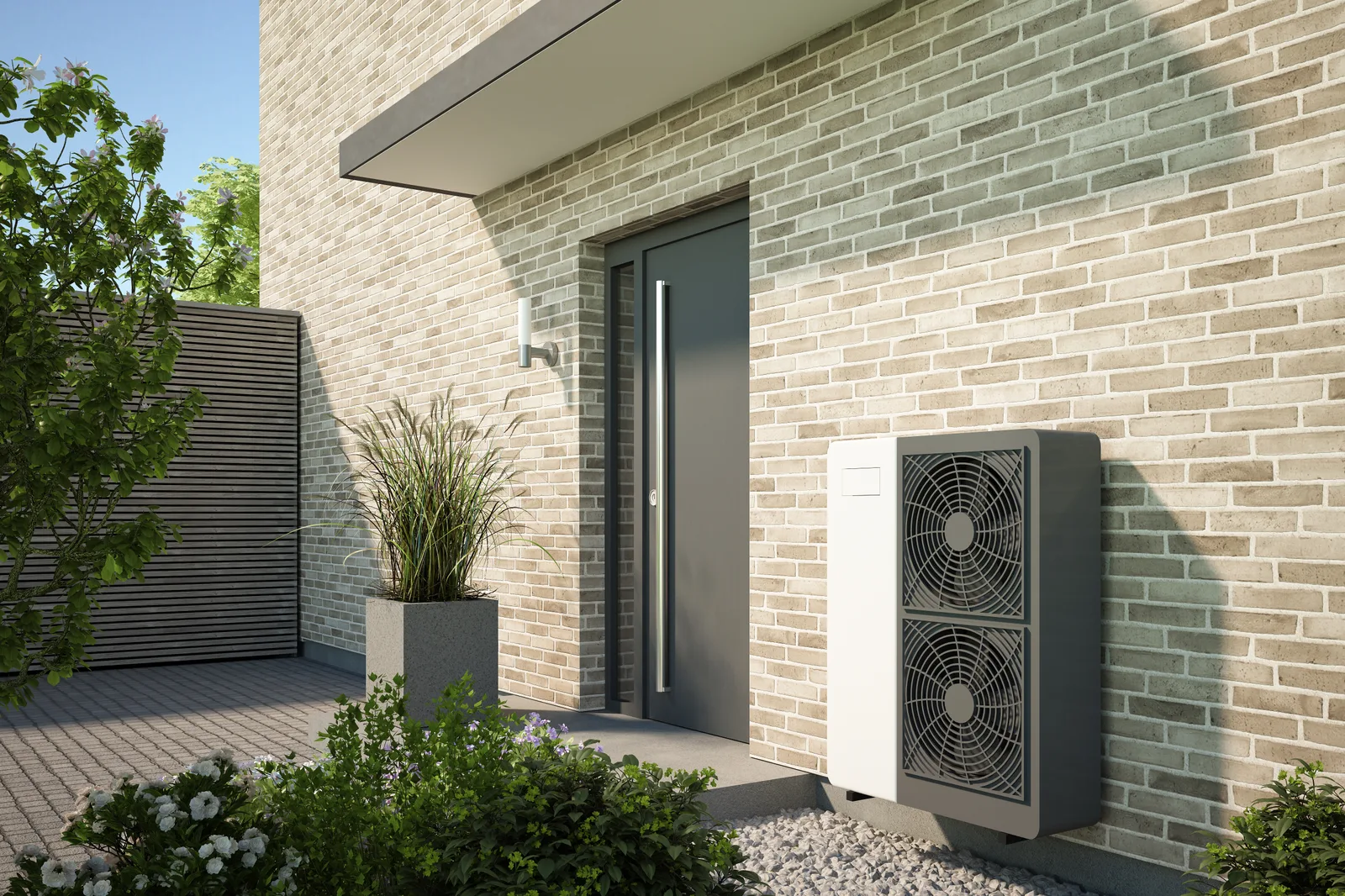
Heat pump installation day is one full day for a straightforward ducted retrofit and two days once a panel upgrade, a difficult line-set route or a multi-zone ductless system is involved. Here is what to expect: the visible half is the outdoor unit going up on a raised stand and a matched indoor coil going on top of your furnace. The half that decides whether the system still performs in year 12 is invisible — the electrical circuit and its inspection, the nitrogen pressure test, a vacuum pulled below 500 microns, and a charge weighed in rather than guessed.
Before the Day: Electrical, Rebates and the Line Set
- An electrical load calculation, not a glance at the panel. The outdoor unit's nameplate gives a minimum circuit ampacity and a maximum overcurrent protection, and the breaker is sized from those — commonly a double-pole breaker in the 30 to 40 amp range on a residential unit, but the plate governs.
- An older 100-amp service, common in 1950s and 1960s Aldershot and Hamilton Mountain bungalows, needs that calculation done before anyone orders equipment. Our guide on panel upgrades for a heat pump covers what triggers one.
- The new circuit is electrical work, so it needs an ESA notification and inspection in Ontario, filed by the licensed electrical contractor doing it. Ask who is taking out the notification and get the number.
- The line set. Most manufacturers require new copper for the current A2L refrigerants rather than reusing a line set from a 2010 air conditioner, because residual oil and contamination are not compatible with the new refrigerant and its oil.
- Rebate registration ahead of the work. The model has to appear on the program's eligible-products list and the project has to be registered before installation rather than afterwards. The Home Renovation Savings Program page sets out the current rules.
- Where the outdoor unit goes: away from bedroom windows, out from under the roof drip line, clear of where driveway snow gets piled, and within the setbacks your municipality applies to mechanical equipment beside a house.
Morning: Out With the Old Condenser, Up on a Stand With the New
If an air conditioner is being replaced, its refrigerant is recovered into a cylinder — never vented, which is illegal — and the old unit is disconnected and taken away. Then comes the mounting decision that separates a heat pump from an air conditioner.
A heat pump throws off several litres of meltwater every time it defrosts, so it cannot sit flat on a slab the way a summer-only condenser can. It goes on a raised stand or wall brackets with the base clear of the snow line, typically 30 to 45 cm above grade, over a gravel bed that takes the water away instead of ponding and refreezing.
Indoors, the furnace plenum is opened and the matched indoor coil is set in — or an air handler replaces the furnace outright on an all-electric job. Matching is not a formality: the outdoor unit, the indoor coil and sometimes the control are certified as a combination, and a mismatched coil costs capacity, efficiency and occasionally the warranty.
Midday: Line Set, Brazing and the Three Tests Worth Watching
- The line set is run through a joist bay, a rim board or the chase the old one used, insulated along its whole length including the outdoor section, and sealed where it passes through the wall.
- Joints are brazed with dry nitrogen flowing through the tubing. That flow stops oxidation scale forming inside the pipe, and scale is what eventually plugs a metering device and produces a mystery fault years later.
- The system is pressure-tested with dry nitrogen and left standing while the crew works elsewhere. A pressure that holds is your proof there is no leak — this cannot be rushed and it cannot be faked.
- Then the evacuation. A proper deep vacuum pulls the system below 500 microns on a micron gauge, the pump is valved off, and the reading has to hold steady. A rise means moisture or a leak is still in there. This is the first step a fast crew shortens, and the one that quietly costs you a compressor.
- Charge: the factory charge covers a set line length, and anything beyond it is weighed in by the gram. On a variable-speed unit the result is then verified by subcooling under load.
- A2L refrigerants are mildly flammable, so brazing practice, leak checking and cylinder handling follow different rules than R-410A did, and some indoor equipment carries a refrigerant sensor and an automatic shut-off valve.
Afternoon: Controls, Balance Point and Commissioning
Free quotes, written pricing.
On a hybrid system the thermostat has to know about both appliances and be told where to hand over. That handover temperature — the balance point — should be set from the heat pump's rated capacity at low temperature and the relative cost of gas and electricity, not left wherever the factory default landed. Ask for it to be written on your paperwork so it can be revisited after the first winter, and read heat pump thermostat settings before you start adjusting it yourself.
- Airflow and static pressure measured. A heat pump moves more air per ton than an air conditioner and delivers it cooler, so a duct system that was adequate for a furnace can be marginal for a heat pump.
- Subcooling and superheat recorded under real operating conditions.
- One defrost cycle forced and watched, so the crew sees the reversing valve, the fan and the drainage behave before they leave.
- The outdoor temperature sensor sited out of direct sun and away from the exhaust plume.
- Auxiliary or backup heat lockout set, so electric elements do not fire before they are genuinely needed.
- A full run in both heating and cooling, because a heat pump is both appliances and both modes need proving.
What Feels Different in the First Week
- The supply air is cooler than a furnace's — closer to body temperature than hot. A register that feels lukewarm on your hand is usually working exactly as designed.
- The system runs for long stretches instead of short blasts rather than cycling on and off the way a furnace does, which is the whole point and not a fault.
- The outdoor unit will steam and pause in damp weather near freezing — see the heat pump defrost cycle so the first one does not alarm you.
- Deep overnight setbacks usually cost money on a heat pump rather than saving it, because recovery calls on backup heat.
- Your gas bill drops and your Burlington Hydro, Oakville Hydro or Alectra bill rises. Judge the system on both together across a full season, not on one month's electricity.
What Turns One Day Into Two
- A panel or service upgrade, which brings the electrical contractor and the utility into the schedule.
- A multi-zone ductless install, where every head needs its own line set, its own wall penetration and its own condensate route.
- Adding a return or resizing a trunk so the duct system can actually deliver the airflow the heat pump needs.
- A ductless line set running up an exterior wall behind a line-hide, especially on a two- or three-storey where lift equipment is involved.
- A condo, stacked townhouse or flat-roof property where the outdoor unit goes on a balcony or a roof and access has to be arranged with the building.
What It Costs on the Day
- Three-ton cold-climate ducted heat pump: $9,500–$15,000 installed, with current Ontario programs returning up to $7,500
- Whole-home ducted cold-climate systems across sizes and tiers: roughly $6,000–$16,000 before rebates
- Single-zone ductless: $4,000–$7,000 installed
- Dual-zone ductless: $7,500–$11,000 installed
- Three to four zones: $10,000–$16,000+ installed
- Current Ontario rebates run $500–$7,500 depending on the system, and we file the paperwork as part of the job
We install cold-climate heat pumps across Halton and Hamilton, and we would rather spend an extra hour on the vacuum and the commissioning than come back for it. See our heat pump installation service for the scope we quote, or book a site visit and we will assess the panel, the ductwork and the outdoor location before quoting anything.
Frequently asked questions
How long does a heat pump installation take?
One working day for a ducted retrofit onto an existing furnace where the electrical is straightforward, and two days when a panel upgrade, multiple ductless zones or duct modifications are involved. All-electric conversions that remove the furnace and fit an air handler usually run into a second day as well, because the electrical work and the backup heat wiring take real time.
Do I need a new thermostat with a heat pump?
Almost always. A heat pump needs a thermostat that understands reversing-valve control and backup heat staging, and a dual-fuel system needs one that can manage the handover between the heat pump and the furnace. Reusing an old single-stage thermostat is the fastest way to end up running expensive backup heat you did not need.
Can I reuse the line set from my old air conditioner?
Usually not. Manufacturers generally require new copper when moving to the current A2L refrigerants, because oil and residue from the previous system are not compatible with the new one, and line sizing often differs anyway. On the rare occasion a reuse is permitted, it involves a documented flush and a pressure test, and the manufacturer's instructions decide, not convenience.
Will my ductwork handle a heat pump?
Frequently yes, sometimes not without help. Heat pumps deliver more air at a lower temperature than a furnace does, so a duct system that was already restrictive will show it as weak airflow upstairs and long run times. That is why static pressure gets measured during the site visit and again at commissioning, and why adding a return is a common line item on the quote.
What happens to my furnace if I add a heat pump?
In a hybrid setup it stays and becomes the deep-cold backup, firing only below the balance point, which means it burns a fraction of the gas it used to. That also extends its useful life. If the furnace is already at the end of its run, the usual approach is to replace both in the same visit so the sheet metal, the electrical and the controls are done once.