
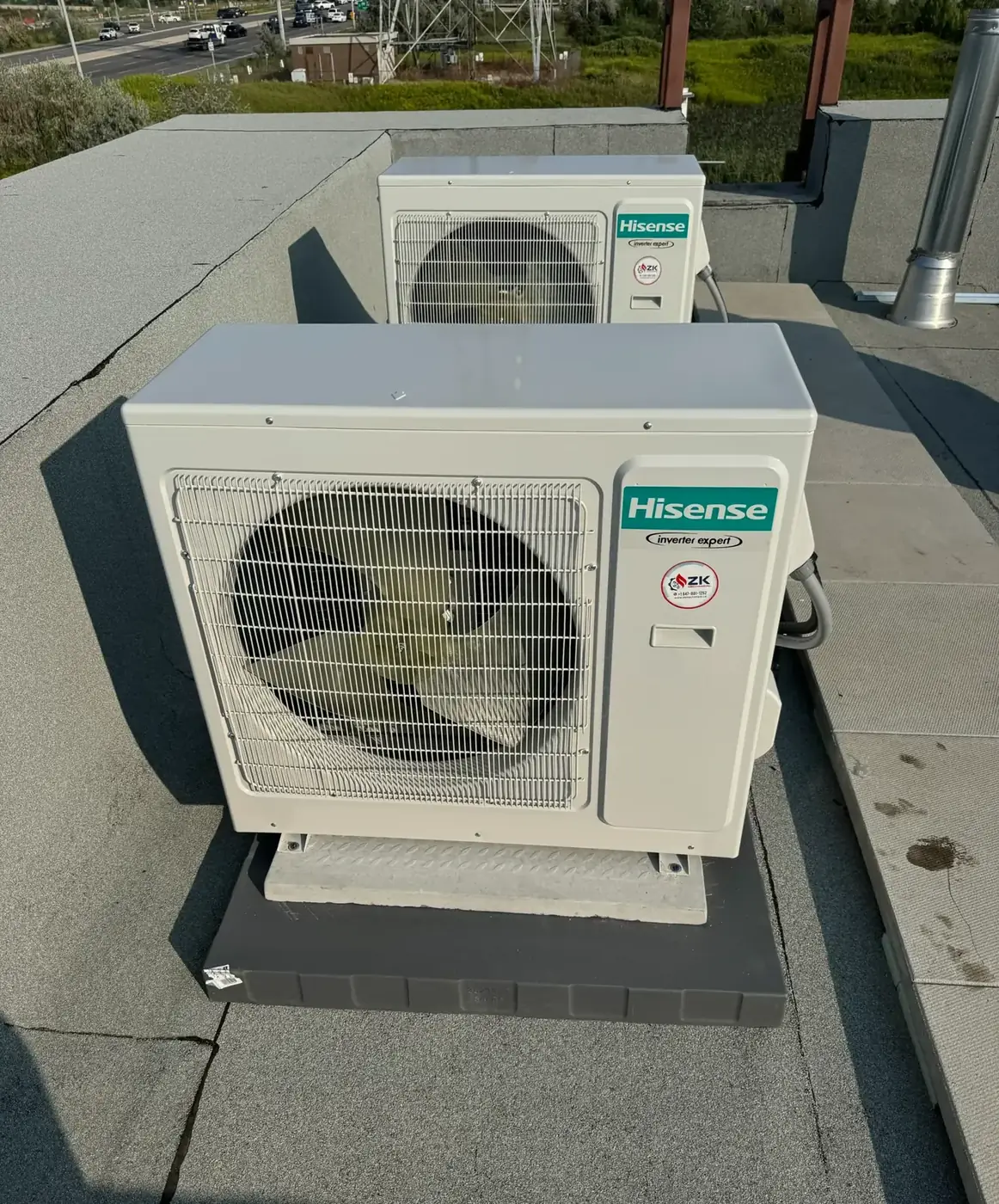
The proof is on our projects page: Hisense rooftop units on a commercial roof. To be exact about what that job was, the equipment is Hisense rooftop condensing units, the outdoor halves of split systems, each with its own disconnect and its own refrigerant circuit. A packaged rooftop unit that sits on a curb and feeds ductwork below is a different cabinet, but the roof work is shared: the lift, the supports, the clearances, the wiring and the commissioning.
Hisense is a large Chinese manufacturer that most Canadians know from televisions and appliances. Its HVAC arm sells mini-splits, light commercial systems and VRF equipment in Canada. On Ontario commercial roofs it is far less common than Carrier, Lennox, Trane or York. That is a statement about the supply chain, not about the quality of the equipment.
For an owner, the supply chain is the whole question. A rooftop unit is a 15-to-20-year decision, and during those years it will need a fan motor, a board or a compressor on a hot afternoon. The brand that suits your building is the one whose parts reach an Ontario contractor quickly and whose warranty process is clear before the first claim. Ask the supplier those questions in writing; we ask them too before we put a price on any Hisense equipment.
The Ontario side of a rooftop job is the same whatever the badge. The unit goes up by crane or boom truck, a curb adapter is needed when the new cabinet does not match the old curb, the gas line is reconnected under CSA B149.1 by a TSSA-licensed technician, and any change to the electrical disconnect or feeder is done under an ESA notification by a licensed electrical contractor. Our rooftop unit service page explains how we schedule a replacement around a tenant's hours.
Hisense lines we install and service
This is the Hisense equipment we have installed. Each outdoor unit serves its own indoor section through its own refrigerant piping, so one can be locked out for repair while the others keep the space cool. Placement matters more than the brand: units set too close together breathe each other's hot discharge air and lose capacity on the hottest days.
Hisense Canada lists light commercial systems alongside its residential mini-splits: indoor units paired with an outdoor unit on the roof or at grade. They suit small offices, retail bays and clinics where a full packaged unit is more than the space needs. Service is refrigeration work on an inverter system, which calls for certified refrigerant handling and the manufacturer's fault tables.
Variable refrigerant flow equipment runs many indoor units from one outdoor system and is commissioned with the manufacturer's software. It is the most demanding of the three to start up correctly, and the start-up record is what the warranty rests on. Our VRF system service page covers how we approach it.
If you are being quoted a Hisense packaged gas/electric or heat pump rooftop unit, ask the supplier to confirm in writing that the exact model carries Canadian certification, is supported with parts in Ontario and comes with a named commissioning process. Gas appliances and electrical equipment must bear a recognized certification mark to be installed here. We check the same points before pricing one.
What goes wrong on Hisense equipment
Inverter-drive faults: read the history before resetting
Inverter rooftop equipment stores its recent faults, and that list is the most useful thing on the roof. A reset wipes the symptom and keeps the cause. We read and record the fault history first, then check supply voltage on each phase, connections at the drive and whether the drive overheated because the coil was blocked. Repeated drive trips on a clean unit point to power quality in the building, which is a conversation with your electrician.
Condenser coil fouling
Dust, cottonwood seed and kitchen exhaust grease mat the outdoor coil, head pressure climbs and the unit cuts back its output or trips on a hot day. The fix is a proper coil cleaning with the cleaner and water pressure the manufacturer allows; too much pressure folds the fins flat. Roofs near a restaurant exhaust or a gravel yard need this twice a season, not once.
Contactors, capacitors and fan motors
On fixed-speed sections the failures are the ordinary ones: a pitted contactor that will not pull in, a weak capacitor, a condenser fan motor with dry bearings. These are generic electrical parts that any GTA wholesaler stocks, so they are same-day repairs on any brand. We measure them at every maintenance visit and change them before the first heat wave does it for you.
On packaged units: economizer actuator and gas-heat ignition
A packaged rooftop unit adds two fault groups that a condensing unit does not have. The economizer's damper actuator seizes or loses its signal, leaving the outdoor-air damper stuck open in winter or shut in spring. On the heating side, the igniter, the flame sensor and the inducer's proving switch are the parts that stop a burner from lighting. Both are covered on our RTU economizer repair page and in fall maintenance.
Hisense warranty: what to know
- Get the warranty certificate for the exact model from the supplier before you buy. We do not quote Hisense commercial terms from memory, and you should not accept them verbally.
- Ask who registers the equipment and by when. Record every serial number and the start-up date on the day of commissioning.
- Keep the commissioning sheet: operating pressures, superheat and subcooling, voltage and amperage on each unit. A manufacturer will ask for those readings when a compressor claim is made.
- A parts warranty covers the part. Ask in writing whether labour, refrigerant or a crane lift for a compressor change is included; on most commercial warranties they are not.
- Maintenance records matter on any brand. A unit with no service history and a coil packed with dirt is a difficult claim.
Parts availability in the GTA
Parts are the trade-off with a less-common brand. Contactors, capacitors, filters and belts are generic and on every wholesaler's shelf. The brand-specific items, such as control boards, inverter drives, fan motors and compressors, come through Hisense's HVAC distributors and not through the counters most Ontario contractors visit daily, so ask the supplier what is stocked in the province and what the lead time is on a board and a compressor. Where a tenant cannot be without cooling, we recommend several smaller units on separate circuits over one large one, so a wait for a part closes one zone and not the building.
Common questions
Has ZK Mechanical really installed Hisense rooftop equipment?
Yes. We installed Hisense rooftop condensing units on a commercial building, set with the manufacturer's clearances, mounted on supports that carry the load to the structure and wired with a disconnect at each unit. The photos and the layout reasoning are on the project page. We describe it as condensing units because that is what the equipment is.
Is choosing a less-common rooftop brand a mistake?
Not if three things are confirmed first: parts are stocked or reachable in Ontario within a time your tenant can live with, the warranty is registered in the owner's name, and a named party commissions the equipment and leaves a start-up sheet. If the supplier cannot answer those, pay the difference for a brand with local parts. Our guide to commercial RTU replacement covers the rest of the decision.
Does replacing a rooftop unit need a crane and a permit?
A crane or boom truck, nearly always. Gas reconnection is done by a TSSA-licensed gas technician under CSA B149.1, and changes to the disconnect or feeder go through ESA. Whether a building permit is needed depends on the municipality and on whether the weight, the structure or the ductwork changes, so we check with the building department for your address before lift day.
Will a new rooftop unit fit the existing curb?
Only if the footprint and duct openings match, which is rare across brands. A curb adapter bridges the old curb to the new cabinet, but it raises the unit, adds weight and changes the airflow path, so it has to be ordered for that exact pair of models. We measure the curb on the roof visit and give the weights to the building's engineer where the load increases.
What does a rooftop unit replacement cost?
There is no honest flat figure. Tonnage, gas or electric heat, the crane and street access, a curb adapter, electrical changes and roofing work around the curb all move the price, and they differ on every building. We visit the roof and give a written, itemized quote. Our answer on what a commercial rooftop unit costs explains each line.