
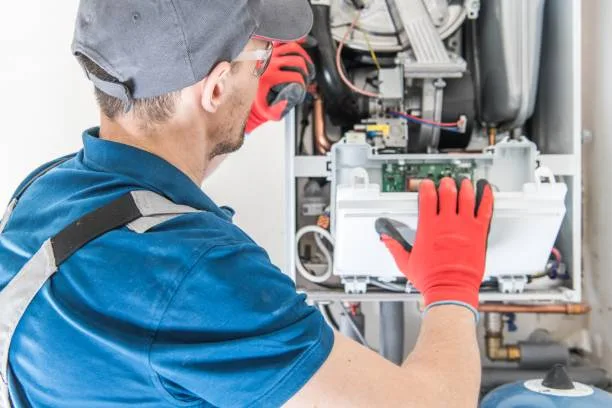
Repair your furnace if it is under 12 years old, the quote covers one failed part, and the number is under half the price of a new unit. Replace it if it is 15 or older, if the heat exchanger has cracked, or if this is the second no-heat call in two winters. Most furnace repairs in the GTA run $150–$800, with a service call of roughly $90–$150 that we credit toward the fix, while a high-efficiency replacement lands at $4,500–$7,500 installed.
The 12-year line: when repairing is the cheaper decision
Under 12 years old, with one failed component and a clean combustion test, repair wins on arithmetic almost every time. Furnaces in Ontario commonly reach 15 to 20 years, so a 9-year-old unit still has most of a decade of service in it. Paying $250–$500 for a pressure switch to buy six more heating seasons is a better trade than putting that money against a new install you were not planning.
The condition to check is not the broken part but the heat exchanger behind it. A technician should pull the burner assembly, inspect the cells with a mirror and camera, and run a combustion analysis at the flue before quoting anything. If those come back clean, fix the part.
What furnace repairs cost in the GTA, part by part
- Diagnostic / service call: $80–$150, often credited toward the repair
- Flame sensor cleaning or replacement: $150–$300 — the most common no-heat call we run
- Hot surface igniter: $200–$450
- Capacitor or pressure switch: $250–$500
- Draft inducer motor: $400–$900
- Control board: $500–$1,200
- Gas valve: $500–$1,000
- Blower motor: $500–$1,500, at the top of that band for an ECM
- Heat exchanger: $1,500–$3,000 — the repair that usually ends the conversation
Two of those rows sit above the point where the maths flips. Once a single repair passes roughly $1,200 on a furnace in its teens, you are financing the last years of a machine that owes you nothing. Our furnace repair quotes are written before the work starts so you can see that number before you decide.
What a furnace replacement costs, and the line items people miss
A high-efficiency replacement runs $4,500–$7,500 installed across the GTA, and the spread has more to do with the house than the badge on the cabinet. Municipal permit costs vary by municipality, typically $100–$300, and Toronto's process is more involved than the smaller cities around it.
- Removal and disposal of the old furnace — worth $150–$400, and it should be named on the quote rather than assumed
- Sheet-metal transitions where the new cabinet does not match the old plenum footprint
- A chimney liner if your water heater was sharing the flue with a mid-efficiency furnace; that flue is oversized the moment the furnace leaves it
- PVC intake and exhaust terminations, plus a condensate drain and trap the old furnace never needed
- A new filter cabinet if the return-side opening is undersized for the blower you are buying
If your air conditioner is also past 12, price the pair. Doing both in one visit typically runs $7,500–$11,500 and saves $1,000–$2,500 versus two separate installs, because the sheet metal, the electrical hookup and the permit only happen once. The full breakdown sits in our GTA furnace cost guide.
Free quotes, written pricing.
Repair vs replacement, compared on the five things that decide it
- Cash today — repair $150–$800 typical; replacement $4,500–$7,500, financeable over 10 years
- How long it buys you — repair: to the next weak component; replacement: a 15-to-20-year clock restarted
- Fuel use — repair leaves your current AFUE where it is; a new condensing furnace takes a 15-year-old mid-efficiency unit's gas bill down noticeably
- Rebates — repairs qualify for nothing; furnace-only upgrades typically see $500–$1,500 through the Home Renovation Savings Program
- Risk — repair on a cracked or corroded exchanger is not a repair, it is a delay; replacement removes the combustion question entirely
Four failures where replacement is the only sensible answer
A cracked heat exchanger is the first. A licensed technician who confirms one is required to shut the appliance down and tag it, because the crack lets combustion products into the air you breathe — the reason a furnace can leak carbon monoxide at all. The $1,500–$3,000 repair almost always appears on furnaces 15 or older, where that money belongs in a new unit.
The second is a gas valve and burner assembly failing in the same visit on a furnace in its teens. The third is a control board that the manufacturer no longer supplies, where the only board available is a salvaged one with no warranty. The fourth is a pattern: three service calls across two winters means the next one is already booked, you just do not know the date.
Do the arithmetic per remaining year, not per repair
Divide the repair quote by the number of heating seasons the furnace realistically has left, then compare. A $700 inducer motor on a 7-year-old furnace spreads across a decade of remaining winters and barely registers. The same $700 on a 17-year-old furnace with two seasons in it costs $350 a winter — and buys nothing but heat, where a replacement also cuts the gas bill and restarts the parts warranty.
One warranty note that catches people out: many manufacturers cover the heat exchanger for 20 years or for life to the original registered owner, but never the labour. A covered part on a 12-year-old furnace still means paying a technician for a full day, and the coverage usually dies with the sale of the house. Ask which parts are still covered before you assume the repair is cheap.
The verdict: a decision rule you can apply in ten minutes
- Under 12 years, one failed part, clean combustion test — repair, and book a tune-up for the fall
- 12 to 15 years, repair quote under $500, no exchanger findings — repair, and start getting replacement quotes while you have time to compare
- 15 or older with any repair over $1,000 — replace
- Cracked heat exchanger at any age past 12 — replace
- Second or third failure in two seasons — replace, regardless of what this one costs
If you are between two of those rows, get the age of the unit off the rating plate and check it against how long a furnace lasts in Ontario, then have someone look at the exchanger before you spend anything. ZK Mechanical gives written pricing on both options in the same visit, so you are comparing a real repair number with a real install number rather than a guess — book an assessment and we will tell you plainly which one we would choose in your basement.
Frequently asked questions
How do I know if I should repair or replace my furnace?
Three things decide it: age off the rating plate, the size of the quote, and what the heat exchanger looks like. Under 12 years with a single failed part and a clean combustion test, repair. At 15 or older with a quote over $1,000, replace. Any confirmed crack in the exchanger ends the discussion at any age past a decade, because the appliance has to be shut down and tagged.
How much does a new furnace cost in the GTA?
A high-efficiency furnace installed across the GTA and Hamilton runs $4,500–$7,500, covering the unit, labour, venting and the removal of the old furnace. Permits add $100–$300 depending on the municipality. What moves a quote inside that band is the house: a chimney liner for an orphaned water heater, new sheet-metal transitions, or a return opening too small for the blower you are buying.
Is it worth repairing a 10-year-old furnace?
Usually yes. At 10 years a gas furnace is roughly halfway through its Ontario service life, so a contained fault — flame sensor, igniter, capacitor or pressure switch at $150–$500 — buys years at a low cost per year. The exception is a repair that needs the burner assembly pulled and reveals scaling or a crack in the exchanger, or a second failure within the same heating season.
How long does a furnace typically last?
A well-maintained gas furnace in Ontario lasts 15 to 20 years. Condensing models tend to sit at the lower end because acidic condensate works on the secondary exchanger, the trap and the drain for their whole life. Annual service — filter changes, burner cleaning and a combustion analysis at the flue — is the biggest single factor in whether yours reaches 20 or quits at 12.
Will a new furnace lower my heating bills?
Yes, and the gap is largest if you are replacing a mid-efficiency furnace that vents into a chimney. Canada's minimum for new residential gas furnaces is 95% AFUE, so anything installed today is condensing, and an ECM blower cuts electricity as well as gas. On the rebate side, furnace-only upgrades typically see $500–$1,500 through the Home Renovation Savings Program — check the program page for the current requirements before you count on a figure.