
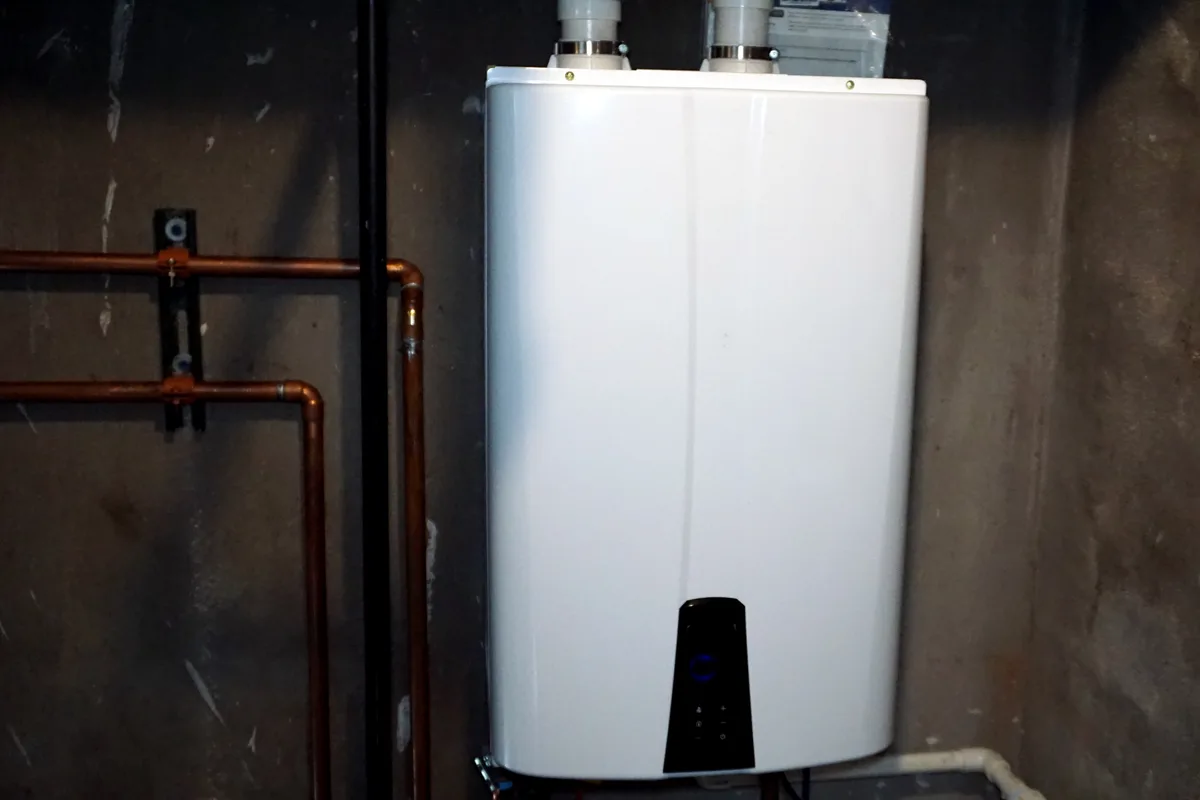
Noritz is a Japanese water heater manufacturer whose North American arm, Noritz America, sells the units installed here. Its EZ series was designed around one job: replacing a tank. The EZ98 and EZ111 put the water connections on top of the cabinet, where a tank's pipes already are, and accept a half-inch gas line; the EZTR bundles add a flexible vent kit so the new unit can use the old vent path.
Water quality decides how a Noritz ages in this area. Halton and Hamilton water is hard, and scale bakes onto the inside of a tankless heat exchanger every time the burner fires. Noritz's warranty excludes damage from water harder than 12 grains per gallon (200 mg/L), so a flush is not an upsell here. It is what keeps the heat exchanger covered.
A proper annual service has three parts: a descale flush through the isolation valves, cleaning the cold-water inlet filter, and a combustion check with the gas pressure measured while the burner is at high fire. If your Noritz was installed without isolation valves, adding them is the first job, because without them nobody can flush it.
Codes vary between Noritz models, and the table in your owner's guide is the authority for your unit. Our Noritz tankless error codes guide covers the common ones and says which are safe to reset. ZK Mechanical is independent of Noritz and services these heaters whoever installed them.
Noritz lines we install and service
Condensing tankless heaters built for tank-replacement installs, with top-mounted water connections. They are the Noritz models we would expect in a house that switched from a rental tank, and the ones with the longest heat exchanger warranty in the range.
The EZTR packages pair an EZ heater with a flexible vent conversion kit for running new venting through an existing vent path. On a service call we inspect that flex run closely, because a sagging or disconnected liner shows up as flame and combustion faults.
Noritz's conventional condensing models, with water and gas connections underneath. They produce acidic condensate that drains through a neutralizer, which is the part behind code 29.
Condensing models equipped for recirculation, so hot water arrives at distant taps faster. Recirculation means more burner hours and more scale, which makes the yearly flush matter even more on these units.
Older and simpler units with no condensate to manage and a hotter exhaust. Ignition, flame-rod and scale faults are the same; code 29 does not apply.
What goes wrong on Noritz equipment
Code 11: ignition failure
The heater tried to light and saw no flame. In order of likelihood: a fouled igniter electrode, a dirty flame rod, low gas pressure when the furnace and the tankless fire together, or a blocked air intake. Check that the gas valve to the unit is open and that the vent termination outside is clear of snow, then reset once. We measure gas pressure with a manometer under full load, because a line that tests fine with one appliance running can starve with two.
Code 12: flame loss
The burner lit and then the flame was lost or could no longer be sensed. A flame rod coated with oxide is the usual cause, followed by gas pressure that sags at high fire and exhaust being drawn back into the intake at a poorly placed termination. This is the code behind showers that go cold partway through. Cleaning or replacing the rod and correcting the gas supply falls in the $150–$800 repair range.
Code 16: overheating from scale
The outlet temperature spiked past the limit, and on hard water the cause is nearly always scale, which insulates the heat exchanger so the burner overshoots. A descale flush at $150–$300 clears it if it is caught early. Left alone, the heater keeps overheating until its thermal fuse opens, and that turns a flush into a parts repair. See how to tell when a tankless needs descaling.
Code 29: condensate neutralizer blocked
Condensing Noritz models stop firing when condensate cannot drain, to keep water from backing up into the burner. The neutralizer media has packed solid, the drain tube is kinked, or the line has frozen where it passes through an unheated space. Do not keep resetting it. We clear or replace the neutralizer, confirm the drain slope and reroute any section that can freeze.
Noritz warranty: what to know
- Heat exchanger terms depend on the series. Noritz America's published warranty gives the EZ series 25 years on the heat exchanger in a single-family home, with an operating-hours cap, and 12 years on its other residential models.
- Recirculation shortens it. The same document lowers the EZ heat exchanger term to 15 years when the heater runs with pre-heated or recirculated water.
- Other parts carry 5 years, and reasonable labour is covered for 1 year, paid to Noritz-authorized service representatives.
- Scale is excluded. Damage from untreated or poorly treated well water, or from hardness above 12 grains per gallon (200 mg/L), is not covered, which matters on municipal water here and more so on private wells in Kilbride, Campbellville and Carlisle.
- Those are the terms Noritz America publishes. Confirm them against the warranty sheet for your model and installation, and keep every flush invoice with it.
Parts availability in the GTA
Noritz parts are keyed to the model number on the rating plate, and the same code can call for a different igniter, flame rod, fan or circuit board from one series to the next. We take that number on the phone, and the service consumables are always with us: descaling solution, a pump and hoses, inlet filter screens, neutralizer media and gaskets. Brand-specific components such as a fan assembly, gas valve or circuit board are ordered through plumbing distribution, and we give you the quoted lead time before you commit. If the wait is long and the heat exchanger is already scaled or leaking, we will put a replacement price beside the repair.
Noritz Tankless Error Codes Explained — what each one means and whether it is safe to keep running.
Common questions
Can I descale my Noritz tankless myself?
Yes, if isolation valves with service ports are installed. Shut off the gas and the water valves, circulate a descaling solution through the heat exchanger with a small pump for the time the product label gives, flush with clean water and clean the inlet filter. Leave the burner, the gas valve and the combustion settings to a licensed gas technician.
Is it safe to keep resetting a Noritz showing code 11?
One reset is reasonable. After that, leave it off, because each attempt releases gas that fails to light. If you smell gas at any point, do not touch the heater or any switch: leave the house and call Enbridge Gas from outside. A code that returns after one reset needs a technician with a manometer.
How often does a Noritz need service in Burlington, Oakville or Hamilton?
Once a year. The water in Halton and Hamilton is hard, and a tankless heat exchanger scales faster than a tank because the passages are narrow and the heat is intense. Households with recirculation or heavy use should not stretch the interval. Our guide to tankless heaters on hard water in Hamilton and Halton explains why.
Do I need a Noritz dealer to repair my Noritz?
No. A technician holding the right TSSA gas licence can service and repair it, and the parts warranty stays with the heater. The exception is labour during the first year, which Noritz pays only to service representatives it has authorized. Outside that window there is no advantage to waiting for a brand dealer.
When should a Noritz be replaced instead of repaired?
Replace it when the heat exchanger itself is leaking or badly scaled and its warranty no longer applies, or when a repair approaches half the cost of a new unit on a heater past 12 years. Igniters, flame rods, fans and neutralizers are worth fixing. A new tankless installed runs $3,500–$6,500 depending on venting and gas line work.