
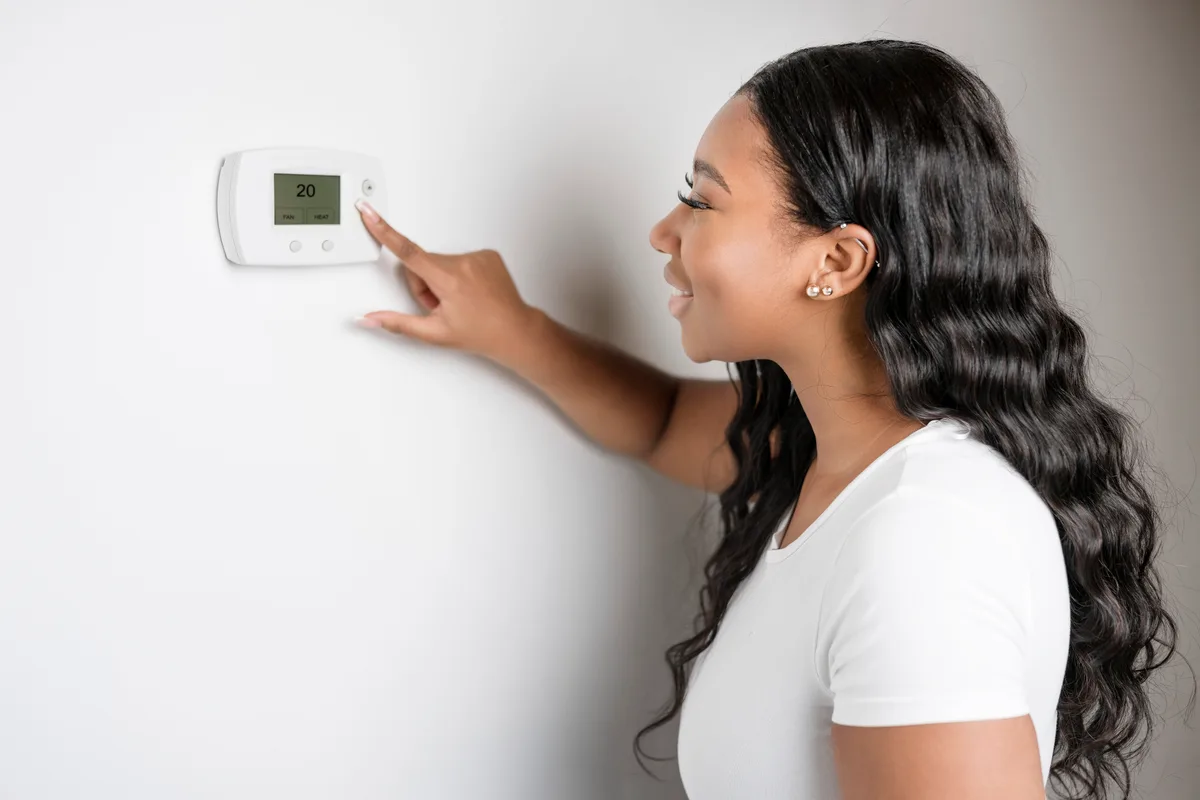
Honeywell Home thermostats have been made by Resideo since Honeywell spun off its homes business in 2018. The Honeywell name on the faceplate is used under licence, so the warranty, the app and the support line all belong to Resideo. That matters when you go looking for a manual or a warranty form: search under Honeywell Home, not Honeywell.
Most calls we get for a broken Honeywell are not thermostat faults. They are power faults that start at the furnace or air conditioner, or set-up choices made in the installer menu on day one that never matched the equipment. A thermostat is a switch with a screen. When the screen is dark, the first question is whether 24 V is reaching it.
The cable in the wall sets the limits. Many 1970s–90s subdivision houses were wired with a four-conductor thermostat cable, enough for heat, cooling, fan and power in, with nothing left over for a common. Older heat-only houses often have two. Before buying a Wi-Fi model, pull the old thermostat off its base and count the wires, including any folded back unused.
We install and set up Honeywell Home thermostats in Burlington, Oakville, Milton, Hamilton and Mississauga as an independent contractor. Our smart thermostat installation page describes the visit from the first wire count to the test cycle.
Honeywell Home lines we install and service
The contractor-grade programmable thermostat on a lot of GTA walls. It runs on batteries or a C-wire, so it works on older two-wire and four-wire cables without changes. It is the sensible choice when nobody in the house wants an app.
The connected version. Honeywell Home lists it for up to three heat and two cool stages on a heat pump and two heat, two cool on a conventional system. It needs a C-wire or the wire-saver adapter; batteries will not run the Wi-Fi radio.
The retail smart model, sold with wireless room sensors that let it average or prioritise rooms. The retail box includes a C-wire adapter for homes with four conductors. It is a good fit for a two-storey house where the hallway reading never matches the bedrooms.
The pro-channel model with its own room sensors and universal relay terminals that can be assigned to a humidifier, dehumidifier or ventilator. That assignment is made in installer set-up; wiring the accessory without it does nothing.
Still serviceable and often still accurate. The one caution is the classic round dial thermostat with a glass mercury switch inside: when it is replaced, the old one goes to a household hazardous waste depot, not the garbage.
What goes wrong on Honeywell Home equipment
Blank screen: batteries first, then the 24 V supply
On a battery model, fresh alkaline batteries fix most blank screens. On a C-wire model a dark display means no 24 V, and there are three usual causes: a blown blade fuse on the furnace control board, a tripped condensate float switch on the air conditioner's drain, or a furnace door that is not seated on its safety switch. A fuse that blows again has a short behind it, often where the cable to the outdoor unit was nicked. Our answer on a blank thermostat screen lists the checks in order.
Flashing 'Cool On', 'Heat On' or 'Wait' is a timer, not a failure
Honeywell thermostats hold the compressor off for about five minutes after it last stopped, after a power interruption or after a quick setpoint change. The words flash during the delay and go steady when the equipment is released. Leave it alone and let the timer run out. If the display goes steady and nothing starts, the fault is at the furnace, heat pump or air conditioner, not at the wall.
Wrong system type or stages in installer set-up
A heat pump configured as a conventional furnace, or the reverse, produces strange symptoms: cooling when you ask for heat, auxiliary heat that never engages, a second stage that never fires. The O/B setting is the common one. Most heat pump brands energise the reversing valve in cooling (O); a few energise it in heating (B), and the wrong choice swaps the two modes. Staging matters as well, because a two-stage furnace told it has one stage runs on low fire all winter.
No C-wire and only four conductors in the wall
There are four ways out, in the order we prefer them: a spare conductor folded back in the wall; Honeywell's wire-saver adapter at the furnace board, which carries two signals on one conductor and frees another for common; a new cable where the route allows it; and, last, giving up the fan wire as a common. That final option works but costs you manual fan control. Our C-wire installation service covers each one.
Honeywell Home warranty: what to know
- Resideo, not Honeywell, is the warrantor on current Honeywell Home thermostats. Claims and support go through the Honeywell Home site.
- Honeywell Home lists a five-year warranty on the T6 Pro Smart. Terms on retail-box models differ from pro-channel models, so read the card in your box before assuming the same number.
- The warranty covers the thermostat. It does not cover the labour to swap it, a blown furnace fuse, or damage from a miswired terminal.
- Keep the receipt or the installation invoice. The term runs from a date somebody has to be able to prove.
Parts availability in the GTA
A thermostat is replaced, not repaired, so parts here means the pieces around it. The T-series models share one wall plate design, which makes moving from a T6 Pro to a T10 Pro a quick change once the wiring supports it. Pro-channel thermostats, wire-saver adapters, cover plates for old paint outlines and room sensors are stocked by GTA heating wholesalers, and the retail models sit on hardware store shelves. The furnace-side items that actually cause most faults, control board fuses, float switches and transformers, are generic stock parts.
Honeywell Thermostat Error Codes Explained — what each one means and whether it is safe to keep running.
Common questions
Can I install a Honeywell thermostat myself?
Often, yes. Switch the furnace off at its power switch, photograph the old wiring, move each wire to the matching terminal and run the set-up. Call for help when the system is a heat pump, a dual-fuel pair, a two-stage furnace or has a humidifier, or when there is no C-wire. Those are the installs where a wrong menu choice shows up as a no-heat call in January.
Will a Honeywell Wi-Fi thermostat work on my boiler with two wires?
Not as it stands. Two wires carry the heat call and nothing else, so there is no common to power a Wi-Fi model. The choices are a new cable from the boiler controls, a separate transformer, or a battery-powered T6 Pro that needs no common at all. On radiator systems the non-connected model is frequently the better answer, because a boiler does not benefit much from deep setbacks.
Is there an Ontario rebate for a Honeywell smart thermostat?
Smart thermostats are included in the Home Renovation Savings Program run by Enbridge Gas and Save on Energy. The amount differs between the official pages, so check the program page for the current figure and the list of eligible models before you buy. Our smart thermostat rebate page links to the official source.
What does Honeywell thermostat installation cost?
It depends on the wiring more than the thermostat: a like-for-like swap on a cable that already has a common is a short visit, while a wire-saver adapter, new cable or a heat pump with a humidifier takes longer. We quote the total in writing after seeing the cable and the furnace board. What smart thermostat installation costs explains the variables.
My Honeywell shows an error number in the corner. What is it?
T-series thermostats report alerts as numbers, for example a lost Wi-Fi signal, a failed sensor or a filter reminder. The number is specific to the model family, and the user guide for your exact thermostat is the authority. Our Honeywell thermostat error codes reference lists the common ones and says which need a technician.