
Lifebreath is built by Airia Brands in London, Ontario, and it is a brand we find again and again in builder-installed mechanical rooms. Ontario's Building Code requires mechanical ventilation in new houses, and an HRV hung beside the furnace is how most builders meet it. If your home was built in the 2000s or later in Milton, Brampton, north Oakville, Waterdown or Binbrook, there is a fair chance the box with four insulated ducts is a Lifebreath.
The unit swaps stale indoor air for outdoor air and passes the two streams through a core so the outgoing air warms the incoming air. A Lifebreath HRV uses an aluminium core, which is why it can be washed and why the manufacturer puts a lifetime warranty on it. The ERV versions use a different core that also moves moisture between the streams; HRV vs ERV explains which one suits which house.
What goes wrong is rarely the core. It is the parts that move: the motor, and the small damper motor that manages frost. The other half of our Lifebreath calls are not breakdowns at all. The unit has run for years without the filters being rinsed or the outdoor hoods being cleared, and airflow has faded to almost nothing.
ZK Mechanical services Lifebreath equipment as an independent contractor. When a unit is past repairing, HRV and ERV installation covers what a replacement involves.
Lifebreath lines we install and service
The compact residential units most often supplied to builders. Small cabinet, a basic wall control in the hallway and timer buttons in the bathrooms. These make up most of what we service in subdivision houses.
The larger-capacity residential line, including the 155 MAX, for bigger or tighter houses. Lifebreath also sells ERV versions in this range, and the two look alike from outside, so read the model label on the cabinet door before ordering a core or filters.
A slim unit designed for condominiums and apartments where the ventilator sits in a ceiling space or closet. Access is the difficulty: servicing one usually means working through a ceiling hatch.
Lifebreath's hydronic air handler with a ventilator built in, heated by a water heater or boiler through a coil. When one stops heating, the fault is as likely to be the circulator or the coil as the ventilation side; see hydronic air handler repair.
The main control sets speed and mode, and the 20/40/60-minute push-button timers boost the unit to high. A unit that never boosts usually has a broken low-voltage wire to a timer, not a failed motor.
What goes wrong on Lifebreath equipment
Defrost damper motor or temperature sensor failure
In cold weather the unit periodically stops bringing in outdoor air so the core can thaw; on damper-defrost models a small motor closes the fresh-air port and recirculates house air. If that motor fails with the damper open, the core ices solid, airflow drops and meltwater appears under the cabinet. If it fails closed, the unit recirculates forever and no fresh air arrives; a failed temperature sensor produces the same two results by telling the control the wrong thing. Why an HRV freezes up covers the homeowner checks.
Noisy or seized fan motor
A motor that hums, rumbles or squeals has bearings on the way out. Many Lifebreath cabinets drive both blower wheels from one motor, so when it stops, supply and exhaust stop together. The repair is a new motor matched to the model and, on capacitor-run motors, a new capacitor with it. A rattle that changes with speed is more often a wheel loaded with lint than a bad bearing.
Plugged core, filters or outdoor hood screens
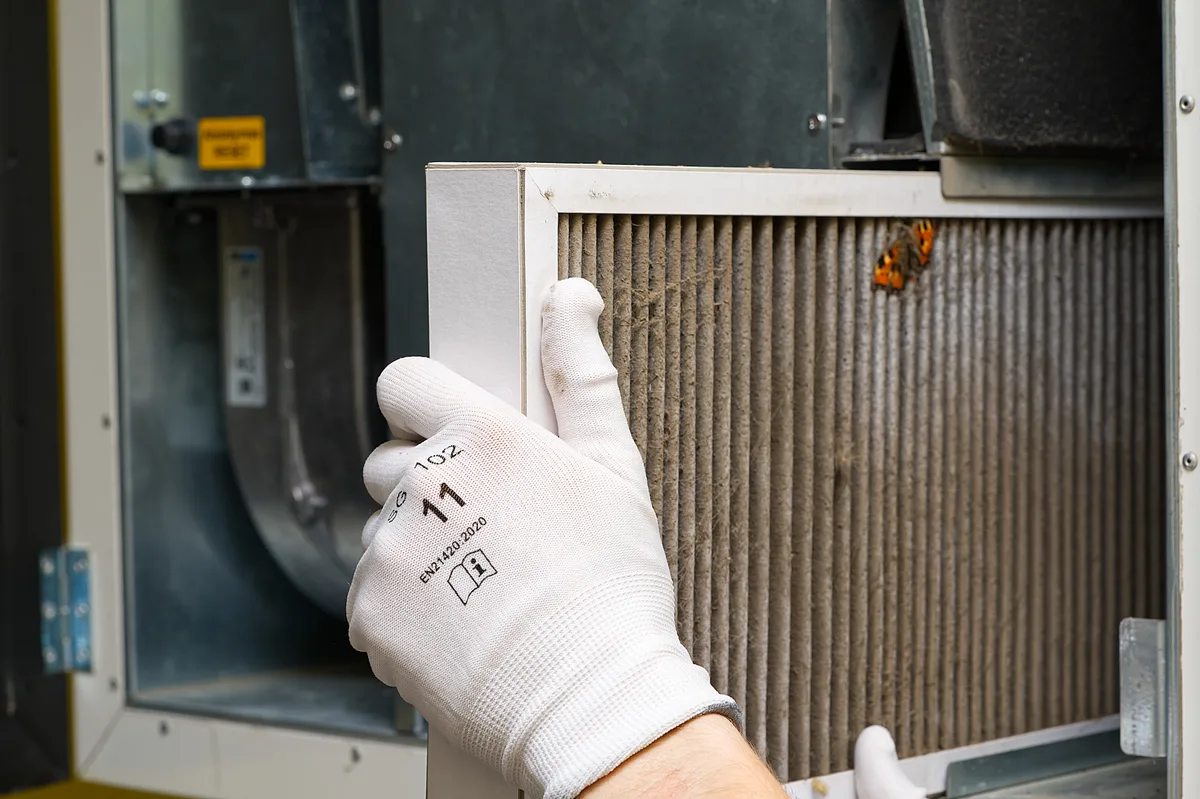
The two filters in front of the core catch household dust on one side and outdoor debris on the other. The intake hood on the outside wall has a screen that mats over with lint, seeds and leaves. Any of the three starves the unit, and a starved unit runs unbalanced. Clearing them is homeowner work between visits, with the unit unplugged.
Blocked condensate drain
An HRV makes water in winter, and it leaves through a drain hose with a loop in it that acts as a trap. A kinked hose or a loop filled with sludge backs water into the cabinet until it drips from the door seam. We clear the hose, re-form the trap and confirm the cabinet is level enough to drain.
Lifebreath warranty: what to know
- Lifebreath's published residential terms are a lifetime warranty on the HRV core and five years on the other components.
- Residential ERV units carry five years on the core and five years on other components.
- The term begins on the installation date, but no later than twelve months after the date of manufacture, and applies only to a unit in its original installed location.
- Coverage requires that the maintenance in the owner's manual was done at the stated frequency, and a core claim needs a photograph of the core.
- Labour to fit a replacement part is paid by the homeowner, and Lifebreath specifies that the work be done by a certified technician.
Parts availability in the GTA
Because the units are made in Ontario and the manufacturer publishes a current parts list by model, Lifebreath parts are easier to identify than most. Motors, damper motors, sensors, cores, filters, door latches and wall controls are ordered by the model and serial number on the cabinet label, through HVAC wholesalers. Filters and drain fittings are simple to get. Motors for older cabinets are where a repair can stall, and we check that the part still exists before quoting it.
Common questions
What does a Lifebreath service visit include?
We remove and clean the core and filters, clear the outdoor hoods, flush the drain, check the motor and defrost operation, and then measure and balance the supply and exhaust airflows so one does not exceed the other. Balancing is the step that gets skipped, and an unbalanced unit either pressurises the house or pulls it negative. Our HRV and ERV cleaning page describes the visit.
Can I wash the Lifebreath core myself?
The aluminium HRV core can be soaked in warm water with mild soap and rinsed, following the owner's manual. Unplug the unit first and note which way the core faces before sliding it out. An ERV core is different and should only be cleaned the way its manual says. Doing this yearly also keeps you inside the maintenance condition on the core warranty.
Why are my windows wet even though the HRV is running?
Three causes are common. The unit is stuck in defrost and only recirculating, so no dry outdoor air is coming in; the outdoor intake is blocked; or a furnace humidifier is set too high for the weather and is adding moisture faster than the ventilator removes it. Hold a tissue at the outdoor exhaust hood: if it does not move, the unit is not exchanging air.
Should a Lifebreath HRV run all the time?
In the heating season, yes, on low speed, with the bathroom timers boosting it when needed. Turning it off in winter traps moisture and cooking and cleaning fumes in a tight house. Summer is a judgment call that depends on outdoor humidity and whether the air conditioner is on, and on a muggy week a lower speed or a timed schedule is reasonable.
When is a Lifebreath worth replacing?
Replace it when the motor for that model can no longer be bought, when the cabinet is rusted through from years of drain trouble, or when the core is physically damaged. Otherwise a motor, damper motor or sensor is a reasonable repair on a unit that will run for years after. For new-unit pricing, see what an HRV costs installed.