
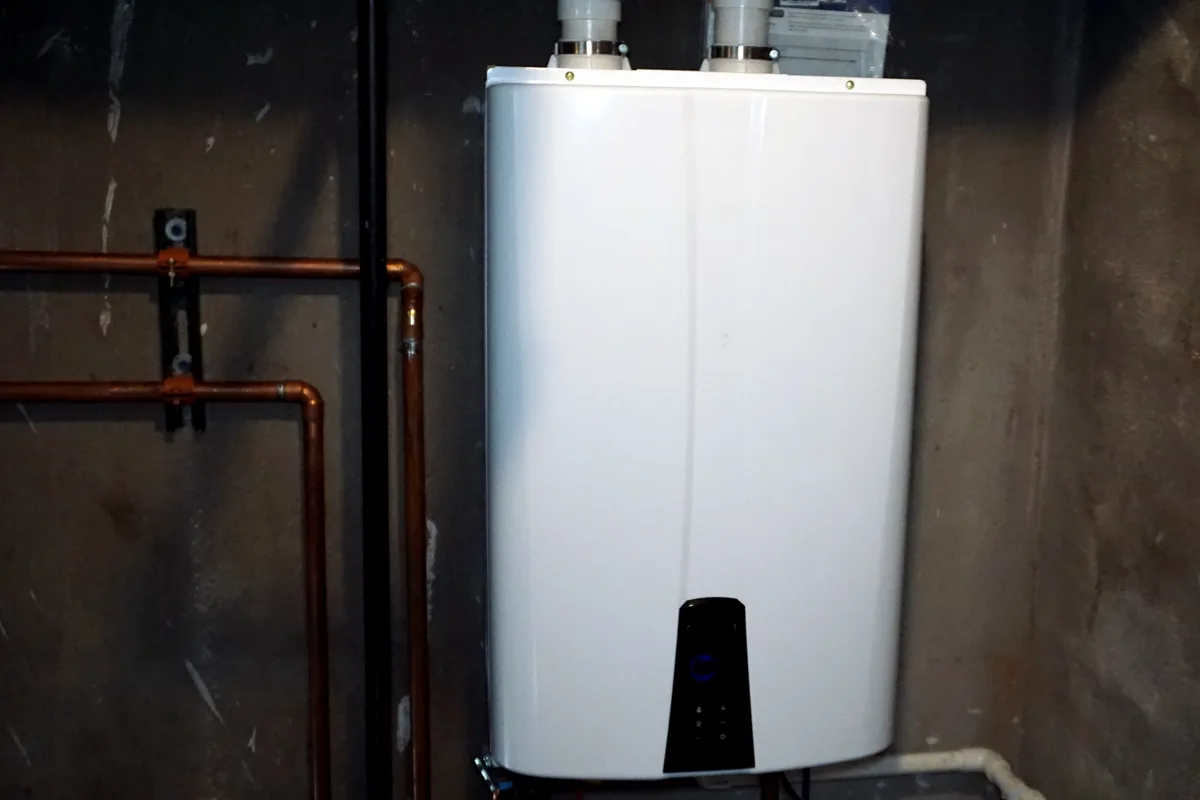
Rinnai has been building tankless water heaters longer than almost anyone selling them in Canada, and the current condensing Sensei units are the ones we see going into Halton homes today. Older non-condensing V-series units are still working away in plenty of Westdale and Old Oakville basements, vented in stainless rather than PVC. Knowing which family is on your wall changes the parts conversation completely, so the model number off the side label is the first thing we ask for.
The feature that sets Rinnai apart in a retrofit is its approach to recirculation. Certain Sensei models can use the existing cold-water line as the return path, which means faster hot water at a far bathroom without opening ceilings to run a dedicated return pipe. In a finished 1970s side-split where every joist bay is drywalled, that is the difference between a one-day job and a renovation.
Rinnai also sells exterior-mounted models, and they are excellent — in climates that are not ours. Outdoor units rely on electric freeze protection, which means a power cut on a -15 °C night puts the heat exchanger at risk with nobody home to notice. For Burlington and Hamilton we install interior units with sealed venting, and if you have inherited an exterior unit we will talk through how to protect it rather than pretend the risk is not there.
We service Rinnai units regardless of who installed them and will file a parts claim where the unit qualifies. If you are weighing a tankless conversion rather than fixing an existing one, read is a tankless water heater worth it in Ontario first — it is an honest answer, not a sales page.
Rinnai lines we install and service
The mainstream residential line: condensing efficiency, PVC venting, and inputs sized for anything from a small bungalow to a four-bathroom house. The RUR variants add factory recirculation. These are the units we most often quote as a replacement, and we rarely wait on a part for one.
Rinnai's cold-line return approach uses a small pump and a valve at the far fixture so the cold line temporarily doubles as the return. It gives you near-instant hot water at the master bathroom without cutting into finished ceilings. It has to be commissioned properly — set the schedule wrong and you will heat the cold line at three in the morning for no reason.
The older generation, vented in stainless steel rather than PVC, still common in homes that converted early. They are simple and durable, but parts support thins out as the platform ages. If yours needs a major component, that is the moment to compare the repair against a $3,500–$6,500 replacement rather than after you have spent the money.
Two or more units linked to share the load, used in larger homes with several bathrooms running at once and in small commercial sites. They add redundancy — one unit down still leaves you with hot water — and they add commissioning complexity. We size these from a fixture count and a realistic simultaneous-use assumption, not a rule of thumb.
What goes wrong on Rinnai equipment
LC codes — scale detected in the heat exchanger
Rinnai will tell you outright when limescale is building up, which is more warning than most equipment gives. Ignore it and flow and temperature fall away until the unit starts protecting itself. The answer is a descale flush at $150–$300 through the isolation valves, done annually on our hard lake water. If the LC code returns within months of a flush, we look at whether a softener or a scale filter is the better long-term fix.
Code 11 — no ignition
The unit calls for heat and never lights. The order of checks is gas supply and pressure under real load, then the igniter and flame rod, then the condition of the vent. On a house where the tankless shares a gas line with a furnace and a range, this fault often appears only when two appliances run together — which is why the diagnosis has to happen with the system loaded, not idling.
Code 10 — air supply or exhaust blockage
A concentric or two-pipe termination that has been buried by lake-effect snow, blocked by ice, or choked with lint from a dryer vent installed too close to it. The unit is doing exactly what it should by refusing to fire. Clearing it takes minutes; keeping it clear means relocating a termination that was mounted too low or too close to another exhaust in the first place.
Condensate trap and neutralizer neglect
Condensing units make acidic condensate, and the trap and neutralizer that handle it are consumables, not permanent fixtures. A plugged trap backs water into places it does not belong; spent neutralizer media sends acidic condensate into your drains. Both are inexpensive to service and both get skipped by companies that only show up when something has already broken.
Rinnai warranty: what to know
- Rinnai publishes different heat exchanger terms for its condensing and non-condensing families, and shorter terms again for commercial applications — the condensing residential units carry the longest coverage. Read the warranty sheet for your specific model rather than trusting a single number quoted online, and register the unit with the serial from the side label.
- The heat exchanger term, the parts term and the labour term are three different lengths. Labour coverage is the shortest by a wide margin, so a covered part in year five still means a paid service visit.
- Installation must follow the manual — venting material, vent length and termination clearances, gas sizing, and condensate handling. Denials we hear about almost always trace back to venting or gas that was never right, not to a defective part.
- Scale and hard-water damage are excluded. On Lake Ontario water that makes documented annual descaling the practical condition of keeping your coverage meaningful.
- Coverage follows the original installation address and the original owner. If you are buying a home with a recent Rinnai, ask the seller for the install invoice and the registration confirmation before closing — it is far easier to get then than afterwards.
Parts availability in the GTA
Parts support is one of Rinnai's genuine strengths in this market: burners, igniters, flame rods, water flow control valves, fan motors and control boards for the current condensing line are readily available through GTA wholesalers, and a routine repair rarely turns into a week of waiting. Descale kits, isolation valve sets, condensate traps and neutralizer media are ordinary stock, so preventive work never needs a special order. The legacy non-condensing units are the exception — as that platform ages, specific boards and valve assemblies get harder to find, and we would rather tell you that before you approve a repair than after the part hunt fails. Whatever the outcome, you get the part price and the labour separately in writing before we start.
Rinnai Tankless Error Codes Explained — what each one means and whether it is safe to keep running.
Common questions
What does an LC code on a Rinnai actually mean?
It is the unit telling you scale has built up inside the heat exchanger and it needs a descale flush. It is a maintenance warning, not a breakdown, and acting on it promptly is much cheaper than waiting. A flush runs $150–$300 and is part of our tankless water heater service; a heat exchanger cooked by years of scale is a different conversation entirely.
Can a Rinnai be installed outdoors in Ontario?
Exterior models exist and are used widely in milder climates, but they depend on electric freeze protection to survive a cold night. A winter power outage in Burlington is a real scenario, so we install interior units with sealed venting instead. If you already have an outdoor unit, we will show you where its isolation and drain-down points are so you can protect it.
How long should a Rinnai tankless last here?
Fifteen to twenty years is a realistic lifespan for a properly installed unit that gets flushed annually, against eight to twelve for a conventional tank. The gap closes fast if the descaling never happens. Lifespan is one of the main reasons people convert — the arithmetic is in our tankless cost guide.
Do you handle warranty repairs on a Rinnai you did not install?
Yes. We diagnose the fault, confirm the coverage against the model, serial and install date, and file the parts claim for you. The labour is billed to you unless the unit is still inside its labour term, and we tell you which situation you are in before the work starts.
Rinnai or Navien — which do you recommend?
Both are solid, and the installation matters more than the badge on either one. Rinnai's parts depth and its scale-warning behaviour are real advantages; Navien's built-in recirculation on the advanced models saves pipework in the right house. Our Navien tankless repair page covers that side, and for a whole-house replacement we quote whichever suits your gas line, venting route and hot-water demand.