
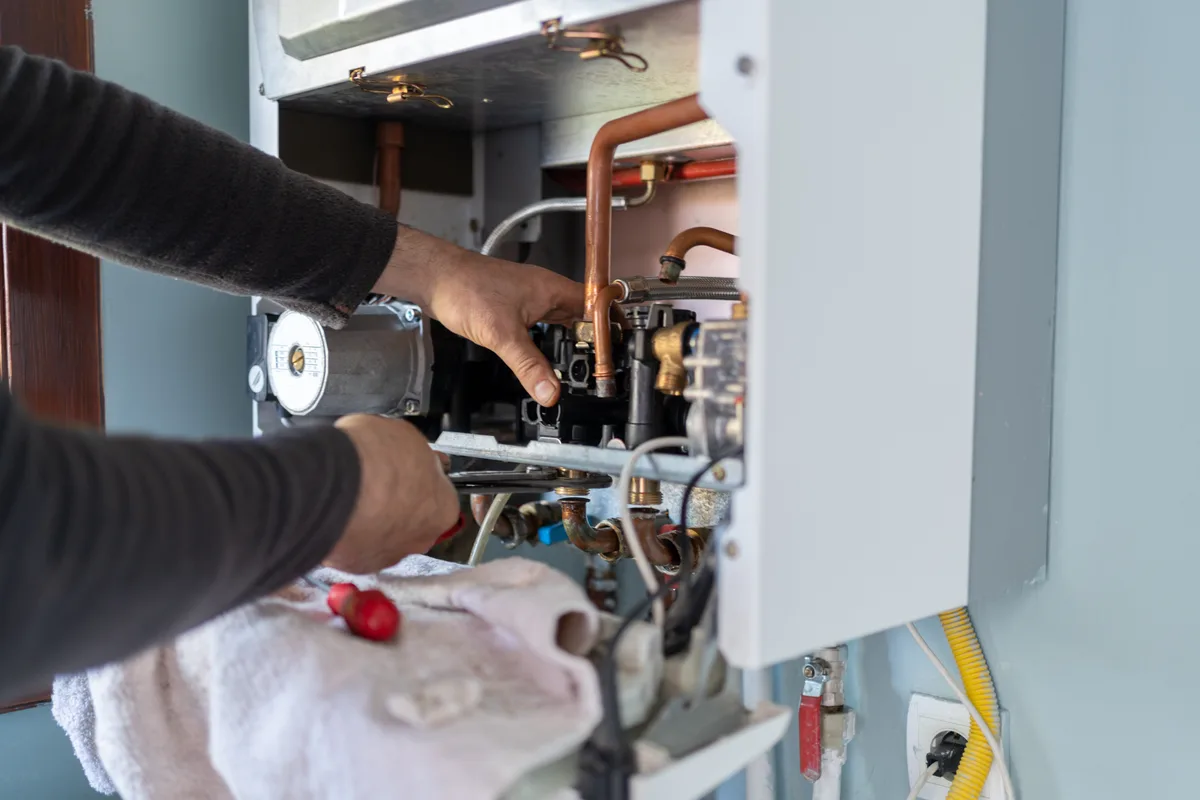
KeepRite is one of several nameplates built by International Comfort Products, which has been part of Carrier for more than two decades. That matters more than the badge on the door: the furnace behind a KeepRite panel shares its cabinet, control platform and nearly all of its wear parts with Tempstar, Heil, Comfortmaker and Day & Night. When a counter tells you a KeepRite part is on backorder, the identical component is often sitting on the shelf under one of those other names.
In Halton we find KeepRite most often in 1990s and 2000s subdivisions — Millcroft, Alton Village, the newer streets above Waterdown — where the builder fitted a mid-tier gas furnace and a matching condenser as a package. Those systems are now fifteen to twenty-five years old, which is precisely when inducer motors, igniters and boards start asking for attention. The condensing models also carry a condensate trap that silts up over the years and, in an unheated Aldershot crawlspace or an attached garage, can freeze solid overnight and lock the furnace out before you wake up.
We are not enrolled in any manufacturer's dealer program, KeepRite included. We buy these parts through GTA wholesalers exactly the way we buy Carrier or Lennox parts, and we will tell you plainly when a repair is no longer worth doing on a furnace near the end of its life. If you want to see the same control family from the other side of the badge, our Carrier furnace repair page covers it.
For replacement, a high-efficiency KeepRite changeout sits in the same range as any comparable brand at the same tier: $4,500–$7,500 for a straightforward swap, with the rebate paperwork handled for you. The GTA furnace cost guide explains what moves that number — venting changes, new sheet-metal transitions, and whether the existing gas and electrical suit the new unit.
KeepRite lines we install and service
The top tier links a modulating furnace, a variable-speed condenser and a communicating wall control over a data bus. The benefit for you is that faults read out in plain language at the wall control instead of as blink codes behind a sight glass in the basement. The trade-off is that the system wants matched components — a generic thermostat will not talk to it, and swapping one part often means matching the other.
These fire anywhere across their range instead of stepping between two fixed rates, so they run long and quiet at low fire through most of a Burlington winter. They suit a well-sealed 2000s house with decent ductwork. They are the least forgiving of undersized returns, because a modulating burner paired with a strangled return will spend its life tripping the high limit.
The volume seller and, in our view, the sweet spot for most Halton homes. Low stage covers the shoulder season, high stage handles a cold snap, and the ECM blower gives you quiet continuous fan for air filtration. Parts for this tier are the easiest of the whole line to source in the GTA.
A basic condensing furnace with a multi-speed blower — fewer electronics to fail and the lowest install price of the family. It is a sound choice for a rental, a small bungalow or a house you plan to sell within a few years. You give up the comfort refinement and some of the fan-mode efficiency.
Single-stage, two-stage and variable-speed condensers that pair with the matching indoor coil and blower. The heat pump versions can be set up as a dual-fuel system with the gas furnace as backup, which is the sensible retrofit for a house that already has good ductwork. Ask us to confirm the model against the current Ontario rebate list before you commit.
What goes wrong on KeepRite equipment
Pressure switch open — a plugged or frozen condensate trap
The inducer spins, the furnace hesitates, and it locks out without lighting. On condensing KeepRite furnaces the usual cause is the condensate trap and the inducer drain port silting up, or the drain freezing where it runs through an unheated space. The fix is clearing the trap, flushing the drain line, correcting the slope and re-routing anything exposed to freezing. Expect a repair in the $150–$450 range.
Cracked hot surface igniter
You hear the sequence start, the inducer run, the gas valve click, and then nothing but a retry. Silicon carbide and nitride igniters are brittle and fail from thermal cycling, usually without any visible crack. Replacement runs $200–$450 depending on the igniter type and how buried it is in the burner assembly.
Flame sensor coated with oxide — burner lights then drops out
The burner ignites, you get flame for a few seconds, then it shuts off and tries again, three times, before a hard lockout. The flame rod has built up a film that blocks the tiny rectification current the board is looking for. Cleaning or replacing the sensor and correcting the ground path is a $150–$300 repair and one of the most common no-heat calls we take in January.
Draft inducer bearings
A whirring, grinding or rattling noise at the start of every cycle, sometimes with intermittent pressure switch faults as the wheel slows. Inducer assemblies are a wear item on units past fifteen years. Replacement is a $400–$900 job, which is a real fork in the road on an older furnace — we will give you the repair-versus-replace math before we order the part.
KeepRite warranty: what to know
- Coverage is registration-based. Register the model and serial on the manufacturer's registration page within the window printed on the warranty certificate that shipped with the unit — on this equipment it has commonly been 90 days from installation — or the parts term drops to the shorter unregistered length.
- Registration is the homeowner's job and it is not automatic. We print the model and serial on your invoice so you have them in one place; the rating plate inside the burner door carries the same numbers.
- The heat exchanger is covered for longer than the rest of the parts, and on the premium models that coverage can run as long as the original registered owner stays in the house. Those terms have been rewritten more than once, so the certificate matched to your model and installation date settles it — not a number on a web page.
- The manufacturer term covers parts, not people. A covered board or igniter still means a paid service call — diagnostics, labour and refrigerant are billed by the contractor unless you separately bought a labour warranty in writing.
- What voids it: installation or gas work by someone without a TSSA licence, running the furnace during construction without a filter, moving the unit to a different address, and damage traced to a system that was never maintained.
Parts availability in the GTA
Parts are the easy part of owning a KeepRite. Because the same chassis is sold under several ICP nameplates, a Tempstar or Heil part number normally cross-references straight to the KeepRite one, so a wholesaler who is out of the branded box can usually still get you running the same day. Igniters, flame sensors, pressure switches, capacitors, limit switches and common single-stage control boards are shelf stock at the supply houses along the Burlington–Mississauga corridor, and the fast-moving ignition parts travel with us, so most no-heat calls on this line are settled in a single visit. The exceptions are communicating Ion boards, modulating gas valves and variable-speed blower modules, which are model-specific and occasionally sit a day or two on order — if you are without heat we will tell you that up front and talk through safe temporary heat while we wait.
KeepRite Furnace Error Codes Explained — what each one means and whether it is safe to keep running.
Common questions
Will you repair a KeepRite furnace we did not buy from you?
Yes — most of the KeepRite work we do is on equipment somebody else installed, usually the builder. Bring us the model and serial from the rating plate and we can look up the parts before the truck rolls. Book through our contact page or call the shop.
Is KeepRite the same furnace as Tempstar, Heil or Comfortmaker?
Functionally, yes, at the same tier. All of them come out of International Comfort Products under Carrier, sharing cabinets, controls and wear parts, with differences in trim, badging and the warranty paperwork. That is good news for repair cost and part availability, and it is why cross-referenced parts are a normal, legitimate part of servicing this line.
Where does a KeepRite furnace show its fault code?
On most models a small LED behind the sight glass in the burner door flashes a repeating pattern, and the legend for that pattern is printed on the inside of the door panel. Communicating Ion systems display the fault as text at the wall control instead. Our KeepRite furnace error code guide walks through what the common patterns mean and which ones are safe to wait on.
Is a 15-year-old KeepRite worth repairing?
It depends on which part failed and what else is tired. A flame sensor or igniter on an otherwise sound furnace is easy money; a $400–$900 inducer or a cracked heat exchanger on the same unit is not. We work through it honestly with you — the reasoning is laid out in our guide on repairing or replacing a 15-year-old furnace.
Do you service KeepRite air conditioners too, or only the furnace?
Both, and usually in the same visit when the timing works out. The matched condenser is the same age as the furnace, shares the same thermostat and blower, and a capacitor or contactor there is a fast fix. For a no-cooling call in Burlington, start at our furnace and HVAC repair service in Burlington page or call the 24/7 line.