
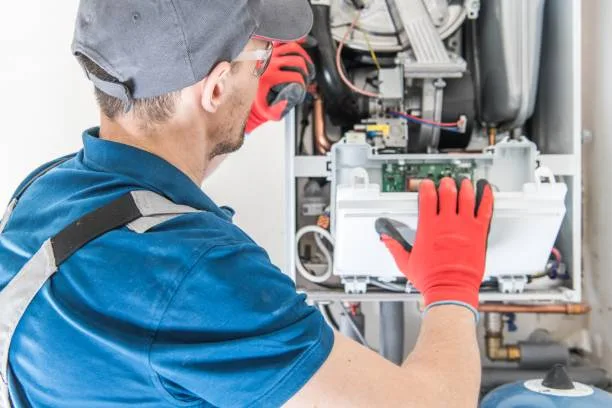
At 15 years a gas furnace is at the practical end of its life in the GTA, so the decision comes down to which part failed. Repair it when the fault is a wear item — flame sensor, igniter, capacitor, pressure switch, condensate trap — and the rest of the unit tests clean. Replace it when the failed part is the heat exchanger, the gas valve, the control board or the blower motor, or when any single repair passes half the price of a comparable new furnace.
The 50% rule, applied to real GTA numbers
A comparable high-efficiency replacement lands at $4,300 to $7,000 installed across most of the GTA, so half the low end is a shade over $2,000. Any single repair past that number on a 15-year-old unit fails the test. The textbook case is a cracked heat exchanger: $1,500–$3,000 in parts and labour on most furnaces, and that money is better put toward equipment that isn't already 15 winters deep.
Efficiency stacks on top of the repair math. If yours is a mid-efficiency unit venting into a chimney, you are burning roughly one dollar in six more than a condensing furnace would — every gas furnace sold in Canada now has to meet a 95% AFUE minimum. If yours is already a 90%+ condensing unit, that gap shrinks and the repair case gets stronger.
Repair it when the failed part is on this list
- Flame sensor cleaning or replacement: $150–$300 — a consumable that oxidises every season and causes more no-heat calls than anything else on the furnace
- Hot surface igniter: $200–$450 — silicon nitride igniters crack from thermal cycling; the swap is under an hour and says nothing about the rest of the unit
- Capacitor or pressure switch: $250–$500 — wear items, unrelated to the age of the heat exchanger
- Condensate trap or drain blockage on a condensing furnace: $150–$350 — housekeeping, not end of life
- Thermostat fault: fix the thermostat. A furnace that won't call for heat is not a furnace that has failed.
Replace it when you see one of these
- Cracked heat exchanger: $1,500–$3,000 — a safety failure and, at this age, the end of the conversation
- Blower motor: $500–$1,500 depending on ECM versus PSC — repairable, but that is a fifth to a third of a new furnace going into a 15-year-old cabinet
- Control board $500–$1,200 or gas valve $500–$1,000 — one is bad luck; two in the same season is a failure cascade
- Draft inducer motor: $400–$900 — genuinely borderline. Repair it if you need to get through this winter, replace if you can choose your timing.
- Rust streaks under the burner box, soot on the burner faces, or a flame that lifts and rolls out toward you when the blower starts
The five-signs test we use at the kitchen table
- Gas bills climbing year over year with no change in thermostat habits
- Rooms that were merely cool are now cold, and the imbalance is getting worse each season
- Two or more service calls in the past 24 months
- The furnace is short-cycling or the limit switch is tripping on a normal day
- Any major component has already failed once
One item on that list is a repair conversation. Two or more, at 15 years, and replacement is the cheaper answer over any horizon longer than a season. Skipped filter changes, poor duct design and a furnace that was never serviced are what push a unit toward the short end of its expected life in the first place.
Free quotes, written pricing.
The chimney problem nobody mentions until install day
If your 15-year-old furnace is a mid-efficiency unit sharing a masonry or B-vent chimney with an atmospheric tank water heater, swapping it for a condensing furnace that vents out the side wall in PVC leaves the water heater alone on a flue sized for two appliances. Under CSA B149.1 that flue has to be resized or lined, or the water heater has to move to a power-vent or tankless unit.
This is routine in 1960s–80s houses in Hamilton, Aldershot and older Burlington streets, and it belongs in the written quote rather than as a surprise on install day. If the tank is also near the end of its life, doing both appliances together is usually the cheaper path — see what it costs to replace a water heater.
What a new furnace costs in 2026 — and what rebates actually cover
GTA furnace replacement runs $4,300 to $7,000 installed depending on efficiency tier, venting work and how much sheet metal has to change. Our GTA furnace cost guide breaks the line items down.
Direct gas-furnace rebates are thin. Ontario's Home Renovation Savings Program, launched in January 2025 through Enbridge Gas and Save on Energy, is aimed at heat pumps and building envelope work; a smart thermostat has a small rebate of its own, at an amount that depends on the channel. The Canada Greener Homes Grant closed to new applicants and Enbridge's HER+ has ended, so discount any quote that leans on either. The current Ontario rebate picture is worth reading before you sign.
The dual-fuel option that defers the whole decision
If the furnace is mechanically sound but old, one option is to install a heat pump now and keep the existing furnace as backup until it genuinely fails. That captures the program money available for heat pumps — $500–$7,500 depending on the system — moves the long shoulder seasons onto electricity, and pushes the new-furnace spend out several years. It only works if the heat exchanger passes inspection, so that inspection comes first. See heat pump vs. furnace.
Get both numbers before you decide
ZK Mechanical quotes the repair and the replacement side by side whenever both are genuinely viable, with the heat exchanger inspection result written down either way. See what our furnace repair service covers, or book an in-home assessment anywhere in the GTA and Hamilton.
Frequently asked questions
Is it worth repairing a 15-year-old furnace?
It is worth repairing for wear items — a flame sensor at $150–$300, an igniter at $200–$450, a capacitor or pressure switch at $250–$500. It is not worth repairing when the heat exchanger, gas valve, control board or blower motor has failed, because those repairs run past half the price of a new furnace. That is the 50% rule: if one repair exceeds half of replacement cost, replace.
How long does a furnace last in Ontario?
A well-maintained gas furnace in Ontario typically lasts 15 to 20 years. Annual professional maintenance can extend lifespan toward the upper end of that range. Furnaces in homes that skip filter changes, run with poor ductwork, or have never been serviced typically fail closer to 12–15 years.
Can I get a rebate for replacing my old furnace?
Not much of one for a gas furnace on its own. Ontario's Home Renovation Savings Program is aimed at heat pumps and envelope upgrades, though a smart thermostat can earn a small rebate whose amount depends on the channel. The larger opportunity is pairing a heat pump with the furnace as backup, which draws on program amounts of $500 to $7,500 depending on the system. Check the program page for current eligibility.
What signs mean it's time to replace, not repair?
Five signs: (1) age over 15 years, (2) energy bills rising year over year, (3) two or more service calls in the past 24 months, (4) uneven heating that's getting worse, (5) any major component failure (heat exchanger, control board, blower motor). If two or more apply, replacement is almost always the better long-term move.
Should I replace the furnace and the water heater together?
Often yes, if the old furnace is mid-efficiency and shares a chimney with an atmospheric tank. Moving to a condensing furnace that vents in PVC orphans that water heater on an oversized flue, which then has to be lined or the tank converted to power-vent. Doing both at once avoids paying twice for venting work and for any permit and inspection the job needs.