
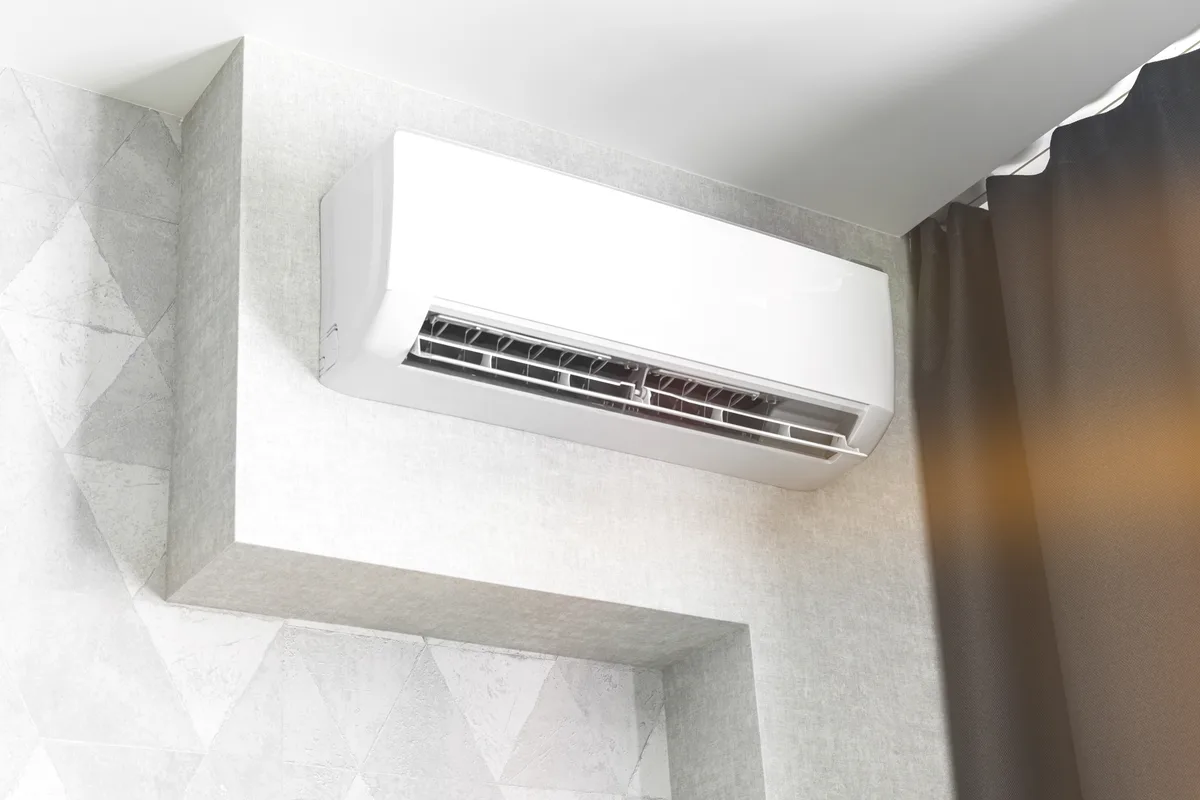
Work out which generation of Samsung you own, because the readout changed three times. Older wall units have no numbers at all: a row of small lamps on the indoor unit (Operation, Timer and a third lamp such as the ion or clean indicator) flash in combinations. Samsung's service booklet decodes them as a pattern of off, blinking and steady across those three lamps, and the pattern table is specific to the model, so do not borrow one from a different unit. If your head has lamps and no digits, write down which lamps blink and which stay solid.
Units with the two-digit display hidden behind the front panel show the code in two flashes, which is why Samsung's own support pages write it as E1 or 21. Put the halves together and you have the three-digit number used in the table below. On some model years the first character is a C in place of the E, so C154 and E154 are the same indoor fan fault. Ducted and cassette units with a wired wall controller show a warning icon; pressing the Test button on that controller brings up the bare three-digit number.
Codes vary by model, and no single list covers every Samsung unit sold in Canada. The service manual for your model number, and any label inside the indoor unit's front panel or the outdoor unit's service cover, win over this page. Other ductless makes use different schemes entirely, so compare with the LG mini-split code guide only if you have mixed equipment. A head that is flashing without showing any code is covered in why a mini-split light blinks, and the full list of makes is on the brands hub.
Samsung mini-split heat pump codes, decoded
| Code | What it means | Safe? | Try first | When to call |
|---|---|---|---|---|
CF | Filter cleaning reminder. The run-hours counter has reached its limit; nothing has failed. | keep running | Slide the mesh filters out, rinse them, let them dry and reset the reminder from the remote. | Not needed. |
dF | Automatic defrost. In heating mode the outdoor coil is melting frost, and the indoor fan pauses while it does. | keep running | Wait it out. Steam rising off the outdoor unit during defrost is normal. | Only if the outdoor unit stays encased in ice after several defrost cycles. |
E101 / E102 | Indoor unit communication error (E101) or indoor-outdoor communication time-out (E102). The indoor board is hearing nothing from outside. | turn it off | Check the outdoor disconnect and the breaker, then switch the breaker off for five minutes and back on. | If it returns after one power reset. The interconnecting cable, a terminal or a board has failed. |
E121 | Indoor room temperature sensor open or short. The head cannot read the room. | turn it off | Power it down at the breaker for five minutes and try again once. | If the code is still there. The sensor or its plug on the indoor board is replaced. |
E122 | Indoor evaporator-inlet (pipe) temperature sensor open or short. | turn it off | Nothing at home beyond a single breaker reset. | Book a repair. The coil sensor protects against freeze-up and has to read correctly. |
E153 | Indoor float switch, second detection. On ducted and cassette units the condensate level has risen and tripped the safety float. | turn it off | Leave it off so the pan does not overflow through the ceiling. | Promptly. The drain line or the lift pump is blocked or has failed. |
E154 | Indoor fan error. The board is commanding the blower and not seeing it turn at speed. | turn it off | With power off, check that nothing has fallen into the louvre and that the filters are not matted. | If it reappears within seconds of restarting. Samsung's guidance is that a constant E154 means the fan motor or the indoor board. |
E162 / E163 | Indoor EEPROM or option-code data error. The settings stored on the indoor board are missing or corrupt. | turn it off | Nothing at home. | Book a repair. The option codes are re-entered with a service remote, or the board is replaced. |
E202 | Indoor-outdoor communication error lasting one minute. The outdoor side has lost contact with the indoor unit. | turn it off | Make sure every indoor head on the system has power, then cycle the breakers once. | If the code survives the reset. Wiring faults after renovation work are a frequent cause. |
E203 | Communication error between the outdoor main board and the inverter board. | turn it off | Nothing at home. | Book a repair. This is inside the outdoor unit's electrical box and carries high DC voltage. |
E221 | Outdoor air temperature sensor error. | turn it off | Brush snow away from the back and sides of the outdoor unit. | If the code stays. The sensor is checked for position and resistance, then replaced. |
E251 | Compressor discharge temperature sensor error. | turn it off | Nothing at home. | Book a repair. The system will not run the compressor blind. |
E416 | Discharge over temperature. The gas leaving the compressor is hotter than the limit. | turn it off | Clean the indoor filters and clear leaves, lint or snow off the outdoor coil. | If it repeats with clean filters and a clear coil. Low refrigerant charge is the usual finding. |
E440 / E441 | Heating operation blocked (E440) or cooling operation blocked (E441). The outdoor unit is refusing the requested mode. | keep running | Confirm the remote is set to the mode you meant for the weather outside. | If the setting is right and it persists. Samsung's checklist is the operation setting first, then the temperature sensors. |
E458 | Outdoor fan error. | turn it off | With the breaker off, look through the grille for ice, a branch or a toy jammed against the blade. | If the blade is free and it will not start. The fan motor or the outdoor board has failed. |
E461 | Inverter compressor starting error. | turn it off | Leave it off. Repeated start attempts are hard on the compressor. | Book a repair. Compressor wiring and winding resistance are tested before any board is blamed. |
E464 | Inverter IPM over-current. The power module driving the compressor saw more current than it allows and shut down. | turn it off | Clear anything crowding the outdoor unit and wash the indoor filters, then restart once. | If it trips again. Samsung's checks are refrigerant charge, compressor connections, airflow and a closed service valve. |
E466 | DC link over or low voltage. The outdoor unit's supply voltage is out of range; Samsung notes it restarts after three minutes. | keep running | Note whether the lights flickered or a storm passed through when it appeared. | If it keeps recurring on a calm day. The supply connection or the inverter board needs testing. |
E554 | Gas leak error. The system's self-check has decided the refrigerant charge is gone or not circulating. | turn it off | Leave it off. Running a compressor without refrigerant destroys it. | Book a repair. Finding the leak and recharging is work for a technician holding an ODP card. |
E556 | Capacity mismatch. The indoor and outdoor units do not agree on size, normally after a board swap or a new install. | turn it off | Nothing at home. | Call the installer first if the system is new; otherwise book a repair to have the option codes corrected. |
The codes that usually mean a real repair
E554 or E416: refrigerant charge
A Samsung that throws E554 has failed its own leak check, and E416 is often the earlier warning from the same shrinking charge. Topping up without finding the hole just schedules the next visit, so the job is a leak search, a repair, a vacuum and a weighed recharge. Refrigerant leak repair and recharge runs $300–$800+, and finding the leak costs more than the refrigerant itself. One caution from Samsung's own checklist: a closed service valve or crossed piping on a multi-zone install produces the same code, so a brand-new system showing E554 goes back to the installer.
E154 or E458: fan motors
Each unit has one fan and one code for it: E154 indoors, E458 outdoors. In an Ontario winter the outdoor fan is more often blocked than broken, with ice built up under a unit that sits too low or drains badly, and clearing it costs nothing. When the motor has failed, a condenser or blower fan motor is $300–$700 in parts and labour, depending on the motor type. Indoor motors take longer to reach because the head has to come apart around the drain pan.
E464, E461 or E203: inverter and control boards
These are the expensive-sounding codes, and half the time the board is reporting a problem somewhere else: low charge, a choked coil or a loose compressor lead. That is why Samsung lists refrigerant, airflow and wiring checks ahead of the board. When the inverter or main board has failed, control board replacement is $400–$800. The diagnostic visit is $90–$150, folded into the repair if you proceed, and on a unit past twelve years old it is worth pricing the board against a replacement; our heat pump repair service gives you both numbers in writing.
Licensed technicians, a written price before the repair, no overtime charges.
Common questions
Why does my Samsung mini-split show E1 and then two other digits?
Because the display can only show two characters. Samsung splits each three-digit code into halves and blinks them one after the other, so E1 followed by 01 is E101 and E4 followed by 64 is E464. Watch a full cycle before writing it down, since reading only the second half sends you to the wrong fault.
My Samsung has blinking lights and no numbers. How do I read it?
That is the older lamp-only generation. Note the state of each lamp on the indoor unit: off, blinking or solid. Samsung's service documents map those combinations to faults, and the map differs between models, so a chart for another unit can mislead you. A photo or short video of the lamps is the most useful thing you can send before a mini-split repair visit.
How do I reset a Samsung mini-split after an error code?
Turn the unit off at the remote, switch off its breaker, wait five minutes and switch it back on. That clears a passing communication or voltage fault. Do it once. A code that returns straight away is a real fault, and repeatedly restarting a system showing E461, E464 or E554 risks the compressor, the most expensive part in the unit.
Is E101 serious on a Samsung mini-split?
It stops the system, but the cause is often small. E101 means the indoor unit is not receiving data from the outdoor unit. A tripped outdoor breaker, a disconnect left off after yard work, or a power flicker will all do it. If power is confirmed at both ends and a five-minute reset does not clear it, the cable or a board needs testing.
Does Samsung's warranty cover these faults?
It depends on the model, the install date and whether the unit was registered, so check the warranty card or Samsung's Canadian support line with your serial number. Manufacturer warranties generally cover parts and leave labour and refrigerant to the owner. We service Samsung ductless systems on a diagnose-and-quote basis; get in touch with the model number and the code.