
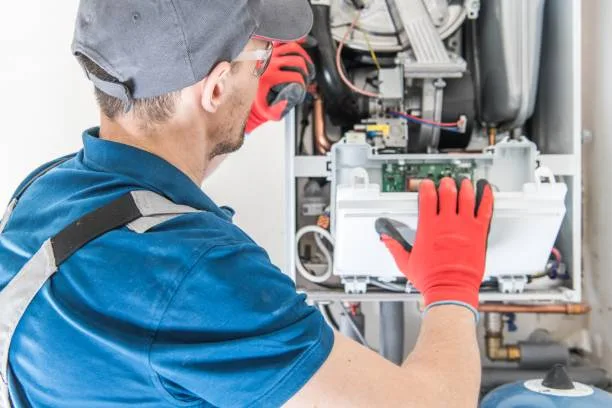
The first thing to clear up is what York furnaces do not have: a screen. Every current York residential gas furnace — single-stage, two-stage and modulating — reports faults by flashing one tri-colour LED a number of times. Lists that show York furnace codes as letter-and-number pairs are describing outdoor heat pump equipment, which genuinely does use two seven-segment displays, or they are describing a communicating thermostat rather than the board. If you are holding a code like that, you are looking up the wrong appliance.
The second thing matters more, and almost every code list online gets it wrong. York uses two different, incompatible code sets, and the split is by burner staging rather than by brand. Single-stage and two-stage furnaces in the LX and Latitude families — TM9E, TM9V, TM9Y, TG9S — use one table. Modulating Affinity furnaces such as the YP9C use another. Six red flashes means a pressure switch that has opened repeatedly on a two-stage furnace and a modulating gas valve fault on a YP9C. Four amber means a thermostat wiring issue on one platform and reduced heating capacity from restricted airflow on the other. Check which furnace you have before you trust any number.
The table below covers the two-stage and single-stage platform, which is what sits in most Ontario basements. Count the flashes through the clear port in the lower door — the LED pulses about a quarter-second on and a quarter-second off, then holds off for two seconds before repeating, so start counting after the long pause. Codes vary by model and the diagnostic label inside the furnace panel is the authority: where this page and that label disagree, the label wins. For what we carry and check on these units, see our York furnace repair page, or ask us to decode it with you.
York furnace codes, decoded
| Code | What it means | Safe? | Try first | When to call |
|---|---|---|---|---|
Slow green flash | Normal operation with no call from the thermostat. | keep running | Nothing. This is the idle state you want. | Not needed. |
Slow amber flash | Normal operation with a call for heat present. | keep running | Nothing. | Not needed. |
LED off | No power reaching the board, or the board fuse has blown. If power and fuse are good, the board itself may be finished. | turn it off | Check the service switch, door switch and breaker. | If the board has power and the LED never lights. |
Steady on, any colour | Control failure. Cycling power sometimes clears it; if it returns, the board needs replacing. | turn it off | Cycle power once at the service switch. | If the steady light comes back. |
Continuous amber flash | Flame sense current has dropped below the board's threshold. The furnace still runs, but it is warning you. | keep running | Book service before it becomes a lockout. Do not sand the sensor. | Soon. This is the warning that precedes seven or eight red. |
1 red | Flame sensed with no call for heat — usually a gas valve leaking through or closing too slowly. | call now | Switch the furnace off and leave the gas alone. | Immediately. Gas past a closed valve is a safety fault. |
2 red | Pressure switch found closed when it should have been open. | turn it off | Nothing at home. A stuck switch bypasses a venting safety. | Right away. |
3 red | Pressure switch contacts open when they should be closed — venting or termination problem. | turn it off | Walk outside and clear snow or ice off the vent terminations. | If the terminations are clear and it still shows three. |
4 red | Main limit switch opened. Five opens within one call for heat sends the furnace into a one-hour lockout. | turn it off | Fit a clean filter and open any registers that were closed off. | If it repeats once airflow is restored. |
5 red | Rollout switch opened, or the limit stayed open more than fifteen minutes. This is a hard lockout needing a power cycle. | call now | Shut it off. Do not reset the rollout switch and walk away. | Immediately. Rollout means combustion escaped the burner box. |
6 red | Pressure switch opened four times during one call for heat, so the board locks out for an hour and then restarts. | turn it off | Look for a blocked drain, a full trap, or an iced termination. | Yes, before the hourly retries stop working altogether. |
7 red | Flame could not be established across three trials for ignition. One-hour lockout. | turn it off | Verify the gas is on and the valve at the furnace is open. | Same day when the house is cold. The commonest no-heat code. |
8 red | Flame was lost five times during the heating cycle, so the board locks out for an hour. | turn it off | Swap a dirty filter, then leave it through the timeout. | Soon. Flame that lights then dies points at the sensor or gas supply. |
9 red | Reversed line-voltage polarity, a grounding problem, or the low-voltage transformer wires reversed. | turn it off | Nothing at home — this is electrical work. | Yes. Common after an install, a move or panel work. |
10 red | Gas valve energized with no call for heat. | call now | Kill power at the service switch beside the furnace. | Immediately, for the same reason as one red. |
11 red | Limit circuit open more than five minutes — typically a failed blower motor or a jammed blower wheel. Hard lockout. | turn it off | Listen for a motor humming without the fan turning, then shut it down. | Right away. A stalled motor drawing current gets hot fast. |
13 red | Second-stage high-fire pressure switch open when it should be closed. Appears on two-stage models only. | turn it off | Check the vent terminations, then note whether the house keeps up. | If the furnace cannot hold temperature on cold nights. |
4 amber | The thermostat is sending a cooling signal without a fan signal. The furnace still heats and cools normally — the code flags the wiring. | keep running | Nothing urgent. Mention it at your next visit. | At your next service call, not as an emergency. |
The codes that usually mean a real repair
Seven red — three failed trials for ignition
This is the York code that puts a house without heat overnight. The board tried three times to establish flame, never proved it, and locked out for an hour. In the field the two parts responsible are almost always the hot surface igniter, which is $200–$450 replaced, or the flame sensor at $150–$300. A useful clue costs you nothing: if the amber light had been flashing continuously for weeks beforehand, the flame sensor was already reading low and that is where to start. If nothing glows at all during a start attempt, suspect the igniter or its circuit.
Four and eleven red — limit trips and a tired blower
Both codes come from heat building faster than the blower clears it, but they mean different degrees of trouble. Four red is the limit doing its job on a restricted system, and the fix is usually free: a fresh filter, registers opened, a return grille unblocked. Eleven red is the serious one — the limit stayed open past five minutes, which on a York points at a blower motor or wheel that has stopped moving air. A blower motor replacement runs $500–$1,500 depending on whether it is a standard motor or a variable-speed ECM. Hamilton Mountain and Westdale houses with finished basements and undersized returns generate more of these calls than newer builds do.
Three and six red — venting, drains and the pressure switch
On a condensing York the pressure switch codes usually report a blocked path rather than a failed part. The condensate trap fills with sediment, a drain line backs up, or the side-wall terminations glaze over during the freeze-and-thaw weeks we get off Lake Ontario. Clearing or replacing a plugged trap runs $150–$350, and a pressure switch sits in the $250–$500 band. Have it diagnosed rather than guessed: a new switch fitted to a blocked vent fails again almost immediately, and you will have paid for the part twice.
Licensed technicians, a written price before the repair, no overtime charges.
Common questions
My York furnace shows a code with a letter in it. What does it mean?
It almost certainly did not come from the furnace. York residential gas furnaces report faults only by flashing a single tri-colour LED — there is no alphanumeric display on the board. Letter-and-number codes on York equipment come from outdoor heat pump controls, which do use seven-segment displays, or from a communicating thermostat showing its own message. Work out which device you actually read the code from before chasing a part, because the two vocabularies have nothing in common.
Does six red flashes mean the same thing on every York furnace?
No, and this trips up more people than any other York code. On single-stage and two-stage furnaces such as the TM9E and TM9V, six red means the pressure switch opened four times during one call for heat. On a modulating Affinity furnace like the YP9C, six red is a fault in the modulating gas valve circuit. Four amber splits the same way: a thermostat wiring flag on one platform, a reduced-capacity warning from restricted airflow on the other. Identify your model number first, then read the code.
How do I see past fault codes on a York furnace?
York boards keep the last five codes and retain them through a power loss. There is a last-error button on the control that plays them back when there are no active thermostat calls — press and release, and the codes flash out most recent first with a gap between each. Two green flashes means there are no stored codes at all. Holding the same button for more than five seconds clears the memory and confirms with three green flashes, so leave that alone until after a technician has read it.
Is a Luxaire or Coleman furnace the same as a York?
For code purposes, yes. Johnson Controls builds all three, and a single installation manual covers the modulating furnaces across the York, Coleman, Luxaire and Tempstar-badged versions. On the two-stage line the model designation does not even change between brands. What actually determines which code table applies is whether the furnace is single-stage, two-stage or modulating — not the badge on the door.
The furnace locked out and restarted by itself an hour later. Is that fine?
It means the timeout expired, not that the fault was fixed. Codes six, seven and eight on a York are one-hour lockouts, and the board retries whether or not anything changed. Five and eleven red are hard lockouts and will not clear on their own, which is the board telling you it does not want to try again unattended. A furnace surviving a cold week on hourly retries will quit properly on the coldest night, so get it looked at while it is still a scheduled visit — our furnace repair service runs a 24/7 line with no overtime surcharge, and same-day repair explains how the scheduling works.