
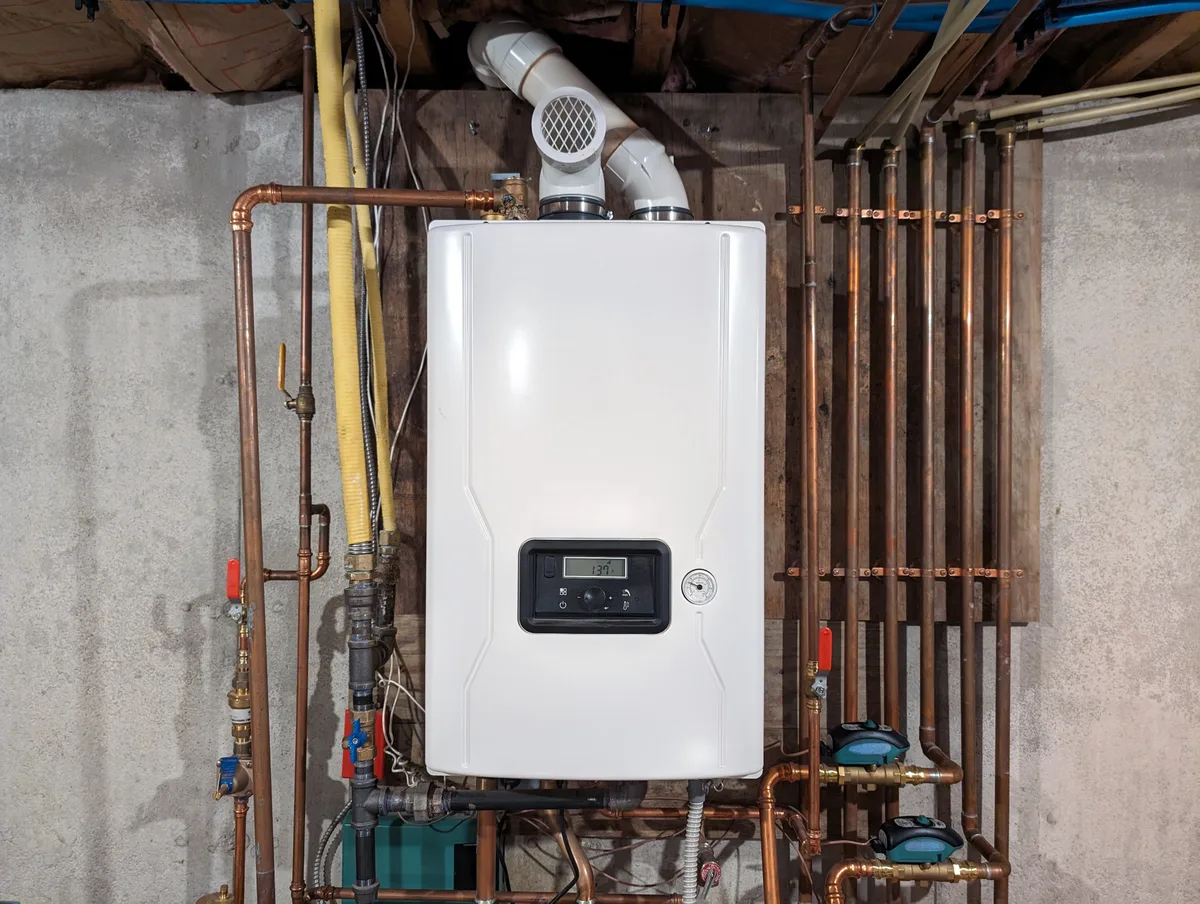
Bosch's current condensing line — the Greentherm 9000 series, covering the T9800 SE and T9900 SE and SEi — shows the code on a colour touch display on the front of the unit, so nothing needs opening to read it. That display also keeps a history: under the information menu there is a failure history screen holding the last ten error codes, with an ellipsis shown when nothing has gone wrong. To clear a code from the display you press and hold the on-off button for more than three seconds.
Two warnings send more people down the wrong path on this brand than on any other. First, Bosch's Greenstar boilers use an entirely different code set, and boiler pages dominate search results — a code you found on a boiler page does not transfer to a water heater. Second, Bosch's older Therm line uses the same characters with different meanings: on a Greentherm, E9 is a broken thermal fuse and F7 is an internal control error, while on a Therm C 1210 the same two codes mean an open overheat sensor and an ionisation error at standby.
So check the model number on the rating label before you trust any table, this one included. Codes vary by model, and the label inside your own front cover is the authority. The table below is the current Greentherm set. Bosch equipment detail sits on the Bosch repair page, the equivalent list for another common make is the Navien code guide, and on-demand work generally is under tankless water heater service.
Bosch tankless water heater codes, decoded
| Code | What it means | Safe? | Try first | When to call |
|---|---|---|---|---|
A1 | Air temperature inside the cabinet is above 70 °C. The unit derates itself to protect against overheating. | turn it off | Check the space around the unit is ventilated and nothing is stacked against it. | Call if it returns in a normally ventilated room — the fault is then internal. |
A3 | Flue gas temperature sensor disconnected or damaged. | turn it off | Kill the power at the switch. The cabinet interior is technician-only. | Call. Flue-side sensing is a safety function rather than a comfort one. |
A6 | Inlet cold water temperature sensor disconnected or damaged. | turn it off | No safe homeowner step; power it off and record what was showing. | Call — the unit modulates against inlet temperature, so output will wander. |
A7 | Heat exchanger hot water temperature sensor disconnected or damaged. | turn it off | Turn it off. Without this reading the unit cannot protect the exchanger. | Call. Sensor replacement is usually a single visit once confirmed. |
A8 | Outlet hot water temperature sensor disconnected or damaged. | turn it off | Shut it down. Outlet temperature control is what prevents scalding. | Call before anyone uses a tap — scald protection is compromised. |
AA | Condensing flue temperature above 200 °C or exhaust temperature above 63 °C. The unit derates to protect itself. | turn it off | Turn it off and check the vent terminal outside for ice, snow or a nest. | Call. Climbing flue temperature usually means scale or a restriction. |
AD | Flue blockage detected at startup from insufficient combustion air; the unit derates. | turn it off | Shut it down and inspect the outdoor terminal. | Call — a derating unit is warning you before it locks out. |
C1 / C2 | Excessive flue blockage at startup — the unit shuts down for safety. | call now | Leave it off. Check the vent terminal outside, then leave the unit alone. | Call immediately. A blocked flue is a combustion-products problem. |
C7 | Fan disconnected or damaged. | turn it off | Shut it down and leave the cover in place. | Call — the unit must not fire without the correct combustion airflow. |
C8 | Main water valve disconnected or damaged. | turn it off | No homeowner fix. Power the unit down. | Call. Water-side valves are diagnosed with the unit open. |
CE | Excessive flue blockage during operation from pressure on the siphon; the unit shuts down. | call now | Turn it off and check the condensate siphon area for standing water. | Call immediately rather than clearing and restarting. |
CF | Excessive flue blockage during operation from insufficient combustion air; shutdown. | call now | Shut it down and check the outdoor terminal for an obstruction. | Call immediately — this is the operating-mode version of C1. |
E1 | Hot water above 90 °C. The burner is cut off to prevent scalding until it cools. | turn it off | Turn it off and warn the household before anyone runs a tap. | Call. Scald risk is the immediate concern here. |
E3 | Flue gas temperature above limit, or too long above 63 °C. The burner is cut off. | call now | Keep it off, then look at the outside vent hood if you can see it. | Call right away; flue heat that high means combustion trouble or heavy scale. |
E4 | Cabinet air above 80 °C, or too long above 70 °C. The burner is cut off. | call now | Shut it down and leave the area ventilated. | Call immediately. A cabinet this hot is not a wait-until-Monday fault. |
E9 | Thermal fuse broken. | call now | Switch it off and resist resetting it just to get a shower. | Call immediately. A thermal fuse does not fail without a cause worth finding. |
EA | Ignition failure. | turn it off | Check the gas supply is on and other gas appliances work. Reset once only. | Call if it repeats rather than forcing further ignition attempts. |
EC | Flame lost during operation. | turn it off | Check whether the furnace or range lit at the same instant. | Call — losing flame under demand implicates gas volume, venting or the rod. |
EF | Wrong gas connected for the appliance's current configuration. | call now | Turn it off and close the appliance gas valve. | Call immediately. Running on the wrong fuel is dangerous. |
FA | Gas leakage in the gas path — the gas valve or the manifold shut-off valves. | call now | Turn it off, isolate the gas, and do not restart the unit. | Call immediately. If you can smell gas, leave the house and call from outside. |
The codes that usually mean a real repair
AA, E3 and E9 — climbing temperatures and the scale behind them
Bosch gives you a ladder here rather than a single fault: AA derates the unit as flue temperature climbs, E3 cuts the burner, and E9 is the thermal fuse giving up entirely. The usual cause on a unit a few years into service is mineral scale lining the heat exchanger, which drives internal temperature up while tap temperature falls. A descale flush at $150–$300 is the preventive version of this whole conversation, and once E9 has appeared we want to look at the exchanger rather than simply clear the fault.
EA and EC — ignition and flame loss
These break into three groups: no gas reaching the burner, no spark, or a flame the unit cannot see. Gas supply is worth ruling out first, particularly on a conversion where the line was sized for the tank that used to hang there — upsizing that run adds $400–$1,200. Everything past that point sits inside a sealed combustion chamber and is licensed work. Appliance-side repairs typically fall between $150–$800.
C1, CF and FA — the codes we treat as urgent
The first two mean the flue is blocked badly enough that the unit has stopped itself, and the third means Bosch has detected gas where it should not be. There is no homeowner troubleshooting step beyond shutting the appliance down and isolating the gas. We run TSSA-licensed gas technicians and a 24/7 line with no overtime, weekend or holiday surcharge, so calling at nine on a Sunday costs what calling on a Tuesday does — reach us here.
Licensed technicians, a written price before the repair, no overtime charges.
Common questions
Why is there no single Bosch tankless error code list?
Because Bosch documents them per model family rather than publishing one master table. The Greentherm condensing line uses the alphanumeric codes above on a colour touch display, while the older Therm series uses the same characters for different faults. Find the manual for your exact model number rather than trusting a general list.
I found a Bosch code list online but it does not match my unit. Why?
Usually because you are reading a Greenstar boiler list. Bosch's boilers and its tankless water heaters use different code sets entirely, and boiler pages tend to rank well in search. Check whether the source is describing a wall-hung boiler or a water heater before acting on anything it tells you.
How do I see previous Bosch error codes?
On a Greentherm, the information menu holds a failure history screen showing the last ten error codes; an ellipsis means nothing has been logged. To clear an active code from the display, press and hold the on-off button for more than three seconds. That history is genuinely helpful for a fault that only appears during a long shower.
Which Bosch tankless codes should I never reset twice?
E9, E3, E4, EF and FA. Those cover a broken thermal fuse, flue and cabinet overheating, the wrong fuel, and gas detected in the gas path. Clearing any of them to buy one more shower is exactly the wrong move. A single reset on EA is reasonable; beyond that, stop and call.
Does hard water cause Bosch error codes?
Indirectly, and it is the most common preventable cause we see. Scale insulates the heat exchanger, so the burner works harder and internal temperatures climb until a derate or a limit trips. Across Halton and Hamilton that makes an annual descale genuine maintenance rather than an upsell, as our hard water guide explains. Whether on-demand still suits your household at all is covered in is a tankless water heater worth it.