
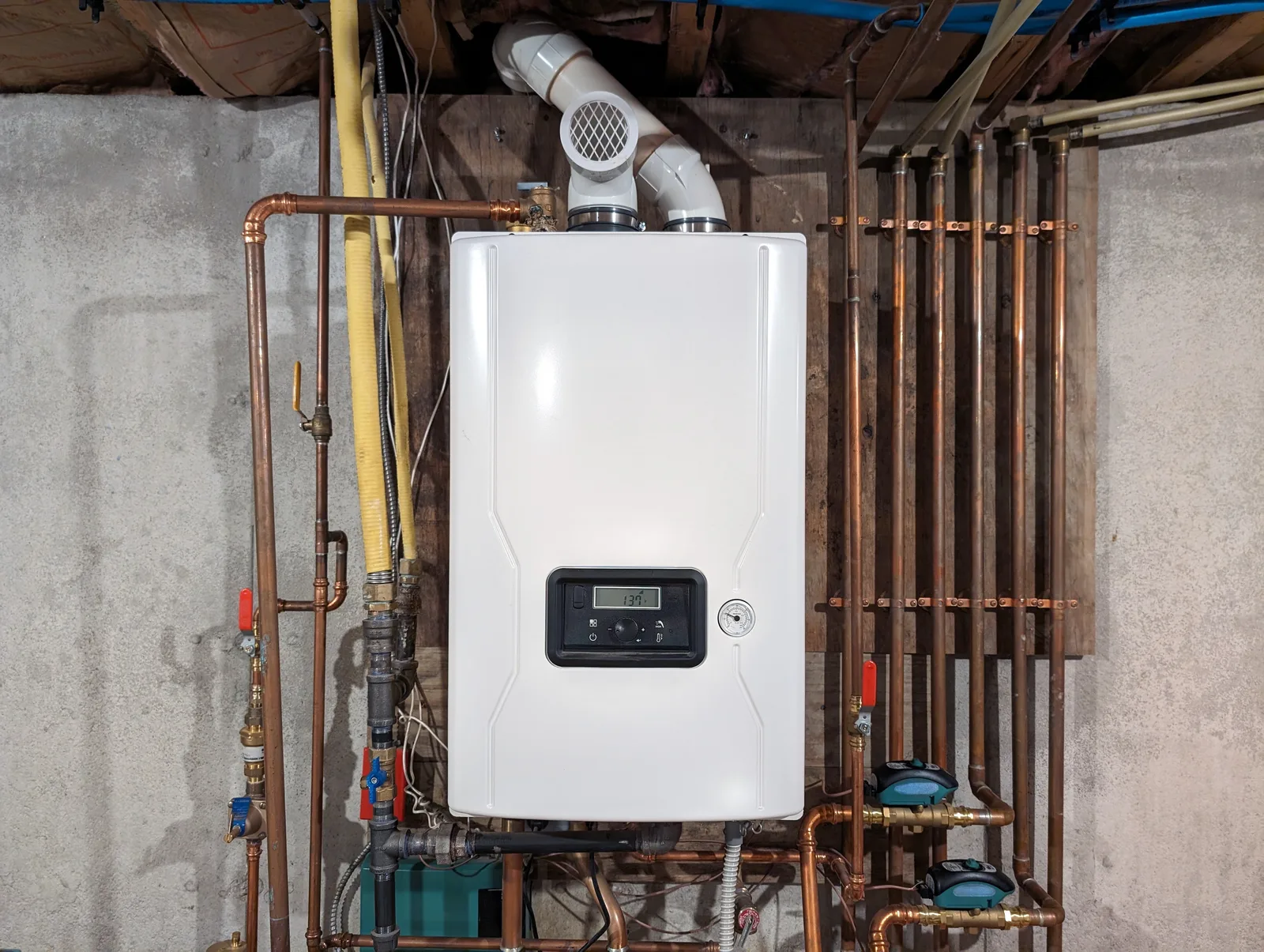
Where the number appears depends on what was installed with the heater. With a TM-RE30 remote the three digits show on the remote; without one, take off the front cover and read the three-digit, seven-segment LED in the centre of the computer board. An older TK-RE02 remote only has two digits, so a 741 shows as a flashing 74. When several heaters are linked on Takagi's Easy-Link cable, the remote changes the first digit to the heater number: 232 on the remote means heater 2 has a 321.
Takagi is part of A. O. Smith, and its troubleshooting guide for the condensing T-H2 line is published under the A. O. Smith name. A. O. Smith-branded tankless heaters use the same three-digit scheme, so this table serves both. Tank-type A. O. Smith heaters are a different story with blink counts and LED patterns, covered in the A. O. Smith water heater error code guide.
Four root causes sit behind most of this table. Scale coats the heat exchanger and the sensors, a standing problem on hard water in Hamilton and Halton, and lint and dust drawn in from a nearby dryer foul the burner and fan. A vent run that is too long or partly blocked upsets combustion. A gas line sized for the old tank cannot feed a 199,000 BTU/h burner, which CSA B149.1 requires the installer to size for.
Codes vary by model and by generation: the label and wiring diagram inside the front cover win over any list, this one included. The other makes we work on are listed on the brands hub.
Takagi tankless water heater codes, decoded
| Code | What it means | Safe? | Try first | When to call |
|---|---|---|---|---|
031 | Incorrect dipswitch settings on the computer board. Gas type is the common mistake, and it often appears after a board has been swapped. | turn it off | None. Dipswitches are set with the power off against the manual for that exact model. | Yes. If a board was just replaced, call whoever fitted it. |
101 | Warning for 991. Combustion is drifting and the heater has reduced its gas input to compensate. | keep running | Check the vent termination for nests, debris or a frozen flap, and note whether high wind sets it off. | Within days. The burner, fan and manifold pressure need checking before it becomes a 991. |
111 | Ignition failure: the heater did not fire after three attempts. | turn it off | Make sure the gas supply valve is fully open and the propane tank, if you have one, is not empty. | If one power-cycle does not bring it back. Flame sensor, igniter and gas pressure come next. |
121 | Flame loss: the flame disappeared while the heater was still supposed to be running. | turn it off | Look for anything blocking the vent outside. Note whether it happens when the furnace is also firing. | Same day if it repeats. A flame that lasts a second or two points at the flame sensor. |
311 | Output thermistor fault. This sensor sits on the right side of the heat exchanger. | turn it off | Nothing at home. | Book a repair. The sensor is cleaned or replaced after draining the unit. |
321 | Inlet thermistor fault. The sensor is embedded in the cold water inlet connection. | turn it off | Leave the cabinet closed. | Book a repair. It is tested by resistance before any part is ordered. |
331 | Mixing thermistor fault. The sensor is embedded in the hot water outlet connection. | turn it off | No homeowner step. | Book a repair, and ask for the other thermistors to be read in the same visit. |
341 | Exhaust thermistor fault. The sensor sits at the top centre of the unit above the heat exchanger. | turn it off | None. | Book a repair. |
391 | Air-fuel ratio rod failure. The rod that monitors the flame for mixture control is dirty, disconnected or failed. | turn it off | None. | Yes. The rod is cleaned with the burner sensors. |
510 or 551 | Gas valve circuit fault: 510 covers the main and solenoid gas valves, 551 the solenoid valve. | call now | If the taps are closed and you can still see flame through the burner sight window, shut off the gas and the power at once. | Immediately. Do not restore gas until the valve assembly has been tested. |
611 | Abnormal fan motor. Wiring, moisture in the fan housing, or the motor itself. | turn it off | Switch the power off and leave it off if you see water around the heater. | Book a repair. A wet fan connection has to dry out completely before power goes back on. |
621 | Abnormal exhaust fan motor. Takagi lists this one for indoor models only. | turn it off | None. | Book a repair. |
651 | Abnormal flow adjustment valve: the motorized valve on the cold inlet is leaking, jammed with sediment or has lost its signal. | turn it off | Check for water dripping under the heater. | Yes. The valve is pulled, cleaned of scale and re-tested. |
661 | Abnormal water bypass valve. Same family of fault as 651, on the valve that tempers the outlet water. | turn it off | None. | Yes. Often sediment or scale in the valve. |
701 | Proportional gas valve or computer board fault. | turn it off | None. | Yes. Wiring, supply gas pressure and the board are checked in that order. |
711 | Hi-limit switch or overheat cutoff fuse compromised. Takagi notes it can appear in place of 111 or 121. | turn it off | Do not go looking for the reset button. The reason for the overheat has to be found first. | Yes, before the heater is used again. |
721 | False flame detection: the heater sees flame when there should be none. | call now | Shut off all gas and power to the unit, as Takagi's own guide instructs. | Immediately. It may only be the flame sensor, but if it is not, it is dangerous. |
741 | Remote controller communication fault between the remote and the heater. | turn it off | Check that the remote cable has not been pulled loose. Only one remote should be connected. | If the wiring looks intact, or after a power surge. |
941 | Abnormal exhaust temperature: excessive vent length, a blocked intake or exhaust, or lint in the burner and heat exchanger. | turn it off | Clear anything obstructing the outside vent openings. | Yes. Vent length and manifold pressure are measured. |
991 | Abnormal combustion. The stage after 101: the heater has stopped trying. | turn it off | Nothing beyond checking the vent termination. | Same day. The computer board is reset only once the cause has been fixed. |
The codes that usually mean a real repair
111 or 121: flame sensor, igniter and an undersized gas line
A flame that lights for a second or two and drops out is the flame sensor asking to be cleaned, and a weak spark that jumps around is an igniter or its wiring. Those are ordinary repairs inside the $150–$800 range. The harder case is gas supply: Takagi calls for a minimum 3/4 inch line, larger on a long run, and air or low pressure in the line produces exactly these two codes. If the line was left as it was for the old tank, upsizing can add $400–$1,200: see whether a tankless needs a bigger gas line.
101 or 991: burner, fan and venting
Takagi's checklist for these starts with a blockage in the airway: the vent run, a backflow preventer installed backwards, the heat exchanger, the fan. Next comes manifold pressure, then contamination: a heater sharing a room with a clothes dryer pulls lint into the burner, and one in a kitchen pulls grease. The repair is a strip-down and cleaning of the burner and sensor assembly, with pressures set afterwards. The $90–$150 diagnostic is credited to the work.
Thermistor, valve and 711 codes: scale
A 311, 321 or 331 on a heater that has never been flushed is often a sensor probe crusted with scale: the service procedure is to drain the unit, pull the probe and clean it to bare metal before deciding to replace it. The same mineral jams the flow adjustment and bypass valves behind 651 and 661, and it is the usual reason a hi-limit trips. A descale flush is $150–$300 and is far cheaper than the parts it protects.
Licensed technicians, a written price before the repair, no overtime charges.
Common questions
Is Takagi code 101 an emergency?
No, but it is a countdown. A 101 means the heater has noticed combustion going off and has cut its gas input, which is why the water may run cooler at high flow, but it keeps working. Ignore it and the next stop is 991, where the heater shuts down. Check the outside vent for a nest or a frozen flap, then book a cleaning and pressure check.
Why did code 031 appear after the control board was replaced?
The dipswitches on the computer board tell the heater its gas type, venting and altitude set-up. If a replacement board goes in with switches that do not match the heater, it shows 031 and will not run properly. Takagi singles out gas type as the common error. The fix is setting the switches from the manual with the power off, which is a job for whoever fitted the board.
My A. O. Smith tankless shows 111. Is that the same code?
Yes. A. O. Smith owns Takagi and its tankless heaters use the same three-digit numbering, so 111 is still an ignition failure and 121 is still flame loss. Model details differ, such as which thermistors and fans a unit has, so read the label inside your own front cover for the exact list. A. O. Smith tank heaters use blink codes and are a separate subject.
Can I press the hi-limit reset button myself?
It is better left alone. Takagi's guide tells the technician to reset the hi-limit with the power off and then find out why it tripped before the heater goes back into service. A limit that opens is reporting an overheat: scale, low flow or a combustion fault. Pressing the button without finding the cause puts a gas appliance back to work with its warning cleared.
What will it cost to fix a Takagi showing an error code?
The diagnostic visit is $90–$150, credited toward the repair. Most tankless repairs come in between $150 and $800, and a descale flush is $150–$300. Gas line upsizing, where it is the real cause of 111 and 121, is a separate $400–$1,200 item, and you get every figure in writing first. Start with our tankless water heater repair service or send the code through the contact form.