
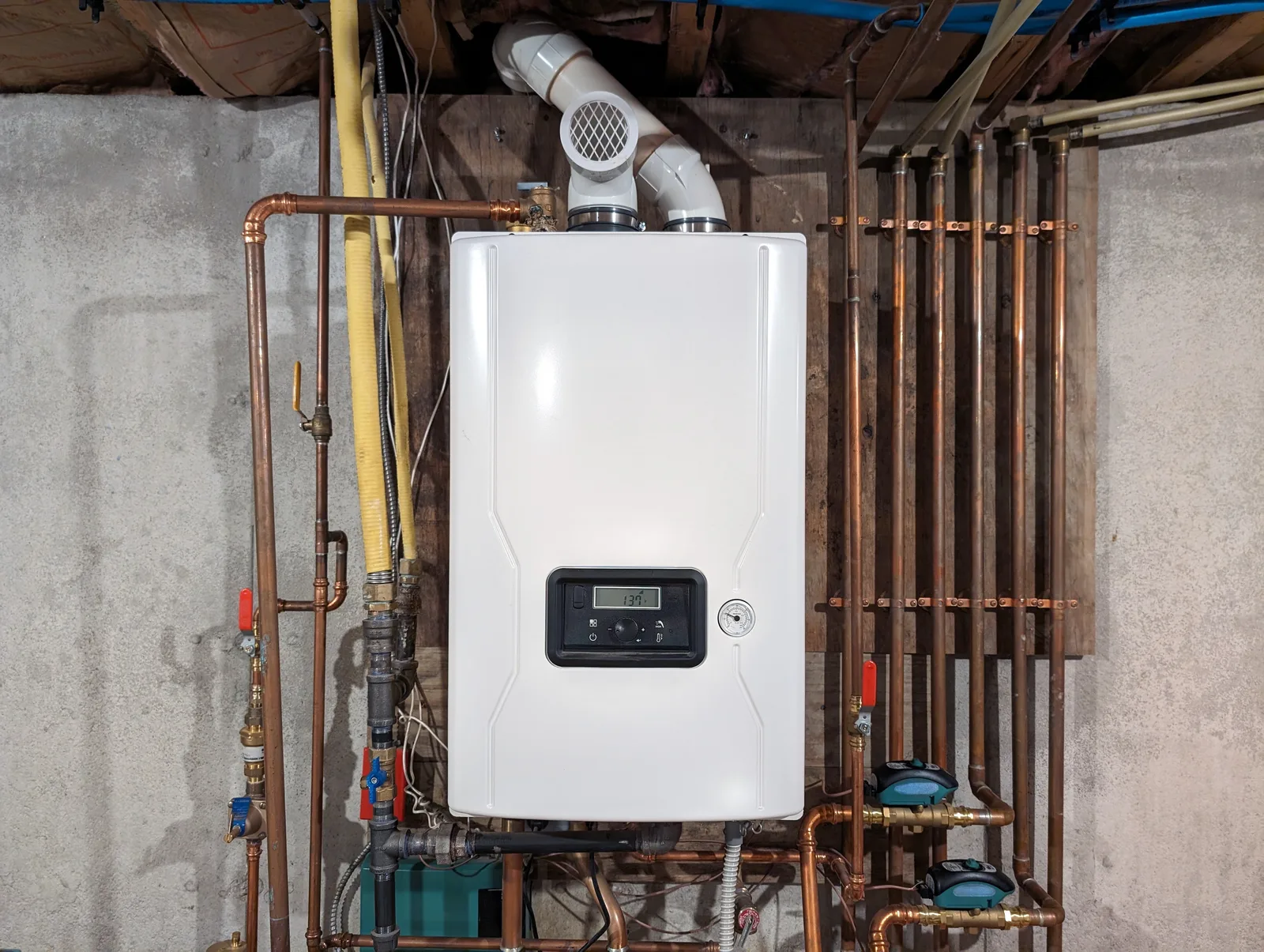
Hard water and tankless heaters in Hamilton and Halton are a maintenance question, not a reason to stay with a tank. Halton Region and the City of Hamilton both treat Lake Ontario water, and lake water carries enough dissolved calcium and magnesium to leave scale inside a tankless heat exchanger over a few years of daily use. An annual descale flush ($150–$300) plus isolation valves fitted at installation handle it completely. On the private wells that serve rural Flamborough, Carlisle and north Burlington, the water is often considerably harder and the treatment plan matters more than which brand you buy.
How Hard Is the Water Here
Burlington and Oakville are supplied by Halton Region from lake-based treatment plants along the shoreline, and Hamilton's municipal supply also comes from Lake Ontario. Lake water in this basin is consistently in the hard range — commonly reported at around seven to eight grains per gallon, which is roughly 120 to 130 milligrams per litre expressed as calcium carbonate. That is not extreme, and it is very stable year to year, which is genuinely useful when you are planning maintenance intervals.
Away from the municipal supply the picture changes. Private wells in rural Flamborough, around Carlisle and Freelton, and in north Burlington near Kilbride and Lowville draw groundwater that has moved through the limestone and dolostone of the escarpment, and that water is normally harder than the treated lake supply — sometimes several times harder — and can carry iron or sulphur as well. Both Halton Region and the City of Hamilton publish annual water quality reports with current hardness figures for their systems; a well needs its own test.
What Scale Actually Does Inside a Tankless Unit
A tankless heater passes water through a narrow, tightly wound heat exchanger and heats it very quickly. Calcium comes out of solution fastest on the hottest surfaces, so it deposits precisely where you least want it: on the exchanger wall between the flame and the water. A tank has the same chemistry, but it has room to shed sediment to the bottom, where it mostly just wastes energy. A tankless exchanger has nowhere to put it.
- Temperature swings — hot, then cold, then hot again — as the unit struggles to read and control the outlet temperature. Why a tankless goes hot then cold covers the other causes worth ruling out.
- Reduced flow, or needing to open the tap further than you used to before the burner fires at all.
- A longer wait for hot water at the fixture.
- Rumbling or kettling sounds as water flashes to steam against scaled hot spots.
- Flow-sensor or outlet-temperature error codes appearing in the unit's history — worth checking against the Navien or Rinnai code lists.
- Slowly rising gas use for the same amount of hot water, because scale insulates the exchanger from the water it is supposed to heat.
Left long enough, scale becomes a heat exchanger replacement, and manufacturers commonly exclude scale damage from warranty coverage — several also expect documented annual maintenance in hard water areas. Keep the service records with the paperwork.
The Annual Descale Flush, Step by Step
A descale flush is not a mysterious procedure. The technician closes the isolation valves, connects a small pump and a bucket to the service ports, and circulates a descaling solution or food-grade white vinegar through the exchanger for roughly 45 minutes to an hour, then rinses it and puts the unit back in service.
- Frequency: once a year on lake-supplied water in Burlington, Oakville and Hamilton for a typical household. More often on a hard well, or in a house running a lot of hot water through a single unit.
- The inlet water filter screen gets pulled and cleaned in the same visit — a clogged screen mimics scale symptoms exactly.
- On a condensing unit, the condensate trap and neutraliser are checked and serviced.
- The venting, combustion and gas pressure are checked by a TSSA-licensed technician, and the error history is read and cleared.
- Budget $150–$300 for the flush as a standalone visit. Full servicing details are in our tankless water heater maintenance guide.
Free quotes, written pricing.
Isolation Valves: The Detail That Decides Whether Service Is Cheap or Painful
A tankless unit installed without a pair of service valves cannot be flushed without cutting into the plumbing. Those valves cost very little at installation and turn a routine visit into an expensive one if they were skipped to shave a quote. When you compare tankless installation quotes in this area, look specifically for isolation or service valves in the scope — their absence is one of the reliable signs of a stripped-down price.
Softener, Scale Inhibitor, or Neither?
The answer depends much more on your water source than on the heater, and the three sensible options are these.
- Flush annually and do nothing else. For most Burlington, Oakville and lower-Hamilton homes on lake water with ordinary household demand, this is genuinely enough.
- A whole-home softener. Worth it on well water, or if you already fight scale on the kettle, the fixtures and the dishwasher. Two caveats: softened water tends to consume the sacrificial anode in a tank heater faster, so if you keep a tank anywhere in the house, check the anode more often; and the softened supply is normally bypassed to the cold drinking tap.
- A scale-inhibiting cartridge or template-assisted crystallisation unit at the heater. No salt and no drain connection, lower maintenance than a softener, and aimed only at protecting the appliance rather than improving the whole house. The media has a service life and must be replaced on schedule.
What does not work is buying a softener and then skipping the annual flush. Softeners fail quietly — a jammed valve or an empty salt tank goes unnoticed for months — and the unit is unprotected the whole time.
The Verdict: Should You Go Tankless in This Water?
Yes, if the house has the hot water demand to justify it, and if you will actually book the annual service. The chemistry here is manageable, and the argument for tankless — endless hot water, reclaimed floor space and a 15 to 20 year service life — is not undermined by lake water hardness.
- A full conversion typically runs $3,500–$6,500, and the most common local swap — a mid-tier condensing gas unit replacing an existing tank — usually lands at $4,200–$5,000 installed.
- If the existing gas line was sized for a tank, upsizing the run can add $400–$1,200. Ask for this to be confirmed on the site visit rather than discovered later.
- A straight tank-for-tank replacement runs $1,200–$2,500 installed, and for a two-person household in a Kerr Village semi or a Westdale bungalow with modest demand, that is often the better financial call.
We install and service tankless units across Halton and Hamilton, always with isolation valves, and we will say so plainly when a household is better served by a tank. For a replacement or a descale on the Hamilton side, see water heater service in Hamilton or book a visit.
Frequently asked questions
Is Hamilton and Halton water hard enough to damage a tankless heater?
It is hard enough to scale one over time, which is why annual descaling is standard here rather than optional. It is not hard enough to make tankless a poor choice on municipal lake-supplied water. Private wells in rural Flamborough, Carlisle and north Burlington are a different conversation and usually need treatment.
How often should a tankless water heater be descaled here?
Once a year for a typical household on municipal water in Burlington, Oakville or Hamilton. Increase that if you are on a well, if the unit serves a large household, or if you are already seeing temperature swings and reduced flow between services.
Can I descale a tankless water heater myself?
If the unit has isolation valves you can circulate a descaling solution with a small pump and a bucket. What a homeowner cannot do is the combustion, gas pressure and venting check that a TSSA-licensed technician performs in the same visit, so most people book the whole service together.
Will a water softener let me skip the annual flush?
No. It extends the interval between heavy scaling but does not remove the need to inspect, clean the inlet screen and verify combustion. Softeners also fail quietly, and a unit left unprotected for months because nobody noticed an empty salt tank ends up worse off than one that was simply flushed on schedule.
Does softened water cause other problems in the house?
It is more aggressive toward the sacrificial anode in a tank water heater, so if you keep a tank, inspect the anode more frequently. Softened water also carries added sodium, which is why the cold drinking tap is normally bypassed around the softener during installation.