
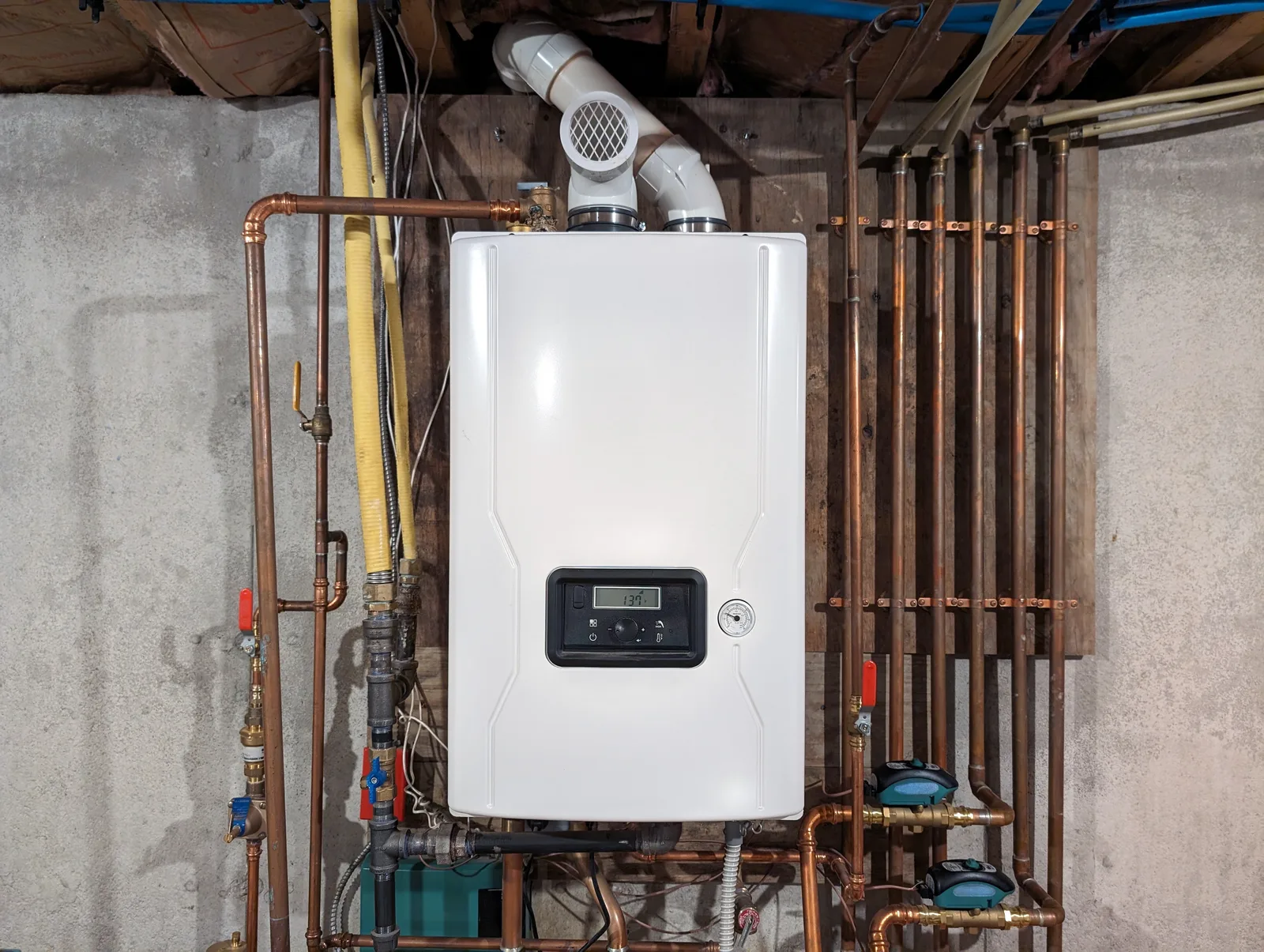
Tankless water heater maintenance comes down to one job done properly: an annual descaling flush that dissolves the mineral scale building up inside the heat exchanger. On a typical GTA unit that visit runs $150–$300, takes under an hour, and should also cover the cold-water inlet screen, the air intake filter, the condensate trap and the outdoor vent terminal. Skip it for several years and you get lukewarm water, swinging temperatures, and eventually a heat exchanger that fails with scale damage that no manufacturer warranty covers.
Why Tankless Units Scale Up Faster Than Tanks
A storage tank heats a large volume slowly, so dissolved calcium and magnesium mostly settle to the bottom as loose sediment. Annoying, but it sits out of the way. A tankless unit does the opposite: it drives water through narrow passages in a copper or stainless heat exchanger at very high heat intensity, and the thin film of water touching that metal is far hotter than the temperature coming out of your tap. Minerals drop out of solution right there, on the wall of the passage.
The effect compounds. A thinner passage means less flow, which means the burner has to work the water harder to hit setpoint, which lays down scale faster still. That is why a unit that ran perfectly for four years can go from fine to frustrating in a single season. It is also why setpoint matters: running the unit at 60 °C because someone wanted hotter dish water will scale it noticeably faster than leaving it at the usual 49 °C.
How Often to Flush in Halton and Hamilton
Frequency is set by your water, not by the calendar on the manufacturer's brochure. Use these intervals as a starting point and adjust after you see what comes out of the first flush.
- Municipal water, no softener — once a year. Book it alongside the fall furnace tune-up so it is one visit, not two.
- With a working softener — every 18 to 24 months is usually enough, provided somebody is actually keeping salt in the brine tank.
- Private well — every six months to start. Rural properties above the Escarpment around Flamborough, north Burlington, Binbrook and the edges of Ancaster often run untreated well water, and those heat exchangers load up quickly.
- With a recirculation loop — annually at minimum, because a loop pushes many times more water through the exchanger than an on-demand-only install does.
- Restaurants, salons and other high-draw commercial units — quarterly is normal, and we schedule it rather than wait for the complaint.
If you want the longer version of the water-chemistry story for this region, our guide to hard water and tankless units in Hamilton and Halton covers softeners, scale inhibitors and what they do and do not fix.
What a Proper Descale Actually Involves
There is no mystery to it, and knowing the sequence lets you tell whether the person in your basement is doing the whole job or half of it.
- Gas shut off at the appliance valve, unit powered down, and the two isolation valves closed so the house water is out of the picture.
- Hoses onto the hot and cold service ports, into a pail with a small submersible pump, and roughly 12 to 15 litres of plain white vinegar — undiluted, not a proprietary acid unless the manufacturer asks for one.
- Circulate for 45 to 60 minutes. Cloudy, gritty return liquid means the interval was too long; nearly clear means you can stretch it next time.
- Drain the vinegar, then run clean water through the cold service port for several minutes so nothing acidic is left sitting in the exchanger.
- Pull and rinse the cold-water inlet screen. This is the step most rushed flushes miss, and a plugged screen mimics every symptom of a scaled exchanger.
- Clean or replace the air intake filter behind the front panel — both Navien and Rinnai residential units have one, and a basement full of drywall dust will blind it.
- On a condensing unit, empty and rinse the condensate trap and check the neutraliser media. Spent limestone chips let acidic condensate attack the drain line.
- Finish on the gas side: inspect the burner and flame rod, run a combustion check, verify gas pressure under full fire, and confirm the intake and exhaust terminals outside are clear.
What You Can Do Yourself and What Needs a Licence
Free quotes, written pricing.
The water side is fair game for a confident homeowner. The gas side is not, and in Ontario that is a legal line rather than an opinion — work on fuel-burning appliances is restricted to technicians certified under the Technical Standards and Safety Authority. Ask for the certificate number and the contractor's registration before anyone opens the front panel, and check both against the TSSA registry rather than taking a business card at face value.
- Do it yourself: the vinegar flush, the inlet screen, the air filter, brushing snow off the vent terminal, keeping the setpoint sensible, and writing down any error codes before you clear them.
- Leave it to a licensed technician: anything on the gas train, combustion analysis, venting changes, gas pressure adjustment and heat exchanger replacement.
- Check first: if your installer never fitted isolation valves with hose bibs, you cannot flush at all. Adding a valve kit is a small extra on the first service visit, and it turns every future descale into a job that can be done in an hour instead of a plumbing exercise.
Warning Signs You Have Waited Too Long
- Water that runs hot, then cold, then hot again during one shower — see why a tankless goes hot then cold.
- The unit holds temperature for one fixture but gives up when a second one opens. Scale shows itself first at high flow.
- A longer wait for hot water at the far tap than you remember from last winter.
- A kettling or whining sound from inside the cabinet while it fires.
- Flow, ignition or exhaust-temperature faults on the display — our Navien error code guide explains which family a code belongs to before you call.
- Gas use creeping up while the hot water gets worse. That combination is almost always scale.
The Ontario Winter Jobs Nobody Puts on the List
A tankless unit vents through a plastic pipe out the side wall, usually low, usually on the side of the house nobody walks past between December and March. That is a problem in a region that gets lake-effect squalls and heavy drifting against north and east walls.
Three jobs, five minutes each. Clear snow away from the intake and exhaust terminals after every significant storm — a blocked intake locks the unit out and you lose hot water on the coldest morning of the year. Make sure the condensate line runs to an interior drain rather than outside, where it will freeze solid and back up. And if the unit lives in an unheated garage or crawl space, leave the breaker on: freeze protection is electric, and switching it off before a March trip south is how heat exchangers split.
Verdict: What the Annual Visit Is Really Buying
The arithmetic is not complicated. A descale is $150–$300. A mid-tier 199,000 BTU replacement unit, the most common tankless install in this area, lands at $4,200–$5,000 installed, and if the gas line needs upsizing the conversion adds $400–$1,200 on top. Manufacturers exclude scale damage from warranty coverage, so a heat exchanger killed by neglect is entirely on you.
- Flush annually on municipal water, twice a year on an untreated well, and keep the receipts — proof of maintenance is what a warranty claim hinges on.
- Bundle it with the furnace tune-up in the fall. Our maintenance plans exist mainly so this stops being something you have to remember.
- If your unit has already gone two or three years without a flush, book the service before the next cold snap rather than after the first cold shower.
We service Navien, Rinnai and Bosch units across Burlington, Oakville and Hamilton, and we note on the paperwork what the vinegar looked like coming out so you know whether to shorten the interval. Book through our tankless repair and service page or get in touch and we will schedule it with your fall maintenance.
Frequently asked questions
Can I descale a tankless water heater with something other than vinegar?
Plain white vinegar is what most manufacturers name, it is cheap, and it will not hurt the exchanger if you leave it circulating a little long. Proprietary descaling solutions work faster and are worth it on a badly loaded commercial unit. Never use hydrochloric or muriatic acid on a residential unit — it is aggressive enough to thin the exchanger wall.
How long does a tankless service visit take?
Around 45 to 75 minutes for a unit with isolation valves already fitted. The circulation itself is most of that, and the technician uses the time to clean the inlet screen, air filter and condensate trap. Add half an hour on the first visit if a valve kit has to be cut in.
Does a water softener mean I can skip descaling entirely?
No, but it stretches the interval a lot. Softened water still leaves some deposit, the softener can run out of salt without anyone noticing, and the flush is also when the burner, venting and combustion get checked. Every 18 to 24 months is a reasonable target on properly softened water.
Is tankless maintenance more work than a tank water heater?
It is more scheduled work and less unscheduled work. A tank heater needs an occasional drain and an anode rod check, and then one day it leaks on the floor. A tankless unit wants an hour a year, and in exchange it tends to run 15 to 20 years instead of 8 to 12.