
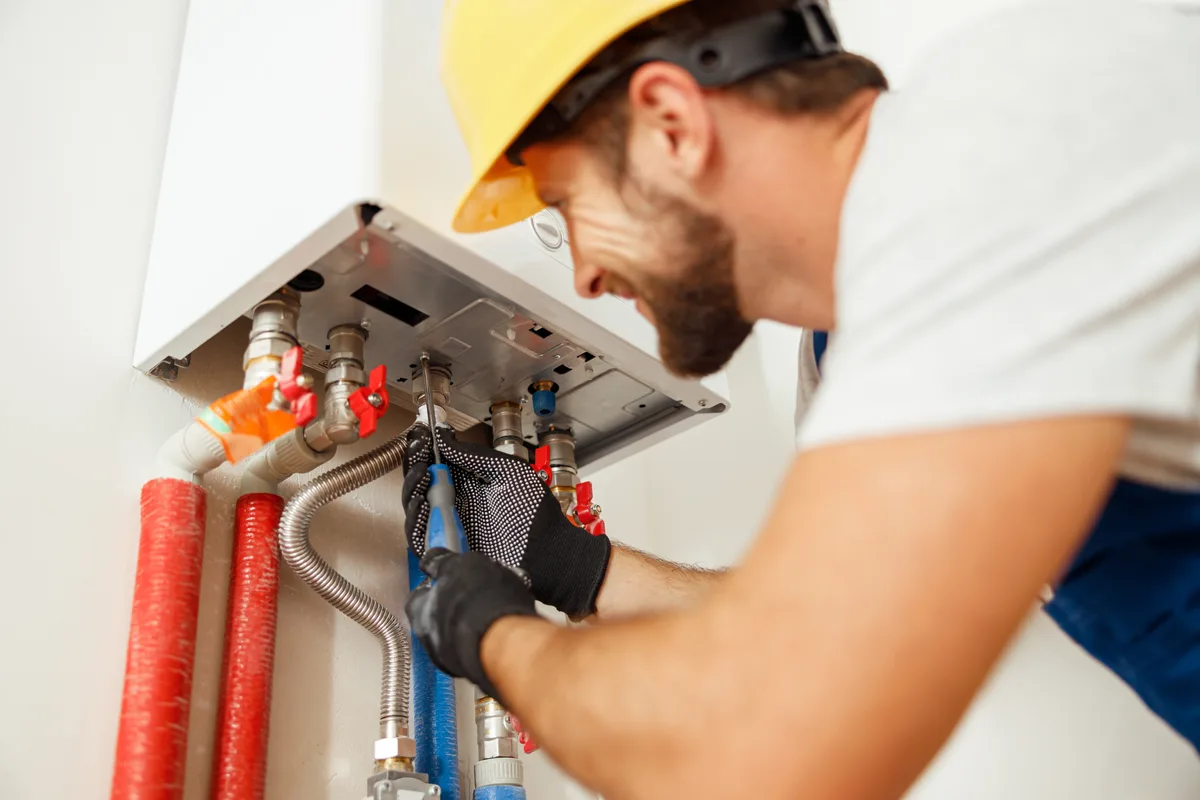
What size tank water heater do I need? For most detached homes in Burlington, Oakville and Hamilton the answer is a 40 or 50 US gallon natural gas tank, or a 60 gallon electric one — electric heats back so much more slowly that it needs the extra stored volume to keep up with the same family. The number that actually predicts whether you run out mid-shower is not the size on the sticker, though. It is the first-hour rating printed on the EnerGuide label.
First-Hour Rating Is the Number to Compare
First-hour rating is how much hot water the appliance can deliver during one busy hour starting from a full, hot tank. It adds the usable stored volume to whatever the burner or elements can reheat while you are drawing. That is why a 40 gallon gas tank with a strong burner can out-deliver a 50 gallon electric one, and why comparing two units on stored gallons alone is close to meaningless.
Ask for the first-hour rating on any tank you are quoted. If a salesperson cannot produce it, they are selling you a number off the side of a cylinder rather than a performance figure. The same label also carries the annual energy use estimate, which is the honest way to compare running cost between two units of the same size.
Sizing by Household, Fixture Count and Habits
- One or two people, one bathroom: 40 gallon gas, or 40 to 50 gallon electric. Anything larger just costs more to keep hot.
- Three or four people, two bathrooms: 50 gallon gas, or 60 gallon electric. This is the most common replacement we do in the 1970s to 1990s subdivisions around Millcroft, Glen Abbey and River Oaks.
- Five or more, or two showers running at once, or teenagers with opposite schedules: 60 to 75 gallon gas, a second tank, or a step to tankless.
- A large soaker tub changes everything. A deep freestanding tub can swallow most of a 50 gallon tank in one fill, so if somebody actually uses it, size for the tub and not the shower.
- A high-flow rain shower head does the same thing more quietly. A typical head moves somewhere between 6 and 9 litres a minute, and a body-spray panel can double that.
Do the Peak-Hour Math Yourself
You do not need software for this. Picture the worst hour in your house — usually a weekday morning — and count what runs. Say two back-to-back ten-minute showers in a four-bedroom home in the Orchard: at roughly 8 litres a minute that is about 80 litres of mixed water each, of which somewhere near two thirds arrives from the tank rather than the cold line. Two showers therefore pull in the region of 100 to 110 litres, or a bit under 30 US gallons, before anyone starts the dishwasher.
Now compare that against the first-hour rating on the label. Gas tanks in this class typically publish a rating well above their stored volume, because the burner recovers meaningful capacity during the hour. A standard electric tank publishes one only modestly above its stored volume, because its two elements fire one at a time rather than together. That single design detail is the whole reason electric tanks are sized a step larger.
Recovery Rate: Why Gas and Electric Size Differently
Free quotes, written pricing.
A common residential gas tank carries a burner somewhere in the 30,000 to 40,000 BTU range. A standard electric tank runs 4,500 watt elements, which is roughly a third of that heat input, and only one element energises at a time. The result is that a gas tank refills its usable capacity while you are still using it, and an electric tank largely does not.
This is also why all-electric households on the Escarpment edge, in rural Flamborough, and anywhere without a gas service should look hard at a heat-pump water heater before defaulting to a bigger resistance tank. They are far more efficient, they need headroom and a reasonably warm space to draw heat from, and their recovery is slower again — so size generously. Our page on whether a heat-pump water heater is worth it covers the trade-offs.
The Physical Fit Nobody Checks Until Install Day
- Height. A 60 gallon tank is taller than a 40, and in a low-ceilinged 1950s Aldershot or Hamilton Mountain basement there may not be room above the draft hood for the vent connector to rise before it turns.
- Width and the route in. Pre-war houses in Westdale, Dundas and Old Oakville have narrow basement stairs with a turn at the bottom. Measure the doorway, not just the corner the tank will stand in.
- Power and drainage. A power vent model needs a receptacle within reach and a wall it can vent through — see power vent vs direct vent water heaters.
- Condo and fan-coil suites. The closet decides the size, not the household. Many suites have a 30 to 40 gallon electric tank and no room for anything larger.
- Thermal expansion. Where the incoming service has a check valve or a backflow preventer, the system is closed, heated water has nowhere to expand, and the job needs an expansion tank on the cold inlet. It is a small part that is routinely left off a low quote.
- Sediment. On hard water an older tank loses usable capacity to sediment at the bottom, which is why your current tank may feel small when it is actually just tired.
When to Stop Sizing Up and Change Category
Above roughly 55 US gallons the equipment class changes — larger gas tanks generally move into more expensive condensing designs — so the jump from 50 to 75 gallons costs far more than the jump from 40 to 50. That is the point where two other answers start to make sense: a second tank in series for a large or spread-out house, or a tankless unit.
For comparison, a tank swap runs $1,200–$2,500 installed and a tankless conversion runs $3,500–$6,500, with a possible gas-line upsize adding $400–$1,200. If the driver is two simultaneous showers rather than total daily volume, tankless is the better fit; if it is one enormous tub fill, a bigger tank still wins. Our tank versus tankless comparison works through both cases.
Verdict: What We Put in Most Local Homes
- 2000s or newer two-storey with two and a half baths, gas service: 50 gallon gas, usually power vent because those houses have no chimney.
- 1950s bungalow, one or two occupants, chimney intact: 40 gallon gas. Bigger buys standby loss, not comfort.
- Large family, two showers overlapping most mornings: 60 gallon gas, or tankless if the gas line supports it.
- No gas service at all: 60 gallon electric as the baseline, heat-pump water heater if there is headroom and a warm-enough space.
- Renting rather than owning: the supplier stocks a limited range of sizes. At $25–$45 a month, roughly $4,500–$8,000 across a 15-year tank life against $1,500–$3,000 to buy the same unit outright, it is worth running the numbers — see should I rent or buy a water heater in Ontario.
We size tanks by asking what your worst hour looks like, then checking that the thing actually fits down your stairs. If you want a straight recommendation with the first-hour rating written on the quote, our water heater service covers Burlington, Oakville and Hamilton, or you can send us a photo of your current tank and we will tell you what belongs in its place.
Frequently asked questions
Is a bigger water heater always better?
No. An oversized tank keeps more water hot around the clock whether you use it or not, which costs money every day of the year, and it takes up floor space in a basement you may want to finish. Size for your busiest hour with a little margin, not for the biggest unit that fits.
How do I know what size my current tank is?
Look at the rating plate on the front of the jacket. It lists the capacity in litres and usually in US gallons, along with the input in BTU for gas or watts for electric. If the label is faded, the model number on the same plate will tell an installer everything they need.
Why does my 50 gallon tank feel smaller than it used to?
Two usual causes. Sediment on the bottom of the tank takes up volume and insulates the water from the burner, and on an electric unit a failed lower element leaves you heating only the top third. Both show up as hot water that runs out sooner than it used to rather than water that is never hot.
Should I match the size of the tank I am replacing?
Only if it was actually working for you. Plenty of tanks were sized by whoever built the house for a household that no longer lives there. If you regularly run out, go up a size or change the fuel type; if you never come close, going down a size will lower the standing losses.