
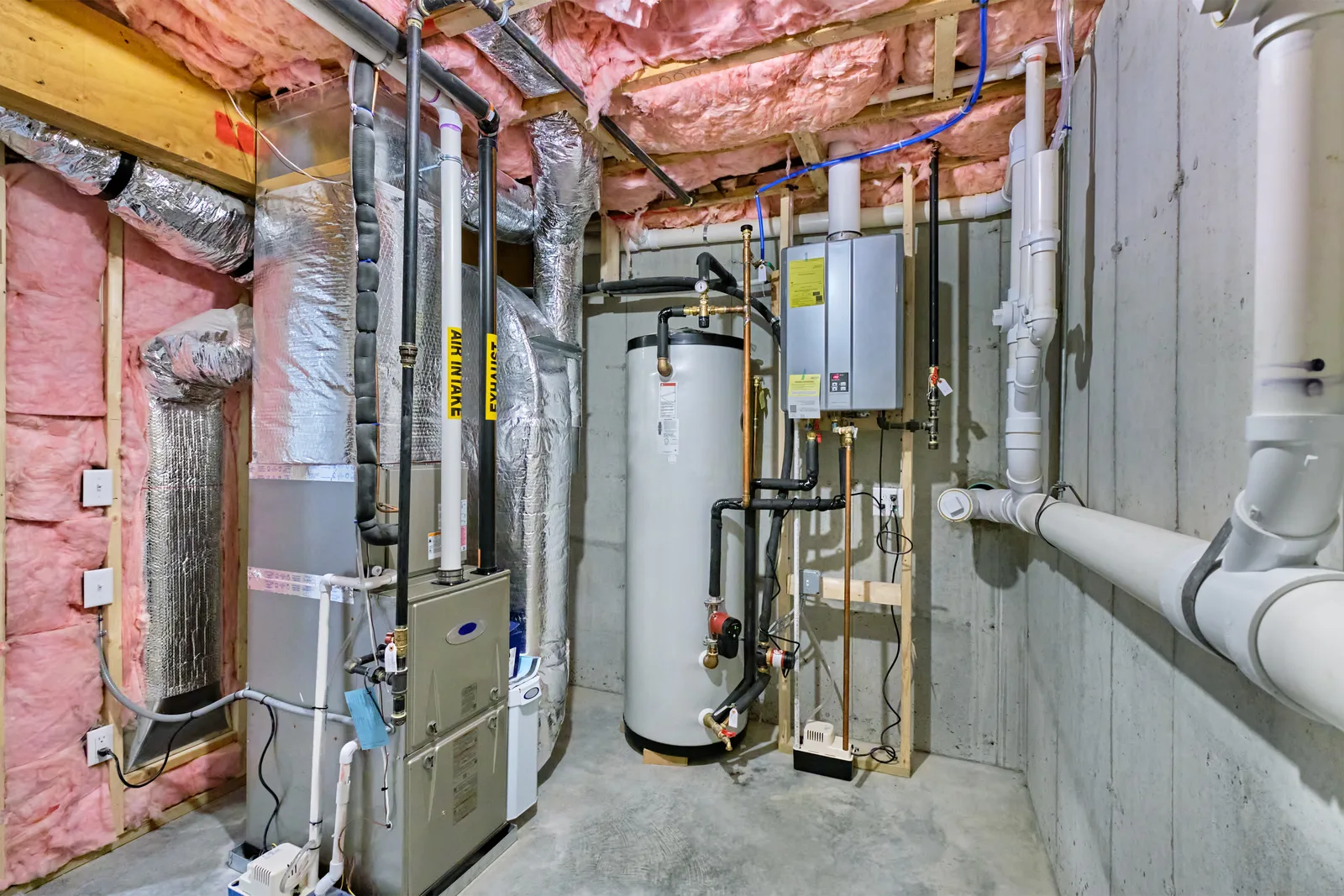
Power vent versus direct vent water heaters is really a question about two separate things: where the exhaust goes, and where the burner gets its air. A power-vent tank uses a blower on top of the unit to push exhaust horizontally out a side wall through plastic pipe, and it takes combustion air from the room around it, so it needs a 120 V receptacle. A direct-vent tank pulls its combustion air from outdoors through a second pipe, sealing the burner off from the room entirely. In most Halton and Hamilton basements the deciding factor is the chimney, not the brochure.
The Three Vent Types You Will Be Quoted
- Atmospheric (natural draft): a draft hood on top, a single metal vent connector into a chimney or B-vent, no fan and no electricity. Cheapest to install, silent, and completely dependent on a chimney that still drafts properly.
- Power vent: an electric blower pushes exhaust through PVC or ABS out a side wall, often 10 metres or more from the tank. Combustion air still comes from the room. Needs a receptacle nearby and makes a noticeable fan noise on every burn cycle.
- Direct vent: combustion air arrives from outside through its own pipe or the outer sleeve of a concentric vent, and exhaust leaves through the inner pipe. Some models draft naturally with no fan at all, which means no power required and no noise.
- Power direct vent: the pair combined — sealed outdoor combustion air plus a blower for longer vent runs. It is the answer when the room is too tight for a room-air appliance and the outside wall is too far for natural draft.
Why the Chimney Question Usually Decides It
In a 1950s or 1960s bungalow in Aldershot, on the Hamilton Mountain or in older Stoney Creek, the furnace and the water heater were designed to share one masonry chimney with a clay liner sized for both appliances together. When the furnace gets replaced with a 96% condensing unit, it moves to PVC through the side wall and the tank is left venting alone into a flue far too large for it.
That orphaned chimney is a real problem, not a paperwork one. Exhaust from a single small appliance cannot warm that much masonry, so it cools, condenses, and soaks the brick and mortar from the inside. Cold flues also backdraft, which puts combustion products into the basement instead of the sky. You have two legitimate fixes: line the chimney with a correctly sized stainless liner ($400–$900) or take the tank off the chimney altogether and move it to power vent. Our guide on chimney liners during a furnace replacement walks through how installers price both.
Power Vent vs Direct Vent, Point by Point
- Combustion air — power vent: taken from the room, so the space must be large enough or have code-sized openings. Direct vent: taken from outdoors, so room size stops mattering.
- Electricity — power vent: required, and no power means no hot water. Direct vent: a natural-draft model keeps making hot water straight through an outage.
- Noise — power vent: an audible blower, roughly the volume of a bathroom fan, several times a day. Direct vent: silent if it is natural draft.
- Vent length — power vent: long horizontal runs are its whole reason for existing. Direct vent: short runs, usually straight out the wall behind the tank.
- Cost within the band — power vent: near the top of the $1,200–$2,500 installed range once you add pipe, a receptacle and a termination. Direct vent: mid-band on a simple wall, higher if a concentric kit and coring are involved.
- Best fit — power vent: an orphaned chimney and a tank that sits well inside the footprint of the house. Direct vent: a tight, sealed mechanical room, a small closet, or a tank on an outside wall.
Side-Wall Termination: The Part Quotes Get Wrong
Both power vent and direct vent put a plastic pipe through your exterior wall, and where that pipe lands is governed by CSA B149.1, the gas installation code Ontario adopts and TSSA enforces. The code sets minimum distances from windows and doors that open, from mechanical air intakes, from the gas meter and its regulator vent, and from grade. Exact figures depend on the appliance input and the edition of the code in force, so ask your installer to show you the clearance they are working to and confirm anything unusual with TSSA.
- Height above grade matters more here than the code minimum suggests. Drifted snow against a north or east wall in Waterdown or on the Escarpment will bury a low terminal.
- Never terminate over a walkway, a driveway or a basement stairwell. Flue gas from a gas appliance is wet, and in January that plume turns a path into a skating rink.
- On the narrow lots in Kerr Village, Old Oakville, Westdale and Dundas, the side wall you would naturally use is only a few metres from the neighbour's window — that clearance has to be checked before the hole gets cored, not after.
- Decks, additions and screened porches built later can turn a compliant termination into a hazard. If you are planning a build, flag the vent locations to the contractor.
Free quotes, written pricing.
The same principles apply to a condensing furnace's intake and exhaust terminals, which is why a house that has already been converted to high-efficiency heating usually has a settled answer about which wall a water heater vent can use.
Noise, and Why It Matters in a Finished Basement
This is the complaint we hear most about power vent tanks, and it never appears in a quote. The blower runs for the full length of every burn cycle, which in a busy household is several times a day and often at six in the morning. In an unfinished basement nobody notices. Share a stud wall with a basement bedroom, a home office or a media room and it becomes the thing you hear instead of the thing you ignore.
If the basement is being finished anyway, plan for it: insulate the mechanical room walls, use a solid-core door with the required air openings, and keep the blower end of the tank away from the shared wall. Our guide to HVAC for a finished basement covers the framing and combustion-air side of the same job.
What Each One Costs and What Moves the Number
A straight tank-for-tank swap typically runs $1,200–$2,500 installed, and both vent types live inside that band. Converting an atmospheric tank to power vent sits at the upper end, because you are adding a vent run, a wall penetration, a condensate provision on some models, and often an electrician's visit for a dedicated receptacle.
Before you commit, price the alternative. If the chimney is otherwise sound and the only issue is that the furnace left, a stainless liner at $400–$900 may cost less than the power-vent premium and keeps a silent, power-independent appliance in your basement. Our breakdown of what it costs to replace a water heater in Ontario lists what else tends to show up on the invoice.
Verdict: Which One We Would Put in Your House
- Choose power vent if the chimney has been orphaned by a high-efficiency furnace, the tank sits deep inside the house, there is a receptacle within reach, and the mechanical room does not share a wall with a bedroom.
- Choose direct vent if the tank is on or near an outside wall, the mechanical room is small or tightly sealed — common in 2000s and newer builds in Alton Village and Joshua Creek — or you want an appliance that keeps working through a power cut.
- Keep atmospheric if the chimney still serves the tank alone with a correctly sized liner and is in good condition. It is the cheapest and quietest option, and it is disappearing only because so many chimneys are being orphaned.
- If the tank is a rental you do not get to choose — the rental company specifies the unit. Read Enercare vs Reliance on water heater rentals before you sign anything longer than you plan to stay.
We install both types across Burlington, Oakville and Hamilton, and every quote states which vent type, where the termination lands, and whether an electrician is needed. See our power vent water heater service or ask us to look at your chimney before you decide which way to go.
Frequently asked questions
Can I convert my existing atmospheric water heater to power vent?
Not the tank itself — the venting is built into the appliance, so a conversion means a new water heater. What you are really choosing is which type to buy when the current one is replaced. If the chimney was orphaned by a furnace upgrade, plan that decision now rather than on the day the old tank leaks.
Does a power vent water heater work in a power outage?
No. The blower needs 120 V, and the control will not allow the burner to fire without proven draft. You will have whatever hot water is already stored in the tank and nothing more. A natural-draft direct-vent or atmospheric tank keeps heating right through an outage, which is worth something on a rural line.
Is direct vent safer than power vent?
Direct vent is inherently more forgiving because the burner is sealed from the room, so nothing indoors can starve it of air or pull its exhaust back inside. A properly installed power-vent tank in a room with adequate air is safe too. The risk with power vent comes from someone later framing a tight closet around it without providing combustion air.
How long is the vent run allowed to be?
It depends on the model — each manufacturer publishes a maximum equivalent length that counts elbows against the total. Power vent units commonly allow long runs, which is why they solve awkward basements. Ask the installer to show the calculation for your layout instead of accepting that it will be fine.