
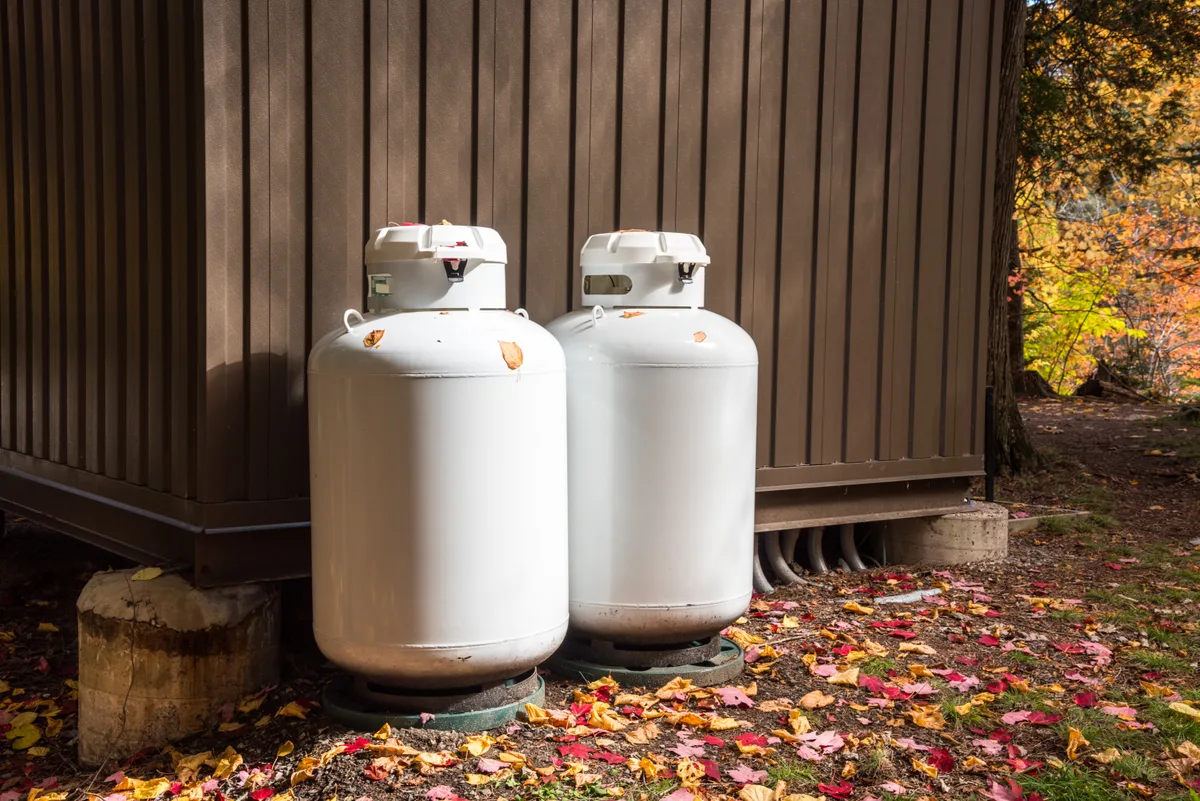
Propane furnaces for rural Flamborough and Halton are what you buy when there is no natural gas main on the road, and there are still plenty of those: Carlisle, Freelton, Millgrove, and the concessions running north of Dundas, along with Kilbride and Lowville above Burlington and the Campbellville side of Milton. The furnace itself is the same cabinet a town house gets — what changes is the burner orifices, the manifold pressure and the tank sitting in your yard. The point most homeowners miss is that propane holds less energy per litre than they assume, which is why a propane furnace paired with a cold-climate heat pump is what we recommend for most of these properties.
A Propane Furnace Is a Gas Furnace With Two Real Changes
- The burner orifices are smaller. Propane carries far more energy per cubic metre than natural gas, so the furnace needs a much smaller opening to deliver the same heat.
- The manifold pressure is different — roughly 10 inches of water column for propane against 3.5 for natural gas on a typical residential furnace. Setting that by eye instead of with a manometer is how you get sooting, nuisance lockouts, and a heat exchanger that fails years early.
- Most manufacturers sell an LP conversion kit for the same model, and the conversion has to be done by a licensed technician who then re-labels the furnace to show the fuel it now burns. An unlabelled converted furnace is a problem at inspection and at resale.
- Everything else is identical to a natural gas install: the condensing heat exchanger, the certified plastic venting, the condensate drain, the blower and the controls.
Propane Behaves Differently in a Basement
Propane is heavier than air, so a leak settles at the low point of a room rather than rising. That changes where you look, where a detector belongs — low on the wall rather than near the ceiling — and why appliances in pits, crawl spaces and below-grade rooms get more attention during an inspection. The odourant is ethyl mercaptan and it smells much like the one added to natural gas, and the response is identical either way: get everyone out first, then call from outside. Our answer on what to do if you smell gas sets out the order.
There is also a winter behaviour worth knowing. Propane has to boil out of the liquid in the tank to feed the appliances, and that vapourisation rate depends on how cold it is and how much wetted surface the liquid has. A tank that is undersized for the connected load, or one sitting low on fuel in deep cold, can struggle to keep up when the furnace, the range and a fireplace all call at once. Sizing the tank for everything connected, not just the furnace, is part of the design rather than an afterthought.
The Tank: Owned Versus Leased, and Where It Is Allowed to Sit
- A leased tank comes from the propane supplier and normally ties you to buying fuel from them. Changing suppliers means one tank leaves and another arrives, which is not a decision to discover mid-winter.
- An owned tank lets you shop for fuel, but you carry the maintenance and the periodic requalification that goes with ownership.
- Setbacks are real and they decide the location: a typical 500-gallon residential tank needs separation from the house, the lot line and any source of ignition — commonly 3 metres under the propane code — plus room for the delivery truck's hose to reach it.
- Suppliers fill to around 80 percent so there is room for the liquid to expand, which is why a full tank never reads full.
- Settle the tank agreement in writing before you sign the furnace contract. The fuel arrangement outlives the equipment decision by years.
The Energy Maths That Decides Propane Versus Heat Pump
Compare fuels on energy delivered rather than on the price of a litre. Propane holds roughly 25 megajoules per litre. Heating oil holds roughly 38 per litre, and natural gas roughly 37.5 per cubic metre. Electricity is 3.6 megajoules per kilowatt-hour.
Free quotes, written pricing.
Put propane through a condensing furnace at 95 percent AFUE or better and you keep about 24 of those 25 megajoules. Put a kilowatt-hour through a cold-climate heat pump running at a seasonal average performance of two-and-a-half to three, and 3.6 megajoules of electricity becomes 9 to 11 megajoules of heat in the house. Whether that wins depends on your delivered propane price and your Alectra or Burlington Hydro rate, both of which move — but in propane country the heat pump generally wins comfortably through the shoulder seasons, and the shoulder seasons hold most of the heating hours in an Ontario year.
Why Hybrid Is the Standard Answer Out Here
Keep the propane furnace, add a cold-climate heat pump, and set the switchover so the heat pump carries everything down to the balance point while propane handles the deep cold. Three rural realities make that the right shape here rather than a compromise.
- Propane is the expensive fuel, so the design goal is to burn as little of it as the winter allows.
- The electrical service on an older farmhouse, already carrying a well pump and a septic pump, often cannot support full electric strip backup without an upgrade.
- The power goes out more often on the concessions than it does in town, and a furnace runs on a modest generator while electric resistance backup does not.
- Homes with no natural gas service also sit in the higher tier of Ontario's heat pump rebate, which narrows the gap on the purchase price. Read the current amount off the program page, because it is revised from time to time.
Our hybrid heat pump page sets out how the switchover is configured and what the propane furnace ends up doing in a normal winter, and the Home Renovation Savings Program page has the current rebate rules.
The Rest of the Rural Package
- Well water is hard water out here, and it shortens the life of tanks and tankless heat exchangers — see hard water and tankless units in Hamilton and Halton.
- Farmhouses grow. Additions, converted summer kitchens and long duct runs make a heat-loss calculation essential rather than optional, and rule-of-thumb sizing is how rural houses end up with a furnace two sizes too large.
- Escarpment wind loads sidewall vent terminals harder than a sheltered town lot does, which affects where the terminal goes and how it is supported.
- Snow sits deeper on the concessions than in Burlington, so vent terminals and heat pump stands both go higher than the code minimum.
- The load calculation has to include the pumps. A well pump and a septic pump starting together are a bigger deal on a rural panel than anything in a subdivision.
Verdict: What to Buy for a Rural Halton Property
- A propane furnace on its own: reasonable when electrification is off the table — no room in the panel, no budget for a heat pump, or a seasonal property that sits empty for months.
- A propane furnace plus a cold-climate heat pump: the setup that fits most year-round homes out here, and the one that survives an outage.
- All-electric heat pump with resistance backup: good on a newer, tighter house with a 200-amp service and a standby generator plan you are actually happy with.
- Whatever you choose, settle the tank agreement and the supplier before the furnace, and insist the manifold pressure and combustion readings are written on the commissioning sheet. A converted furnace that was never properly set up is the most common fault we find on rural service calls.
We serve Flamborough and the rural edges of Halton alongside the towns, and rural quotes get the same written scope as anything else. Book a site visit — for rural properties we would rather look at the tank, the panel and the duct runs before quoting anything.
Frequently asked questions
Can a natural gas furnace be converted to propane?
Most models can, using the manufacturer's own LP conversion kit, which changes the burner orifices and the gas valve setting. It must be done by a licensed technician, the manifold pressure has to be verified with a manometer, and the furnace has to be re-labelled for the fuel it now burns. What you should never accept is a conversion done with generic parts or signed off without pressure readings.
How big a propane tank does a house need?
It depends on everything connected — furnace, water heater, range, dryer, fireplace, generator — and on how often you want deliveries. The supplier sizes it, but ask them to size for the connected load rather than for the furnace alone, because vapourisation in deep cold is the constraint that bites. Undersized tanks show up as appliances faltering on the coldest evening of the year, not on a mild one.
Is a propane furnace less efficient than natural gas?
No. The same furnace model achieves the same AFUE on either fuel once it is correctly converted and set up, because the efficiency comes from the heat exchanger rather than the fuel. What differs is the cost per unit of heat delivered, which is where propane loses ground to natural gas and, over most of an Ontario winter, to a cold-climate heat pump.
Do I need a carbon monoxide alarm with a propane furnace?
Yes, and Ontario requires alarms adjacent to sleeping areas in homes with a fuel-burning appliance regardless of the fuel. Add a propane-specific leak detector mounted low, because propane pools at floor level rather than rising the way natural gas does. The two devices do different jobs and one does not replace the other.
Can I run a propane furnace on a generator during an outage?
Usually, because the furnace itself only needs power for its blower, inducer and controls rather than for heat. The safe way to do it is through a transfer switch installed by an electrician, not an extension cord run to the furnace. That resilience is a genuine argument for keeping a combustion appliance in the house on a rural road that loses power.