
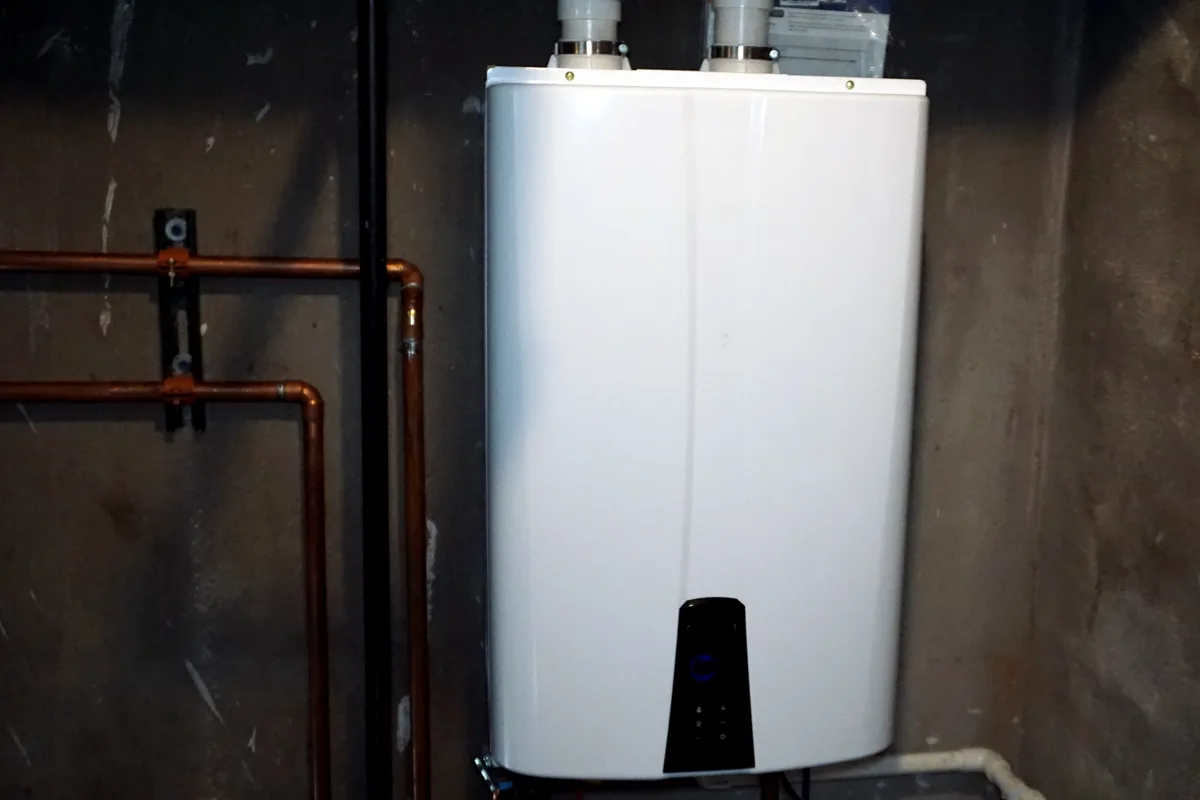
On current SENSEI residential units the controller is built into the heater, so you do not need an accessory remote to see a code. Indoor units show it on the controller panel on the outside of the front cover; outdoor units make you open the front panel to reach the same buttons. Optional wall controllers exist, but they are an accessory rather than a prerequisite, which is worth knowing if someone has told you the unit cannot report a fault without one.
Rinnai also keeps a history. Press the on-off button, then hold on-off and the up button together for a couple of seconds, and the last several maintenance codes flash in sequence. That history is genuinely useful for intermittent faults, and it is where FF appears — a placeholder Rinnai drops in to record that a service provider performed maintenance, rather than an error you need to chase.
Codes vary by model and generation, and Rinnai is a brand where that caution has teeth: several numbers were redefined between the earlier condensing range and the current N-Series, so most of the code lists circulating online publish the older meanings. Code 14 is a heat exchanger overheat on a current unit where the earlier table called it a thermal fuse; 70 is the PC board where it used to be a sensor harness. Let the label inside your own front cover win. Model detail sits on the Rinnai tankless repair page, another common make is on the Bosch code guide, and installed pricing is in our tankless cost guide.
Rinnai tankless water heater codes, decoded
| Code | What it means | Safe? | Try first | When to call |
|---|---|---|---|---|
10 | Air supply or exhaust blockage, or the condensate trap is full. | call now | Shut it down and check the outdoor vent terminal for snow, ice or a nest. | Call immediately if the terminal looks clear — the restriction is then inside. |
11 | No ignition — the heater did not turn on. | turn it off | Confirm the gas supply is on and other gas appliances still work. Reset once. | Call if it repeats. Do not keep forcing ignition attempts. |
12 | No flame — the burner lost flame during operation. | turn it off | Note whether another gas appliance fired at the same moment. | Call. Flame loss under load usually means gas supply, venting or the flame rod. |
14 | Heat exchanger overheat. | call now | Turn the unit off and leave it off. This is a safety device doing its job. | Call immediately. Overheat protection does not operate without a reason. |
16 | High outgoing temperature — a safety shutdown because the water is too hot. | turn it off | Shut it down and warn the household before anyone runs a tap. | Call. Scald risk is the immediate concern, particularly with small children. |
25 | Condensate pump fault, where a condensate pump accessory is fitted. | turn it off | Look for water pooling under the unit and check the condensate line is not kinked. | Call — condensate from a condensing unit is acidic and should not sit on a floor. |
32 | Outgoing thermistor fault. | turn it off | Turn it off. Outlet temperature control is what stops scalding. | Call. This is a same-visit sensor replacement in most cases. |
33 | Heat exchanger thermistor fault. | turn it off | Nothing to adjust at home; switch it off and write the number down. | Call. The unit cannot protect the exchanger without this reading. |
38 | Exhaust thermistor fault. | turn it off | Shut it down. Do not remove the cover. | Call. Flue-side sensing is a safety function, not a comfort feature. |
51 | Inlet thermistor fault. | turn it off | Nothing to try at home. Power it down and wait. | Call — the burner modulates against inlet temperature, so output will be erratic. |
52 | Gas valve fault. | call now | Switch it off, then close the gas cock at the unit if it is within easy reach. | Call immediately. Anything on the gas valve is licensed-technician work. |
54 | High exhaust gas temperature. | call now | Turn it off and leave it off. Check the vent terminal outside if it is accessible. | Call immediately — high flue temperature points at combustion or scale. |
61 | Combustion fan fault. | turn it off | Shut it off. The unit should not attempt to fire without its fan. | Call — correct combustion air is not optional on a gas appliance. |
65 | Water flow control fault. | turn it off | Nothing safe to do inside the cabinet. Note whether temperature was swinging. | Call. Erratic flow control shows up as hot-cold cycling at the tap. |
70 | PC board fault. | turn it off | Try one reset only; if the code comes straight back, stop there. | Call. A failed control board is replaced rather than reset. |
71 | Solenoid valve circuit fault. | call now | Shut the unit down and isolate the gas if you can do so safely. | Call immediately — the gas valve circuit is not a wait-until-Monday fault. |
72 | Flame rod fault — the flame sensing device. | call now | Turn the unit off rather than letting it retry. | Call immediately. Flame sensing is what tells the unit gas may keep flowing. |
LC | Scale build-up in the heat exchanger — the unit needs flushing. Not a lockout. | keep running | Book a descale flush. The unit will usually keep heating meanwhile. | Call to schedule maintenance; there is no emergency here, only a deadline. |
SS | Service soon — a time-based reminder to flush the heat exchanger. | keep running | Book the flush. The reminder resets from the temperature controller afterwards. | Call to schedule; ignoring it is how SS turns into an overheat code. |
The codes that usually mean a real repair
LC and SS — the maintenance codes that save you a heat exchanger
These two are the most useful things a Rinnai ever tells you and the most widely ignored. LC means mineral scale has coated the inside of the heat exchanger; SS is the time-based reminder that arrives before the scale gets that far. A descale flush runs $150–$300 and takes well under a morning. Skip it long enough and the polite codes are replaced by overheat faults, and then by an exchanger bill that dwarfs a decade of flushes.
Code 11 — no ignition, and why it is so often the gas line
A Rinnai that will not light on a cold morning but behaves in the shoulder seasons is usually starved rather than broken. On conversions where the gas run was sized for the tank that used to sit there, the unit simply cannot draw what it needs at full fire. Correcting the line adds $400–$1,200 to the job, and it is the difference between an appliance that works and one you keep resetting. Appliance-side repairs generally sit in the $150–$800 range.
Codes 10 and 54 — flue restrictions in an Ontario winter
Both put us at the vent terminal first. Drifted snow, a glaze of ice from a freeze-thaw cycle, or a nest built over the summer will restrict a flue enough to trip either, and terminals set low near a driveway or a walk-out catch it worst. This is not a fault to work around: restricted combustion products are a safety issue, which is why both sit in the call-now column rather than the wait-and-see one.
Licensed technicians, a written price before the repair, no overtime charges.
Common questions
Do I need a controller for my Rinnai to show an error code?
No. On current SENSEI residential units the controller is built into the heater itself. Indoor models put the buttons and display on the outside of the front cover; outdoor models put them behind it, so you open the panel to look. Wall-mounted controllers are an optional accessory, not a requirement for the unit to report a fault.
How do I see past codes on a Rinnai?
Press the on-off button, then hold on-off and the up button together for a couple of seconds, and the last several maintenance codes flash in sequence. If FF appears in that list it is not an error — it is a placeholder Rinnai records when a service provider has performed maintenance on the unit.
Is code LC an emergency?
No, and that is what separates it from nearly everything else here. LC reports scale in the heat exchanger rather than a lockout, and the unit generally keeps producing hot water while it displays. Book the descale at your convenience — but do book it, because the codes that follow a long-ignored LC are considerably less polite.
Why does an online Rinnai code list not match my unit?
Because most of them publish the earlier generation's meanings. Several numbers were redefined for the current N-Series: 14 became a heat exchanger overheat where it used to be described as a thermal fuse, 52 became the gas valve, and 70 became the PC board. If a list disagrees with the label inside your front cover, the label is right.
How often should a Rinnai be descaled in this area?
Once a year is the sensible default across Halton and Hamilton, because our water builds scale steadily. Homes with a working softener can often stretch that interval; homes without one, or with heavy hot-water draw, should not. What the local water actually does to an exchanger is set out in the hard water and tankless guide, and we cover the area for water heater service.