
Quick answer
Repair a boiler when the fault is a serviceable part, such as a circulator pump, zone valve, expansion tank, relief valve, igniter or aquastat, and the boiler itself is dry and sound. Replace it when cast-iron sections are leaking or cracked, when a condensing boiler's heat exchanger has failed, or when a 25- to 30-year-old boiler needs a major repair.
Whether to repair or replace your boiler turns on what failed: the vessel that holds the water, or one of the parts bolted around it. Boilers outlast furnaces because most of what breaks is external and replaceable. A boiler is finished when the heat exchanger itself leaks, and rarely before, unless age and gas bills make the case without help from a breakdown.
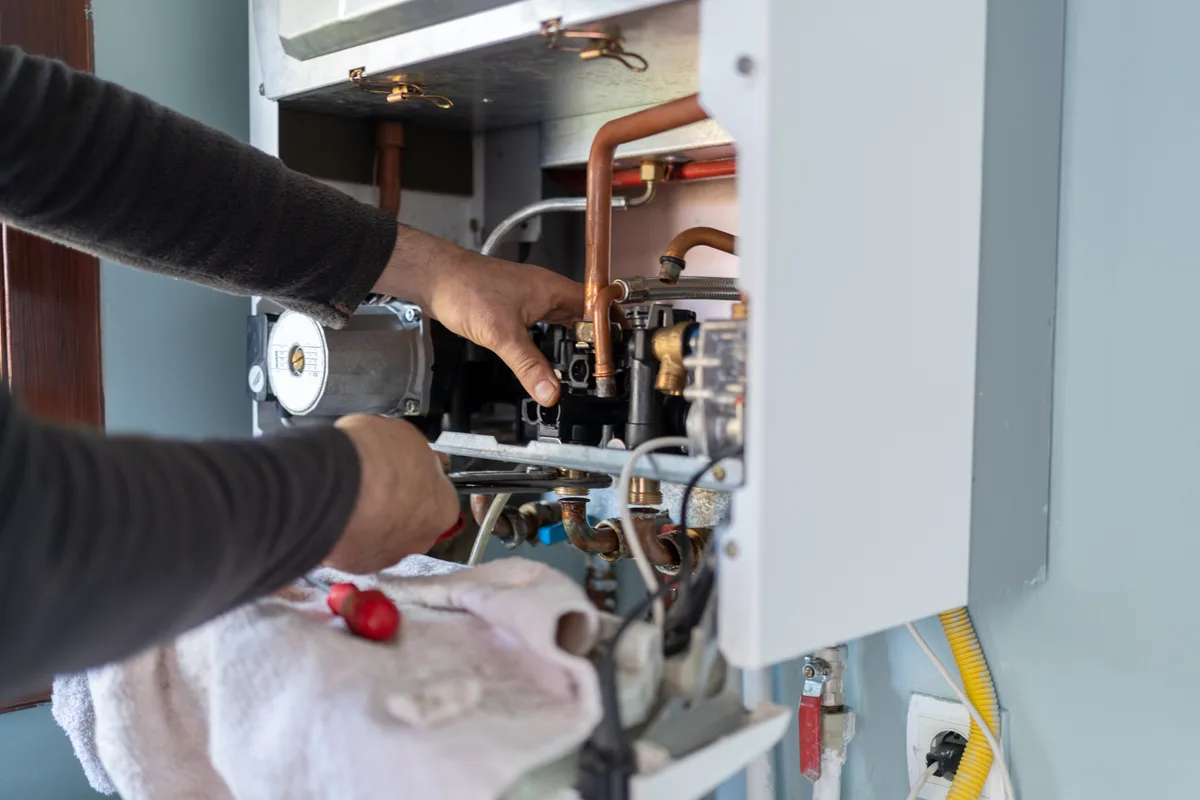
Boiler parts that are worth repairing
- Circulator pump: seized bearings, a failed capacitor or a leaking flange gasket. The boiler fires but the radiators stay cold. Circulator pump replacement is routine work.
- Zone valve: the motor head fails and one zone stops heating, or the valve sticks open and a zone overheats. The head often swaps without draining the system.
- Expansion tank: the internal diaphragm ruptures and the tank waterlogs, so pressure climbs as the boiler heats and the relief valve starts to drip.
- Pressure relief valve: once it has opened a few times it seldom reseats cleanly. Replace it, and fix what made it open, which is usually the expansion tank or the fill valve.
- Igniter, pilot assembly or thermocouple: the boiler will not light or will not stay lit.
- Aquastat: the control that sets the water temperature limits. A failed one leaves the boiler cold or lets it overshoot.
None of these faults says anything about the life left in the boiler. Prices depend on the part and on how much of the system must be drained and refilled, so they are quoted in writing after a $90–$150 diagnostic visit. Typical jobs are listed in what boiler repair costs.
Faults that mean it is time to replace the boiler
- Water weeping between cast-iron sections, or a cracked section. Resealing sections on an old boiler rarely makes economic sense, and a crack usually means thermal shock or low-water firing has already happened.
- A failed heat exchanger on a modulating-condensing (mod-con) boiler, either leaking or corroded and blocked. Out of warranty, the part with labour approaches the price of a new boiler.
- Rust-through at the burner tray or the base of the jacket from years of small leaks or flue condensation.
- Discontinued controls on a boiler where a second major component is also due.
- A warning tag for flue gas spillage that traces back to the boiler and not to the chimney.
Age and efficiency thresholds: 80 per cent cast iron versus 95 per cent condensing
Cast-iron atmospheric boilers, the kind with a draft hood and a metal flue into the chimney, commonly run 25 to 30 years and longer, at about 80 per cent AFUE when they are in good order. A condensing boiler is rated around 95 per cent. The decision rule: past 25 years, replace when one repair costs more than a third of a new boiler or when any leak comes from the block; under 15 years, repair nearly everything except a failed heat exchanger that is out of warranty.
The rated efficiency only shows up when the water returning to the boiler is cool enough for the flue gas to condense, roughly 55 °C or lower. Cast-iron radiators in pre-war brick houses in Hamilton, old Oakville and west Toronto hold a lot of water and heat a room at modest temperatures, so they suit a condensing boiler well. Fin-tube baseboard was designed around hotter water; with an outdoor reset control it still condenses for most of the season, but less in the coldest weeks.
Old gravity systems with large iron pipes need extra care. The new boiler should be piped with a primary-secondary loop or a hydraulic separator, and the system flushed, or decades of sludge end up in a heat exchanger with passages far narrower than the old block had.
What replacing a boiler changes: venting, drain and hot water
- Venting moves from the chimney to a side wall. A condensing boiler vents through certified plastic or polypropylene pipe (ULC S636), with terminations on an exterior wall that must keep their clearances from windows, doors and the gas meter.
- The chimney may be left with one appliance. A gas water heater venting alone into a flue sized for two can need a chimney liner.
- A condensate drain is required. The boiler produces acidic water that has to reach a floor drain or a pump, normally through a neutralizer.
- A combi boiler can take over domestic hot water and remove the tank. Its size is set by the hot water flow you need, not by the heating load, and it suits houses with one or two bathrooms better than large households.
- Gas piping and venting changes are done to CSA B149.1 by a TSSA-licensed gas technician.
There is no flat replacement price, because the venting route, the piping changes and whether a combi replaces the water heater move the number a long way. The drivers are set out in what a new boiler costs in Ontario, and the quote is free and in writing.
Is it safe to wait on a boiler decision?
- Shut it down and call now for water on the floor from the boiler block, a relief valve discharging steadily, soot at the draft hood or a carbon monoxide alarm.
- Book a visit this week for a slow pressure drop, one cold zone, a noisy pump or a relief valve that drips now and then.
- Plan for the off-season when the boiler is past 25 years, running, and you want the replacement done without a cold house.
ZK Mechanical repairs and replaces gas boilers in Burlington, Hamilton, Oakville and the west GTA. If the boiler is down now, start with boiler repair; the technician will say plainly when the diagnosis points to replacement, and why. To arrange a visit, contact us.