
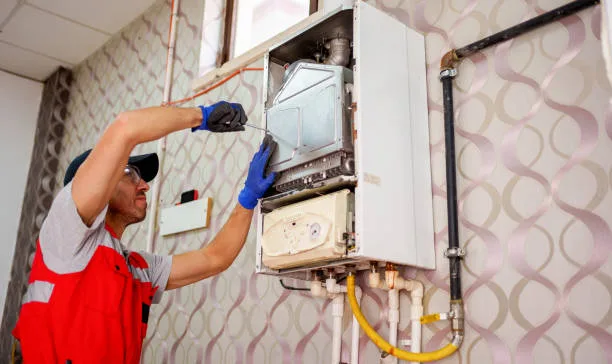
For most Ontario homes the answer is decided by what is already in the walls. If you have ductwork, a gas furnace is the practical choice — it is cheaper to install, and the same ducts carry central air conditioning, filtration and humidification. If you have cast-iron radiators and no ducts, keeping and upgrading the boiler almost always beats a conversion, because tearing ducts into a pre-1960 house costs more than the heating system itself. The interesting cases are the ones in between, and they turn on air conditioning and on return water temperature.
How Each One Actually Moves Heat
A furnace burns gas in a heat exchanger and a blower pushes house air across it, sending roughly 50–60°C air through ducts to registers. Everything else you might want — cooling, filtering, humidifying, ventilating — hangs off that same air stream, which is why a furnace is really a whole-house air system that happens to make heat.
A boiler heats water and a circulator pump sends it to cast-iron radiators, fin-tube baseboard or tubing in a floor. Heat arrives by radiation and gentle convection off warm surfaces rather than by moving air. The system holds pressure — typically around 12 psi cold on a residential system — with an expansion tank absorbing the swell as the water warms, and it needs air bled out of the high points or the top of a radiator goes cold.
Boiler vs Furnace, Compared
- Installed cost: a gas furnace replacement in the GTA runs $3,500–$7,500 depending on tier. A boiler replacement costs meaningfully more for equivalent efficiency, and near-boiler piping is a large share of the labour — get it in writing rather than by rule of thumb
- Distribution: furnace uses ducts and registers; boiler uses radiators, baseboard or in-floor tubing
- Comfort: a furnace delivers heat in bursts of warm air, which some people feel as drafts; a boiler delivers steady radiant warmth from surfaces that stay warm between cycles
- Cooling: a furnace shares its ducts with a central air conditioner; a boiler house needs a separate cooling system entirely
- Air quality: a furnace circulates air, so it can filter and humidify — and can also spread dust if the returns leak; a boiler moves no air at all, so it neither filters nor spreads
- Zoning: boilers zone easily with additional circulators, zone valves or thermostatic radiator valves; furnaces need motorised dampers and a zone panel
- Efficiency: gas furnaces sold in Canada must meet a 95% AFUE federal minimum, and condensing boilers reach comparable numbers — but only under the conditions in the next section
- Service life: a furnace typically runs 15–20 years; cast-iron boilers commonly run far longer, though their circulators, controls and expansion tanks are consumables along the way
The Condensing Boiler Catch Nobody Mentions
A condensing boiler only hits its advertised efficiency when the water coming back from the radiators is cool enough to condense the flue gas — roughly below 55°C. That is the whole trick: the extra efficiency comes from wringing latent heat out of the exhaust, and it stops happening when return water is hot.
Most cast-iron radiators in Ontario houses were sized for water at around 82°C. Bolt a modern condensing boiler onto that system, run it at the old temperature, and it behaves like an expensive mid-efficiency unit. The fix is outdoor reset control, which lowers water temperature as the weather mildens, and radiators generous enough to give up their heat at lower temperatures — which, luckily, oversized old cast-iron rads often are. If a boiler quote does not mention outdoor reset, ask why.
Air Conditioning Decides It for Most Ontario Homes
This is the practical fork. A furnace and a central air conditioner share a blower, a coil cabinet and a duct system, so cooling is an incremental cost rather than a separate project. A boiler house has to solve cooling on its own.
Free quotes, written pricing.
- Ductless mini-splits: the usual answer in a pre-1960 house with radiators. One head per zone, no ductwork, and each head heats as well as cools — see whether a ductless mini-split is worth it in Toronto
- High-velocity small-duct systems: flexible 2-inch tubing snaked through joist bays and closets, which is how many Old Oakville and Westdale houses get central cooling without losing ceilings
- Window units: the cheapest route and the one that costs you the window, the view and a good night's sleep
- Full duct retrofit: possible, expensive, and disruptive in a house with plaster walls and no chases — the comparison in central air versus ductless is worth reading before committing
What Each Costs to Run and to Keep
Running cost tracks fuel and efficiency more than system type. Two 96% appliances burning the same gas will not differ much; what differs is control. A boiler with outdoor reset and a house with heavy radiators rides through a cold snap with fewer, longer, lower-temperature cycles. A right-sized two-stage furnace does the same thing with air.
Maintenance differs more. A furnace visit is combustion, a filter, a blower and a condensate trap. A boiler visit adds system pressure, the expansion tank charge, circulator and zone valve operation, air elimination, and — on a condensing unit — cleaning the heat exchanger and checking the condensate neutraliser. Boiler parts fail one at a time and are usually replaceable, which is why a well-kept boiler outlives two furnaces.
One more thing worth pricing. A combi boiler makes domestic hot water on demand as well as heating the house, which frees the floor space a tank occupies, but its hot-water output is limited by flow rate. In a house where two showers run at once, ask for the litres-per-minute figure at a realistic temperature rise before you agree to lose the tank.
Verdict: The Decision Rule
Have ducts and want cooling: replace with a gas furnace and match the air conditioner to the blower. The GTA furnace cost guide sets out what a straightforward change-out includes and what shows up as an extra.
Have radiators and a working boiler: keep the hydronic system. Upgrade the boiler when it fails, insist on outdoor reset, and solve cooling with ductless heads rather than converting to forced air. Converting a radiator house to ducts is a renovation decision, not a heating one — and it only makes sense when walls are already open.
Have radiators and are gutting the house anyway: run the numbers both ways, including what you lose in floor space and what you gain in filtration and humidity control. Radiant floors in a bathroom or a basement slab can also be added to a hydronic system that already exists, which is an argument for keeping it.
ZK Mechanical's TSSA-licensed technicians handle gas heating work across Burlington, Oakville, Hamilton and the wider GTA. That includes boiler repair and replacement, not just furnaces — if you are weighing a boiler swap against a conversion to forced air, tell us what is in the basement and we will give you a straight read on both, in writing.
Frequently asked questions
Is a boiler or a furnace cheaper to install in Ontario?
A furnace, clearly. A gas furnace replacement in the GTA runs $3,500–$7,500 depending on tier, and a boiler costs more for comparable efficiency because the near-boiler piping, circulators and controls are a large share of the labour. The gap widens if the house has no ducts, since a furnace then needs a full distribution system as well.
Can I add central air conditioning to a house with a boiler?
Yes, but not through the boiler. The common routes are ductless mini-splits, which need only a small refrigerant line per head, or a high-velocity small-duct system that threads 2-inch tubing through joist bays. Full conventional ductwork is possible in a radiator house but is a renovation project, best done when walls are already open.
Are boilers more efficient than furnaces?
Not inherently. Both are sold as condensing appliances with comparable AFUE ratings. The difference is that a condensing boiler only reaches its rating when return water is cool enough to condense flue gas, roughly below 55°C. On radiators sized for much hotter water, that requires outdoor reset control and generous radiator surface, or the efficiency stays on paper.
Should I convert my radiators to forced air?
Rarely, on heating grounds alone. Installing ducts in a pre-1960 house with plaster walls costs more than the heating equipment and takes ceiling height and closet space. Convert when you are gutting the house anyway and want central cooling, filtration and humidification on one system. Otherwise keep the hydronic heat and add ductless cooling.