
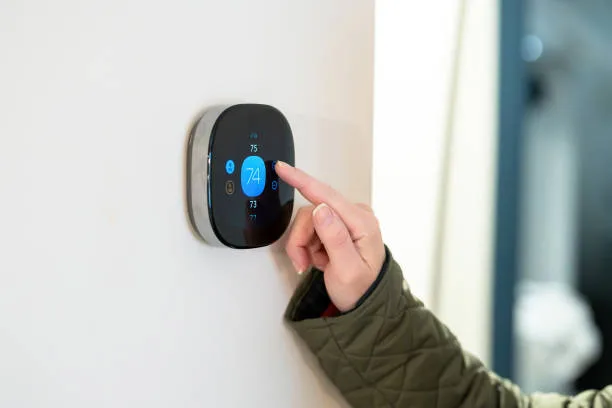
A smart thermostat earns its place in a GTA home for three concrete reasons: remote sensors that let the thermostat average several rooms instead of obeying the hallway it happens to hang in, schedules and geofencing that actually run instead of being overridden, and alerts that tell you the house is at 9°C while you are away. Manufacturers advertise savings around 10–15%, but that figure assumes you were not using setbacks before — if you already set the temperature back at night, expect comfort gains rather than a dramatic bill change.
What Changed From a Programmable Thermostat
The old programmable thermostats failed for a human reason: setting a four-period weekday schedule through two buttons was miserable, so most were left in hold. Smart thermostats moved that job to a phone, which is why the schedules actually get used.
Three other differences matter mechanically. They calculate recovery time and start early, so a 6:30 a.m. setpoint is met at 6:30 rather than begun then. They count blower runtime instead of days, so a filter reminder arrives when the filter has done its work. And they log run cycles, which turns "the furnace seems to run a lot" into a chart you can show a technician.
Remote Sensors Are the Feature That Fixes Comfort
Nearly every complaint about an uneven house traces back to where the thermostat lives — usually a central hallway on the main floor, which is the most thermally comfortable spot in the building. It satisfies while the front bedroom over the garage sits three degrees colder.
A remote sensor in that bedroom, weighted into the average or prioritised at night, changes how long the system runs and how the upstairs feels. It is not a substitute for fixing airflow — an undersized return or a crushed flex duct still needs work, and why one room stays colder than the rest walks through those causes — but it is the cheapest first move in a 1970s–90s two-storey with one central return.
Where the Savings Come From, and Where They Do Not
- Setbacks on a gas furnace: real savings. A house loses heat more slowly the cooler it is, so 8 hours at a lower setpoint costs less than holding temperature, and the recovery does not erase the gain
- Geofencing on an unpredictable schedule: real savings, and more than a fixed schedule delivers for shift workers or hybrid office weeks
- Setbacks on a heat pump: be careful. A deep overnight setback forces a hard recovery, and on many systems that means electric or gas backup heat carrying the load. Small setbacks of a degree or two, or none at all, usually cost less
- Cooling setbacks in a humid Ontario August: modest savings, and worth pairing with the fan on AUTO so the coil is not re-evaporating moisture back into the house
- Zoning by wishful thinking: no savings. A single thermostat cannot heat one floor and not another — that needs dampers and a zoning panel, or a ductless head
If your bills jumped and you are hoping a thermostat fixes it, start with the diagnosis instead: why heating bills climb in winter covers the causes that a control change cannot touch.
The C-Wire and Other Compatibility Traps
Free quotes, written pricing.
Smart thermostats need continuous power, which means a common wire — the C-wire — running from the furnace control board. Houses wired before the late 1990s often ran four conductors and no common.
- If a fifth conductor is present and unused at both ends, landing it on C is the clean fix and takes minutes
- If the cable only has four, a power extender module at the furnace (Ecobee ships one; Honeywell and others sell equivalents) sends power over the existing wires
- Power-stealing thermostats without a C-wire are the ones that cause intermittent, maddening faults: a furnace that starts and stops for no visible reason, or a control board that resets. If your old thermostat worked and the new one misbehaves, this is the first thing to check
- Millivolt systems — old wall furnaces and some fireplaces — generate their own tiny voltage and are not compatible with line-powered smart thermostats at all
- Boilers, zone valves and combi systems can work, but need a model that supports the wiring; do not assume the box on the shelf covers it
Heat Pumps, Two-Stage Furnaces and Dual-Fuel
Wiring gets specific past a single-stage furnace. A two-stage furnace uses W1 and W2, a two-stage air conditioner uses Y1 and Y2, and a heat pump adds an O or B terminal to drive the reversing valve — with O being the common convention on most North American equipment. Fitting a thermostat that only supports one stage means the second stage never runs, and you have quietly paid for capacity you cannot use.
Dual-fuel is the case to get right. The control needs to know the outdoor temperature and hold a balance point, so the heat pump carries mild weather and the furnace takes over below the crossover. Some thermostats do this natively with an outdoor sensor; some rely on the equipment's own control. Getting this wrong is the most common reason a hybrid system disappoints — see whether a heat pump is worth it in Toronto winters for what a correctly set balance point is meant to achieve.
The Ontario Rebate, and What It Applies To
The Home Renovation Savings Program — run by Enbridge Gas and Save on Energy since January 2025 — includes a $75 amount toward a qualifying smart thermostat when it is part of a larger eligible install. It is not a standalone giveaway, and it is small next to the heating and cooling measures in the same program, so treat it as a line item on a bigger job rather than the reason to do one. Check the current amounts and terms on the program page, or through our Ontario HVAC rebates hub.
Verdict: Which Homes Should Fit One
Fit one if your house has a persistent cold or hot room and a C-wire is available, if nobody in the house is home to a fixed schedule, if you travel in winter and want a low-temperature alarm, or if you are already replacing a furnace or heat pump and the wiring is open anyway. In those cases the sensors and alerts justify it on their own.
Skip it if your system is a single-stage furnace on a rigid schedule that already works, or if the real problem is duct balancing, a failing blower or an oversized furnace. A better control cannot fix a system that is short-cycling — that is a mechanical job, not a software one.
ZK Mechanical wires and configures smart thermostats as part of our heating work across Burlington, Oakville, Hamilton and the wider GTA, including two-stage, heat pump and dual-fuel setups where the terminals have to be right the first time. Tell us your furnace model and thermostat wiring and we will confirm compatibility before anything is ordered.
Frequently asked questions
Do smart thermostats really save money in Ontario?
They save if you were not already using setbacks. The gains come from consistent scheduling, geofencing when nobody is home, and recovery timing rather than from the device itself. On a heat pump the picture flips: deep setbacks can trigger backup heat on recovery and cost more, so small or no setbacks usually win there.
What is a C-wire and do I need one?
The C-wire is the common conductor that gives a thermostat continuous 24-volt power. Most smart thermostats need it. Houses wired before the late 1990s often lack one, and the fixes are landing an unused spare conductor, fitting a power extender module at the furnace, or running new cable. Skipping it and relying on power stealing causes intermittent furnace faults.
Will a smart thermostat work with my heat pump or two-stage furnace?
Only if the model supports the terminals your equipment uses — W1 and W2 for two-stage heat, Y1 and Y2 for two-stage cooling, and O or B for a heat pump's reversing valve. Dual-fuel systems also need a balance point set from an outdoor temperature reading. Check the equipment's wiring diagram against the thermostat's compatibility list before buying.
Is there a rebate for a smart thermostat in Ontario?
The Home Renovation Savings Program from Enbridge Gas and Save on Energy includes $75 toward a qualifying smart thermostat installed as part of a larger eligible project. It is not offered as a standalone rebate, and amounts and eligibility change, so confirm current terms on the program page before counting on it in a quote.