
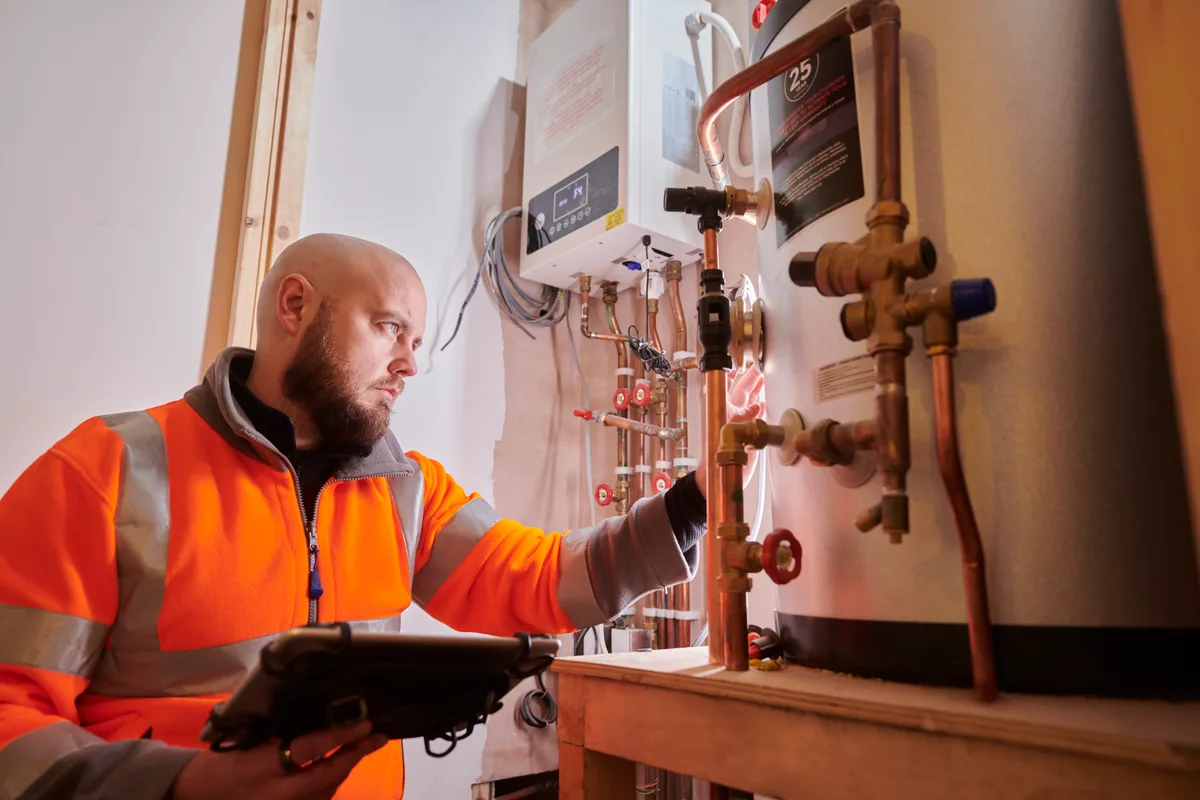
Cast iron vs condensing boiler is a narrower choice than most homeowners expect, because for a hot-water system the replacement is almost always condensing. Canada's Energy Efficiency Regulations require household gas hot-water boilers manufactured on or after July 1, 2023 to reach at least 90% AFUE, and a cast-iron atmospheric boiler cannot. The real decision is whether to keep repairing a sound cast-iron boiler or replace it now. Repair it while the sections are dry and it passes a combustion test; replace it with a condensing boiler when it leaks, cracks or is red-tagged.
Can You Still Buy a Cast-Iron Boiler in Ontario?
For a steam system, yes; for a hot-water system, only from stock built before the rule changed. The federal standard for household gas steam boilers is 82% AFUE, which cast iron meets, so one-pipe and two-pipe steam radiators keep a cast-iron boiler. For hot water, the 90% standard also requires the boiler to ship with an automatic water-temperature adjustment control, which most installers call outdoor reset.
If a quote for a hot-water system lists a non-condensing cast-iron gas boiler, ask for the manufacture date and the AFUE on the rating plate. Remaining stock is thinning, and replacement sections and parts for a discontinued model get harder to find over a 30-year life.
A Condensing Boiler Only Saves Gas When the Return Water Is Cool
The efficiency on the brochure appears only when the water coming back to the boiler is below roughly 54 °C. Under that temperature the water vapour in the flue gas condenses on the heat exchanger and gives up its latent heat, and the boiler runs in the mid-90s. Above it, nothing condenses and the same boiler performs like a good non-condensing unit in the high 80s.
Outdoor reset is what gets it there. The control reads the outdoor temperature and lowers the supply water temperature as the weather warms, so the boiler sends water near 50 °C on a mild day and saves its hottest water for the coldest nights. A condensing boiler installed with reset disabled and a fixed high setpoint is an expensive way to get cast-iron efficiency.
Cast-Iron Radiators Usually Condense; Some Baseboard Loops Do Not
Big radiators are the best partner a condensing boiler can have. The radiators in pre-war brick houses in Hamilton, Old Oakville, downtown Burlington and the west side of Toronto were sized for walls with no insulation and single-pane windows. After new windows and attic insulation they are oversized for the house, so they heat it with cooler water for most of the winter and return it well under the condensing threshold.
Fin-tube baseboard is the opposite case. Baseboard loops in 1950s and 1960s houses were laid out for water near 82 °C, and their output drops steeply as the water cools. On mild days they still condense, but on the coldest days the loop comes back hot and the efficiency gain disappears.
- Cast-iron radiators with outdoor reset: condensing for most of the heating season.
- In-floor radiant: condensing all season, with a mixing control to protect the floor.
- Fin-tube baseboard: condensing in fall and spring, often not on design days unless baseboard length is added or panel radiators replace it.
- The test: measure the return water temperature on a cold day with the current boiler, and compare the radiator output against a room-by-room heat loss.
Venting Changes From the Chimney to the Side Wall
A cast-iron boiler vents by natural draft into a chimney; a condensing boiler pushes cool, wet exhaust through plastic pipe. That one change drives much of the installation work.
- Cast iron: a draft hood and metal vent connector into a masonry chimney, which should carry a liner sized to the appliance.
- Condensing: sealed-combustion plastic venting certified to ULC S636, run through a side wall or the roof in the material the boiler manufacturer specifies.
- Condensate: the acidic water that forms in the heat exchanger drains through a trap and a neutralizer before it reaches a floor drain or a condensate pump.
- The water heater left behind: if a gas water heater shared the chimney, it is now venting alone into a flue that is too large for it and needs a liner, or the boiler can heat an indirect water heater and the old tank goes.
Free quotes, written pricing.
Side-wall terminations have to clear windows, doors, the gas meter and the neighbour's openings. On narrow pre-war lots that sometimes sends the vent up through the old chimney as a chase or out the back wall instead of the side.
Lifespan and Upkeep: 30 Years Against 15 to 20
A cast-iron boiler commonly runs 30 years or more with very little attention. The sections are thick, the controls are simple, and the parts that fail sit outside the block where they are easy to replace. Many are still on a standing pilot.
A condensing boiler lasts 15 to 20 years and needs service every year. Its stainless-steel or aluminum heat exchanger has narrow water passages, and it relies on a combustion fan, sensors, an igniter and a condensate trap that all need cleaning or checking. Skip the annual visit and the trap blocks, the flame signal weakens and the boiler locks out in January.
Old systems add one more requirement. Decades of corrosion leave black iron-oxide sludge in radiators and large-bore pipe, and that sludge will plug a new heat exchanger within a few seasons. A hydronic system flush before the changeover and a dirt separator, ideally a magnetic one, on the return are part of a proper condensing install, not optional extras.
Which Cast-Iron Boiler Faults Are Worth Repairing
Repair anything bolted to the outside of the boiler; replace the boiler when the block itself fails. A diagnostic visit is $90–$150 and is credited to the repair if you go ahead.
- Worth repairing: a seized or noisy circulator, a waterlogged expansion tank, a dripping relief valve, a thermocouple or pilot assembly, a sticking zone valve, a failed aquastat or gas valve.
- Replace instead: water weeping between sections, a cracked section, burners and base rusted through from flue condensation, spillage at the draft hood that a chimney repair does not cure, or a red tag for a heat exchanger fault.
- Plan ahead: a boiler past 30 years that needs its second major part in two winters. Price the replacement in summer so the venting and flushing are not rushed.
Our answer page on whether to repair or replace a boiler walks through the same call by age and symptom.
Verdict: Repair Sound Cast Iron, Replace With Condensing Done Properly
Keep a dry, safe cast-iron boiler running; it owes you nothing and it is cheap to maintain. When it has to go, the replacement for a hot-water system is a condensing boiler, and the installation decides whether you get the efficiency you paid for.
- Keep and repair if the sections are dry, the combustion test is clean, the chimney liner is sound and the faults are external parts.
- Replace with condensing if the block leaks or is cracked, the boiler has been red-tagged, or the chimney needs work that costs more than rerouting the vent.
- Insist on outdoor reset set up for your radiators, a boiler sized to a heat loss rather than to the old nameplate, a flush, a dirt separator and a neutralizer.
- Stay with cast iron on a steam system, where condensing boilers do not apply.
There is no single price for the changeover, because venting, piping and the water heater vary house to house; what a new boiler costs in Ontario explains what moves the number. If yours is down or leaking today, start with our boiler repair service, and if you already hold a replacement quote, send it to us and we will tell you what it is missing.
Frequently asked questions
Will a condensing boiler work with my old cast-iron radiators?
Yes, and they are the best match for one. Large radiators heat the house with cooler water, which keeps the return temperature low enough for the boiler to condense through most of the winter. The system must be flushed first and fitted with a dirt separator, because sludge from old radiators damages the new heat exchanger.
Can a condensing boiler vent into my existing chimney?
Not directly. Condensing exhaust is cool and wet and will soak and damage a masonry flue. Some manufacturers allow their approved plastic or flexible vent system to be run up inside the chimney as a chase. Otherwise the vent goes through a side wall or the roof, and any water heater still on the chimney needs its own liner.
What does the condensate neutralizer do and does it need service?
Condensate from a gas boiler is acidic enough to corrode cast-iron drain pipe and concrete over time. The neutralizer is a small cartridge of mineral media that raises the pH before the water reaches the drain. The media dissolves slowly and is checked and topped up or replaced at the annual service.
Is it safe to keep running a 40-year-old cast-iron boiler?
Age alone is not the hazard. A boiler that drafts properly, passes a combustion test, shows no water between sections and vents into a sound liner can keep working. Have it checked each fall, keep carbon monoxide alarms outside the sleeping areas as Ontario law requires, and budget for replacement so a failure does not force a rushed decision.