
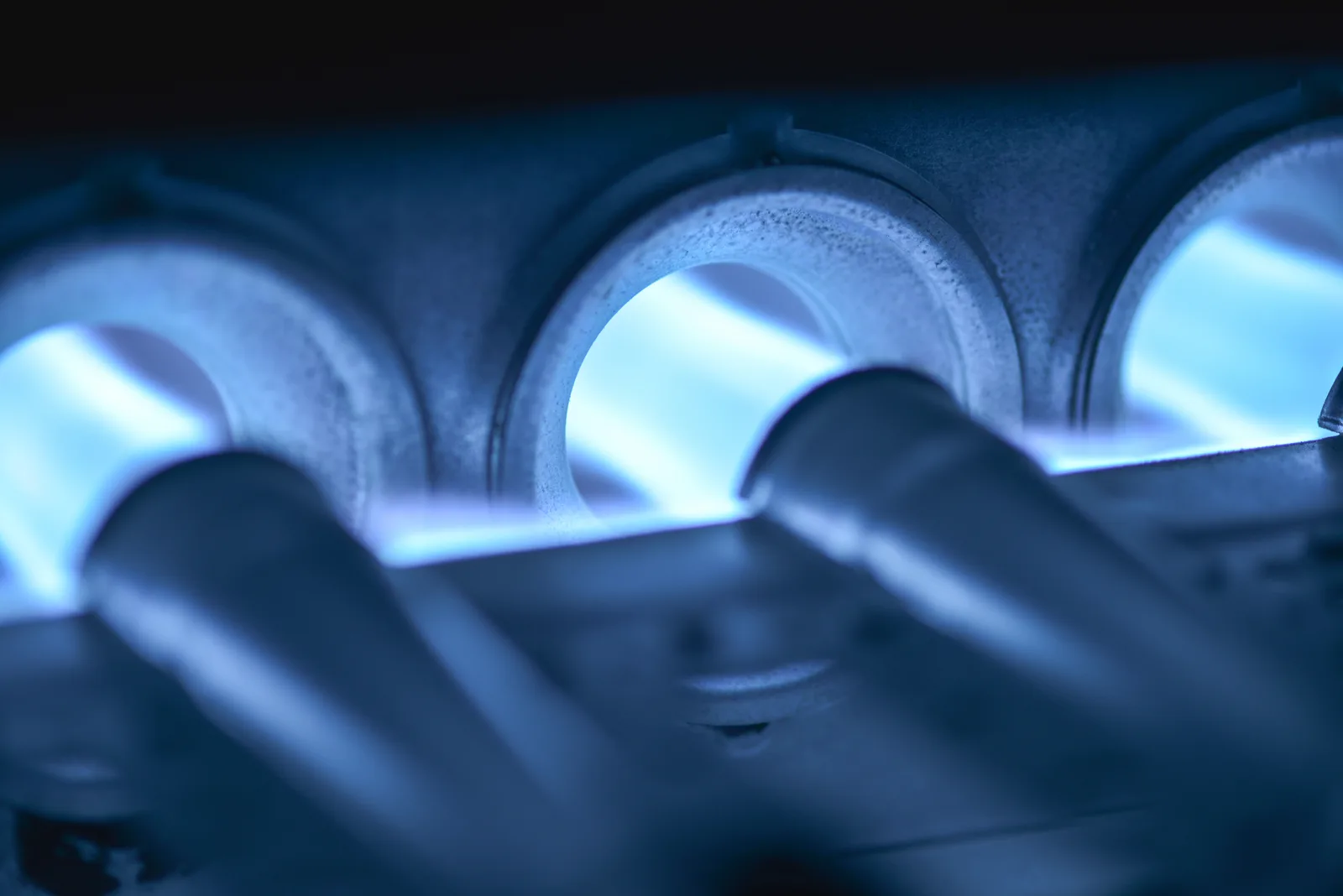
Infrared vs forced-air garage heater is settled by ceiling height and by how often the big door opens. A forced-air unit heater is the better fit for most attached garages with ceilings of roughly 8 to 9 feet, where it tucks into a corner and warms the air quickly. An infrared tube heater is better in a taller shop whose door opens often, because it heats the slab, the vehicles and the person working rather than air that leaves with the next car. Both need a gas line installed by a TSSA-licensed technician and an ignition source at least 450 mm (18 in.) above the floor.
How an Infrared Tube Heater Warms a Garage
A tube heater fires a gas burner down a steel tube and a reflector above the tube directs the radiant heat at the floor. The concrete, the workbench, the vehicles and your back absorb it directly, and the air warms second-hand from those surfaces. It is the same effect as standing in the sun on a cold day.
That is why it recovers fast after the door opens. The warm air escapes either way, but with radiant heat most of the energy is stored in the slab and the objects in the room, so the space feels comfortable again within minutes of the door closing. It is also the better heater for anyone lying on a creeper under a car, because the floor itself is warm.
The limits are about space. Every tube heater has a certified clearance to combustibles below and beside the tube and a minimum mounting height, both printed in its manual. The roof of a parked pickup, lumber on a rack, a kayak hung from the ceiling and the overhead door in its open position all have to sit outside that clearance, which a standard two-car garage often cannot manage.
How a Forced-Air Unit Heater Warms a Garage
A unit heater burns gas inside a sealed heat exchanger and a fan blows room air across it. It hangs from the ceiling in a corner, aims across the space, and raises the air temperature quickly from a cold start. For a garage that sits cold all week and gets turned up on Saturday morning, that fast response is the main advantage.
- It needs a 120 V supply for the fan, the igniter and the power venter, plus a vent through a wall or the roof.
- Low-profile models are built to fit tight against an 8-foot ceiling, clear of the door track and the vehicle roof.
- Separated-combustion models draw their combustion air from outdoors through a sealed pipe. They are the right choice in a woodworking shop, where fine dust would otherwise be pulled through the burner, and anywhere finishes or solvents are used.
- Standard models burn garage air, which is acceptable for parking and general use.
The trade-offs are the mirror image of radiant heat. Warm air rises to the ceiling and leaves when the door opens, the slab stays cold, and the fan moves dust and makes noise. Tube heaters also need a vent and a 120 V circuit, so neither type is a plug-in appliance.
What CSA B149.1 Requires for a Gas Heater in a Garage
The gas code treats a garage as a place where gasoline vapour can collect at floor level, and the rules follow from that. These apply to both heater types.
- The burner and any ignition source must be at least 450 mm (18 in.) above the floor. Ceiling-hung heaters meet this easily; floor-standing appliances with open burners do not.
- The heater must be protected from vehicle impact, either by mounting it out of the vehicle path or by a guard.
- Clearances to combustibles follow the rating plate and the installation manual, not a rule of thumb.
- It must vent to the outdoors with the vent material the manufacturer certifies. Unvented construction and patio heaters are not garage heaters.
- The gas piping and connection are done by a TSSA-licensed gas technician working for a registered contractor, and the electrical circuit follows ESA rules.
One more rule sits outside the gas code. Ontario requires carbon monoxide alarms in homes with a fuel-burning appliance or an attached garage, so check that the alarm outside the bedrooms is in date before a heater goes in.
Free quotes, written pricing.
Ceiling Height, Door Traffic and Dust: Three Things That Decide It
- Ceiling at 8 to 9 feet with a vehicle parked inside: forced air. There is rarely enough room under a tube to meet its clearance.
- Ceiling around 10 feet or more: either works, and infrared becomes practical.
- Door opens many times a day, or you work with it open: infrared, because the heat is in the slab.
- Garage is heated only for occasional weekend use: forced air, because it brings a cold room up quickly.
- Woodworking, sanding or finishing: a separated-combustion forced-air heater, or an infrared tube with its combustion air ducted from outside. Radiant heat also avoids blowing dust onto wet finishes.
- Floor work on vehicles, a hoist, or a detached shop: infrared, mounted to clear the raised vehicle.
Gas Supply, Venting and What Drives the Installed Price
The heater is the predictable part of the price; the gas line and the vent route are not. An attached garage with the gas meter on the same wall is a short run. A detached garage at the back of the lot needs a buried gas line and often a new electrical feed, and that work can cost more than the heater.
We also check that the meter and the existing piping can carry the added load alongside the furnace, water heater and range. On rural lots in Caledon and Flamborough with no gas main, both heater types are available for propane. We do not publish a flat figure for this job; the page on what a garage heater costs installed lists what moves the quote, and what size garage heater you need covers the BTU question.
Insulation changes everything. An uninsulated garage with a bare steel door loses heat faster than a modest heater can replace it, and insulating the door and ceiling first usually drops the heater a size.
When Neither Gas Heater Is the Right Answer
If the garage is becoming a gym, an office or a hobby room and you want it cool in July as well as warm in January, a ductless heat pump does both without a gas line or a vent. It holds a steady temperature in an insulated, closed room and struggles in a leaky one with the door cycling. See garage mini-split installation for where that option fits.
Verdict: Forced Air for Most Attached Garages, Infrared for Tall Working Shops
For the typical attached two-car garage, buy a forced-air unit heater, and make it a separated-combustion model if you make sawdust. Buy an infrared tube heater when the ceiling gives it room and the garage is a workspace with the door in regular use.
- Choose forced air if the ceiling is 8 to 9 feet, vehicles park inside, and you heat the space on demand.
- Choose infrared if the ceiling is 10 feet or higher, the door opens often, or you work at floor level.
- Choose separated combustion in any dusty or solvent-heavy shop, whichever heater type you prefer.
- Choose a mini-split if the room is insulated, closed and needs cooling.
We install and vent both types as part of our heating services, with the gas line sized and pressure-tested by a licensed technician. Measure your ceiling height and the distance from the gas meter, then book a visit through our garage heater installation page or ask for a written quote.
Frequently asked questions
Can an infrared tube heater go in a garage with an 8-foot ceiling?
Sometimes, but often not. The answer depends on the model's minimum mounting height and its required clearance below the tube. Once you subtract the height of a parked SUV or pickup and allow for the overhead door in its open position, many 8-foot garages have no compliant location. We measure before recommending one.
Which type costs less to run, infrared or forced air?
They burn gas at similar efficiency, so the difference comes from how the heat is used. Infrared keeps people comfortable at a lower air temperature and loses less when the door opens, which favours it in a busy shop. In a closed, insulated garage used occasionally, a forced-air heater that runs only when needed costs about the same.
Do I need to insulate the garage before installing a heater?
You do not have to, but it is the cheapest improvement available. An insulated ceiling, insulated walls and an insulated overhead door with good weatherstripping cut the heat loss sharply, which allows a smaller heater and shorter run times. In an uninsulated garage an infrared heater copes better because it does not depend on holding warm air.
Is it safe to leave a gas garage heater on a thermostat overnight?
A vented, certified heater installed to its clearances and controlled by a thermostat is designed to cycle unattended. Keeping the garage at a low setpoint is common in winter. Keep stored items out of the clearance zone, never store open fuel containers near it, and have the heater and its vent checked each year.