
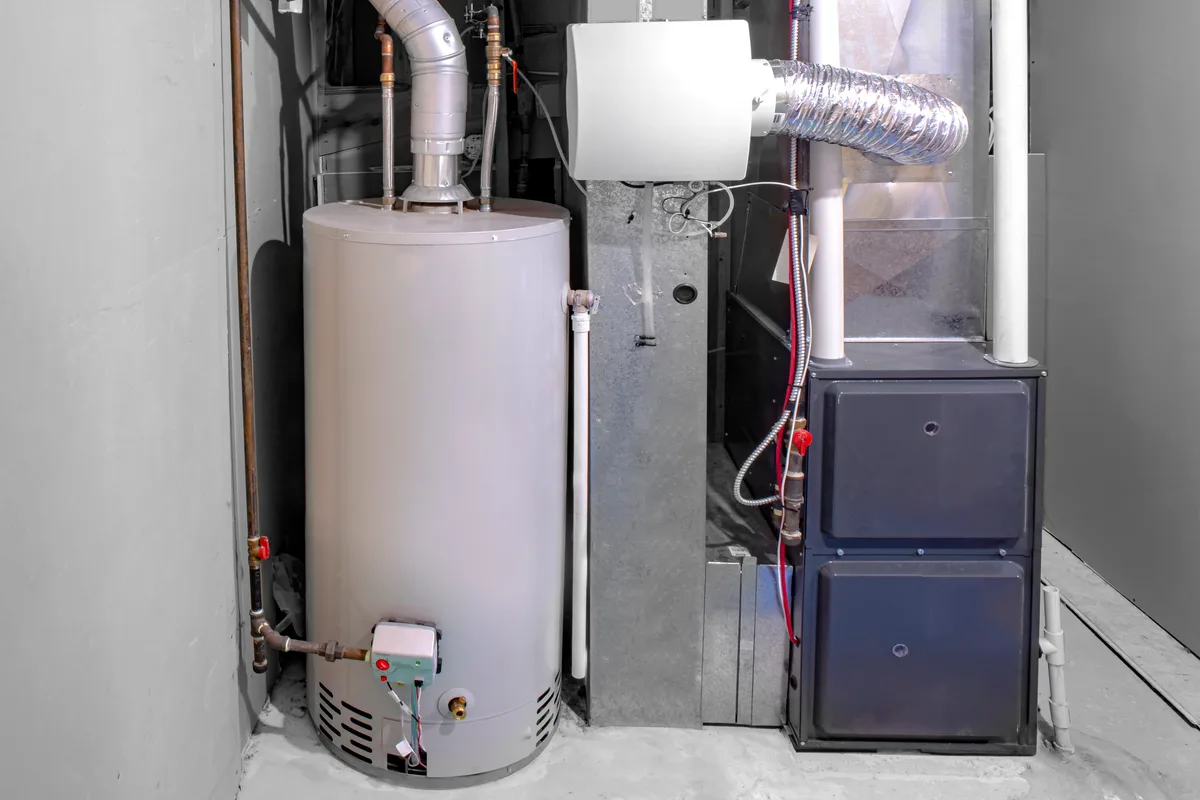
The best furnace for a bungalow in Ontario is usually the smallest one in the catalogue: a 40,000 to 60,000 BTU, 96% AFUE two-stage furnace with an ECM blower, chosen from a heat-loss calculation and not from the nameplate of the old unit. A typical 1,000 to 1,400 sq ft bungalow needs far less heat than the 80,000 or 100,000 BTU furnace many still carry. Get the size and the cabinet configuration right first, sort out the water heater venting second, and choose the brand third.
What Size Furnace a 1,000 to 1,400 sq ft Bungalow Needs
After a proper calculation, most bungalows in this range land at 40,000 to 60,000 BTU of input. At 96% efficiency a 60,000 BTU furnace delivers 57,600 BTU to the ducts, which is more than a one-storey house with upgraded windows and a topped-up attic loses on the coldest night of the year.
The calculation is a CSA F280 heat loss, done room by room from wall area, insulation, windows and air leakage. The basement counts, because a bungalow's basement has the same footprint as the main floor and the furnace heats it whether it is finished or not. Square footage alone will not get you the right answer, and neither will the size of the furnace coming out.
Why Oversizing Is the Common Bungalow Mistake
The 1950s and 1960s bungalows across Aldershot, the Hamilton Mountain, Etobicoke and older Mississauga were fitted with large furnaces, and each replacement since has tended to copy the last one. Meanwhile the houses gained insulation and tighter windows. The result is a furnace two sizes too big for the building it serves.
- It short-cycles: a few minutes of heat, a shutdown, and a wait, repeated all winter.
- It is loud, because the ducts were sized for less air than the blower pushes, and the bedrooms in a bungalow sit a few metres from the furnace.
- Rooms swing between too warm and cool instead of holding one temperature.
- The high-limit switch trips when the furnace cannot shed its heat fast enough, which shortens the life of the heat exchanger.
If a quote lists the same BTU as the old furnace and nobody measured the house, ask to see the calculation. Our answer on whether a furnace can be too big for a house explains what the short cycles cost you.
Upflow, Downflow or Horizontal: Match the Furnace to the Foundation
The foundation decides the cabinet. A bungalow on a full basement takes an upflow furnace, and a bungalow on a slab or a crawlspace takes a downflow or horizontal one.
- Full basement: an upflow furnace on the basement floor, blowing up into a trunk line along the basement ceiling. This covers most bungalows in Halton and Hamilton.
- Slab-on-grade: a downflow furnace in a main-floor closet, blowing down into ducts cast in or under the slab. Have those ducts inspected with a camera first, because in-slab ducts from that era can be rusted, wet or partly collapsed.
- Crawlspace: a horizontal furnace laid on its side in the crawlspace, or a downflow furnace in a closet above it. A condensing furnace in an unheated crawlspace needs its trap and drain protected from freezing and a clear path for service.
Many furnaces convert between upflow and horizontal in the field, while downflow is often a separate model, so the configuration has to be named on the quote. A downflow furnace set on a combustible floor also needs the manufacturer's sub-base under it.
Stages and Blower: What a One-Floor House Needs
Free quotes, written pricing.
A bungalow has no upstairs to balance, so staging here is about noise and cycle length. Two-stage is our first choice because low fire brings even the smallest furnace closer to the real load, and it runs quietly under the bedrooms. A correctly sized single-stage furnace with an ECM blower is a fair second choice when the budget is fixed.
Check the blower against the air conditioner as well. Most bungalows cool with 1.5 to 2.5 tons, and the furnace blower has to deliver that airflow through the same ducts. A small furnace with a blower matched to the cooling load is the right pairing; a large furnace bought for its blower is the wrong one.
The Orphaned Water Heater Problem
When a high-efficiency furnace leaves the chimney, a gas water heater that shared it is left venting alone. The flue was sized for two appliances, so the water heater's small volume of exhaust cools, condenses on the masonry and may not draft at all. That can spill combustion gases, carbon monoxide included, into the basement.
- Line the chimney with a liner sized to the water heater alone. Our guide to chimney liners at furnace replacement shows when one is required.
- Replace the tank with a power-vent water heater that exhausts through the side wall, and retire the chimney for gas appliances.
- If the tank is more than ten years old, replacing it during the furnace job avoids paying for a liner that serves it for only a few years. A tank replacement runs $1,200–$2,500 installed, depending on size and venting.
This is the line most often missing from a low bungalow quote. Ask what the water heater vents into after the furnace is gone, and get the answer in writing.
What a Bungalow Furnace Costs Installed
- High-efficiency furnace, standard replacement: $4,300–$7,000 installed across the GTA, with most jobs between $4,500 and $6,500.
- Condensate pump, where the floor drain is on the far side of the basement: $250–$450 installed.
- Chimney liner, duct corrections and in-slab duct repairs: quoted after we see them.
A 40,000 BTU furnace does not cost much less than an 80,000 BTU one, because the labour, the venting and the gas connection are the same. The saving from sizing correctly shows up in comfort, noise and the life of the equipment.
Verdict: Small, Two-Stage, and Sized by Calculation
- Buy a 40,000 to 60,000 BTU, 96% AFUE two-stage furnace with an ECM blower if the heat loss supports it, which it usually does.
- Buy single-stage only if the budget requires it and the size is right.
- Match the cabinet to the foundation: upflow for a basement, downflow or horizontal for a slab or crawlspace.
- Settle the water heater venting in the same quote.
- Walk away from any quote that sizes by square footage or by the old furnace.
We measure the house before we recommend a size, and we put the heat loss, the model and the venting plan on paper. Read how the job runs on our furnace installation page, or book a free in-home quote for your bungalow in Burlington, Oakville, Hamilton, Mississauga or Etobicoke.
Frequently asked questions
Is 40,000 BTU enough for a bungalow with a finished basement?
Often, yes. A finished basement is mostly below grade, where the soil keeps heat loss low, so it adds less load than its floor area suggests. A 1,000 sq ft bungalow with updated windows and attic insulation can calculate well under 40,000 BTU including the basement. The heat-loss calculation settles it for your house.
Will a smaller furnace take longer to warm the house?
Slightly, after a deep thermostat setback. A correctly sized furnace runs longer cycles and recovers a few degrees more slowly than an oversized one. In exchange it holds temperature more evenly, runs quieter and lasts longer. Keeping setbacks to two or three degrees removes most of the recovery delay.
Can the furnace go in the attic of a bungalow?
It can be done with a horizontal furnace, but we rarely recommend it for a condensing unit. The condensate trap and drain can freeze in an unheated attic, service access is poor, and a leak lands on the ceiling below. A basement, crawlspace or main-floor closet location is easier to protect and maintain.
Should I put a heat pump in a bungalow instead of a furnace?
A bungalow is a good candidate, because the load is small and the duct runs are short. The common approach is a hybrid: a small two-stage furnace with a cold-climate heat pump in place of the air conditioner, so the heat pump carries mild weather and the furnace takes the cold nights. The heat pump is the part current rebates apply to.