
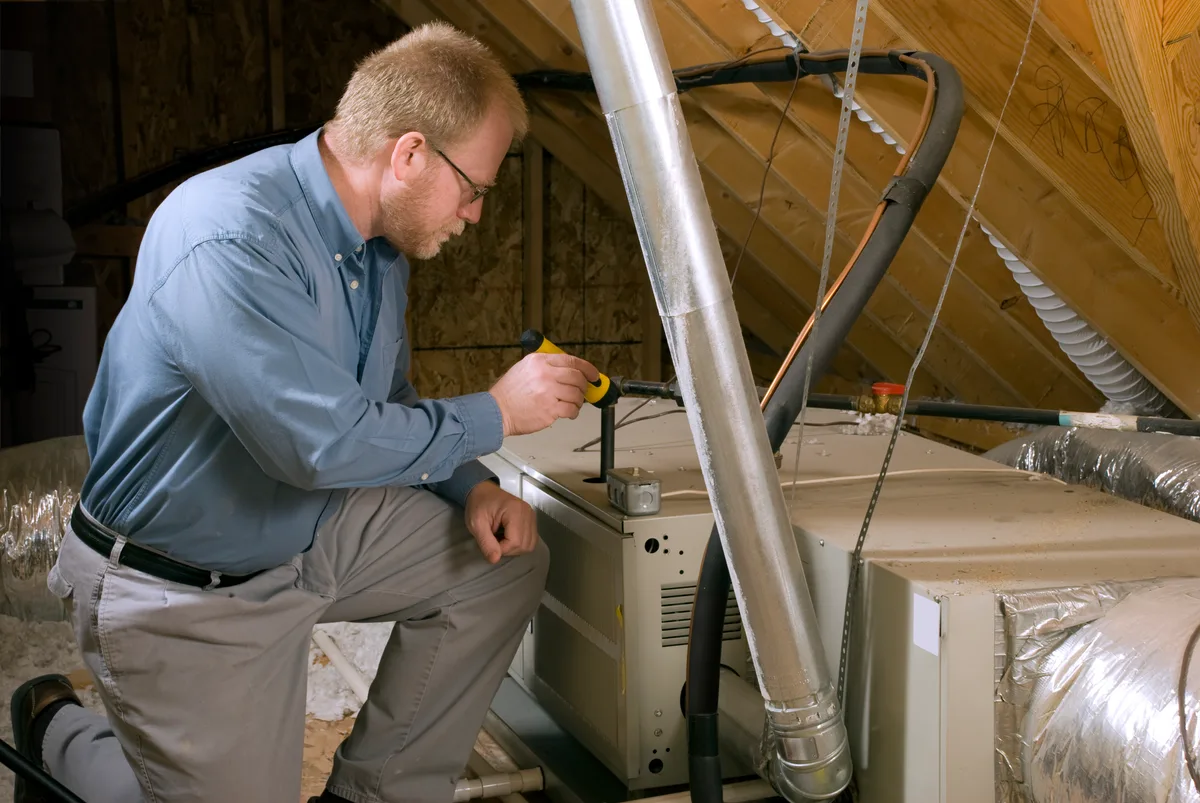
The best furnace for a townhouse in Ontario is a 40,000 to 60,000 BTU two-stage condensing furnace in a narrow cabinet, installed as a two-pipe direct-vent system. Shared walls cut the heat loss, so capacity is rarely the problem in a townhouse; the vent termination and the mechanical closet are. Work out where the two pipes can leave the building before you compare brands, because on a middle unit that route can rule a model in or out.
How Much Furnace a Townhouse Needs
A townhouse loses heat through the front wall, the back wall and the roof, and almost none through the party walls, because the neighbours on the other side are heated too. A middle unit has two shared walls and an end unit has one. That is why a townhouse needs noticeably less furnace than a detached house of the same floor area.
The calculated heat loss of a middle unit often comes in below the output of the smallest furnace most brands make, which is 40,000 BTU. End units and three-storey layouts tend toward 60,000. Our rule: when the heat loss is under about 30,000 BTU/h, buy two-stage or modulating, because low fire on a 40,000 BTU furnace sits much closer to what the house needs than full fire does.
Narrow Cabinets and the Mechanical Closet
Small furnaces come in the narrowest cabinets, usually 14 or 17-1/2 inches wide. Goodman, for example, lists its GR9S96 at 34-1/2 inches tall and 14 inches wide. That short, slim format is what lets a furnace, an air conditioner coil and a filter rack stack inside a closet with a normal ceiling.
- Service clearance: the manual sets a clear space in front of the furnace, and the closet door has to open wide enough for a technician to pull the blower.
- Height: measure floor to ceiling, then subtract the furnace, the coil and the transition. A tall cabinet that fits on paper can leave no room for the coil.
- Drain: a condensing furnace makes water. If the closet has no floor drain, a condensate pump at $250–$450 installed sends it to the laundry standpipe.
- Filter access: the filter slot must be reachable without tools, or it will not get changed.
- Noise: a closet beside the living room or under a bedroom is where a two-stage burner and an ECM blower earn their cost.
Why Closet Installs Need Two-Pipe Direct Vent
A furnace in a closet should take its combustion air from outdoors through its own pipe. In a two-pipe direct-vent setup one pipe brings outside air to the sealed burner compartment and the second carries the exhaust out, so the furnace draws nothing from the room around it.
That matters in a tight townhouse. A dryer, a range hood and bathroom fans all pull air out of the house, and a furnace that depends on room air has to compete with them. A single-pipe installation also needs combustion-air openings sized by the gas code, which a small closet seldom has.
There is a durability reason as well. Many townhouse furnaces share a room with the laundry, and bleach and detergent vapours drawn through the burner corrode a heat exchanger over time. Outdoor combustion air avoids it.
Where the Vent Can Exit: CSA B149.1 Clearances on a Narrow Lot
A townhouse has two outside walls and both are crowded. The gas code and the furnace manual set minimum distances from the vent termination to nearby openings and equipment, and the manual's table governs where it is stricter.
Free quotes, written pricing.
- A minimum distance from any window or door that opens, set by the size of the furnace.
- Clear of the vent outlet on the gas service regulator, which sits at the meter on the front wall of most townhouses.
- A larger distance from a mechanical air intake, such as the fresh-air hood of an HRV.
- A minimum height above grade, and higher where snow drifts against the wall. The exact figures are in the furnace manual and the current gas code.
- Not directly above a paved walkway or driveway that runs between two dwellings and serves both.
Now put those on a real wall. The front has the gas meter, the front door, a window and often the garage. The back has a patio door, windows, a deck, the air conditioner and the neighbour's openings a short distance past the party wall.
When no wall location passes, the pipes go through the roof. That adds length and elbows, and every furnace has a maximum equivalent vent length that can force a step up from 2-inch to 3-inch pipe. The differences between layouts are covered in our guide to furnace venting types.
Replacing an existing high-efficiency furnace is simpler, because the holes are already there. The old pipe may still have to go: new furnaces must be vented in plastic certified to ULC S636, and older uncertified ABS or PVC runs are replaced with the furnace.
Condo Townhouse or Freehold: Who Approves the Holes
In a condominium townhouse the exterior walls and roof are usually common elements, so a new wall or roof penetration needs the corporation's approval before the work is booked. Reusing the existing penetrations is normally straightforward. Moving them, or adding an intake pipe where there was only an exhaust, is what triggers an application.
Ask the property manager what the declaration and rules require, and allow time for the board to meet. The process is close to the one in our answer on condo board approval for an AC or heat pump. A freehold townhouse has no board to ask, but the code clearances and the manufacturer's vent table apply all the same.
What a Townhouse Furnace Costs Installed
- High-efficiency furnace replacement using the existing vent route: $4,500–$6,500 installed for most jobs.
- The full GTA band for a new high-efficiency furnace: $4,300–$7,000, with long roof vent runs and closet rework toward the top.
- New wall or roof penetrations, vent re-piping and condensate pumps: itemized on the written quote.
The small furnace does not bring a small price, since the venting, gas and commissioning work matches a larger install. Budget by the vent route and the closet, not by the BTU.
Verdict: Small, Two-Stage, Two-Pipe
- Buy a 40,000 BTU two-stage furnace for a middle unit, and consider 60,000 BTU only for an end unit or a three-storey plan where the calculation calls for it.
- Buy the narrowest, shortest cabinet that leaves room for the coil and for service.
- Insist on two-pipe direct vent in any closet or laundry-room location.
- Confirm the termination against the clearances, and get condo approval in hand, before you pay a deposit.
- Skip modulating unless the heat loss is very low or the closet is beside a bedroom and silence matters.
Three-storey units have their own airflow problems, which we cover in heating and cooling a three-storey townhouse, and if you are weighing electric heat instead, read heat pumps for townhouses. For the furnace itself, our furnace installation page describes the visit, and you can request a written quote with a photo of the closet and both outside walls.
Frequently asked questions
Can I put a bigger furnace in my townhouse so it heats faster?
It will heat faster and feel worse. An oversized furnace in a low-loss townhouse runs for a few minutes, overshoots the thermostat and shuts off, leaving the upper floor uneven and the closet noisy. The ducts in most townhouses were also sized for a small furnace and cannot carry the airflow a larger one needs.
Can a townhouse furnace vent through the roof instead of the wall?
Yes, if the total pipe length and number of elbows stay within the furnace's vent table, which sometimes requires larger pipe. The roof penetration needs a proper flashing and the terminations must sit above the expected snow level. In a condo townhouse the roof is a common element, so approval comes first.
Can I keep the old plastic vent pipes when the furnace is replaced?
Only if they are the certified material and size the new furnace's manual calls for and they are in good condition. Plastic venting on new gas appliances in Ontario must be certified to ULC S636. Older uncertified pipe, or pipe glued with the wrong cement, is replaced along with the furnace.
Will a new furnace be quieter in a main-floor closet?
Usually. A two-stage burner on low fire and an ECM blower that ramps up slowly make far less noise than an older single-stage furnace with a fixed-speed motor. Sealed two-pipe combustion removes the burner roar from the room. Proper sizing matters most, because an oversized furnace is loud whatever its features.