
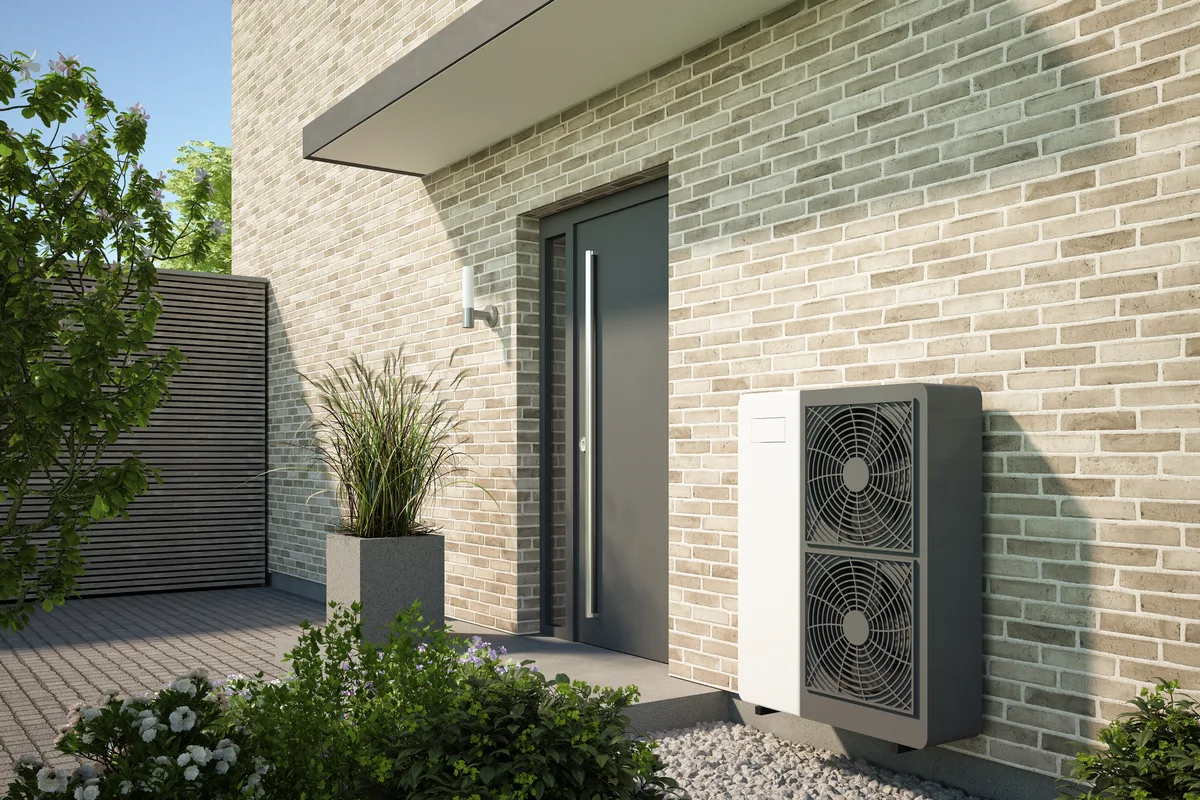
The right heat pump for a townhouse depends on three things you can check tonight: who owns the outside wall, how much yard or balcony you have, and whether the panel is 100 or 200 amps. For a freehold townhouse with a gas furnace and a 100-amp service, a hybrid system (a slim side-discharge heat pump on the existing furnace) is the usual answer in Ontario. A condo townhouse needs the corporation's written approval before anything is mounted outside.
Freehold or Condo Townhouse: Who Has to Approve the Outdoor Unit
In a freehold townhouse the decision is yours; in a condo townhouse the exterior usually is not. The outside walls, roof, and often the yard or balcony of a condominium townhouse are common elements or exclusive-use common elements. A new outdoor unit, a line-set hole through brick and a condensate drain all alter them.
Ontario's Condominium Act deals with owner changes to common elements in section 98: the board has to approve the change, and the approval is normally recorded in an agreement that sets out who maintains and insures the equipment. Ask the property manager for the corporation's heat pump or air conditioner policy before you collect quotes. Many policies specify where units can sit, what the line-set cover must look like and how loud the unit may be. Our answer on condo board approval for an AC or heat pump covers what to send them.
Freehold owners are not free of rules. Municipal zoning sets how close equipment can sit to a lot line and noise bylaws apply, and a townhouse lot leaves little room for error on either. Some freehold rows also share a private road or parking area through a common-elements corporation, so check your title documents if you are unsure which kind you own.
Which Outdoor Unit Fits a Small Rear Yard or Balcony
A slim side-discharge inverter unit is the right shape for a townhouse. It is a shallow cabinet that blows air out the front instead of up through the top, so it can stand close to the house wall or hang on a wall bracket and leave the patio usable. A traditional cube-shaped top-discharge unit needs open space on every side and above.
Three placement details decide whether you and the neighbours can live with it.
- Sound. In a row of townhouses the nearest bedroom window may belong to the neighbour, a few metres away. Compare the outdoor sound rating in dB(A) on each quote, pick the location furthest from windows on both sides of the fence, and avoid inside corners where two walls reflect the sound back.
- Defrost meltwater. In heating mode the outdoor coil frosts over and the unit melts it off at intervals, releasing water under the cabinet. On the ground that water needs gravel or a drain path that is not your walkway. On a balcony it must not drip onto the unit below or freeze across the deck, which often rules a balcony out unless a drain pan and a protected drain route are possible.
- Snow and airflow. The unit sits on a stand or bracket above expected snow, clear of the fence and the dryer vent, with open air in front of the fan.
Inverter units run at part speed most of the time, and part speed is quiet, which matters more on a narrow townhouse lot than on a detached one. The trade-offs between cabinet styles are covered in our comparison of side-discharge and top-discharge units.
Hybrid With the Existing Furnace or All-Electric: The 100-Amp Question
On a 100-amp service, hybrid is usually the only version that fits without a panel upgrade. The heat pump takes over the circuit the air conditioner used, the furnace blower moves the air, and the gas furnace is the backup on the coldest nights. Nothing new and large is added to the panel.
All-electric means replacing the furnace with an air handler and an electric backup heater. A 10 kW heater by itself pulls roughly 42 amps on a 240-volt circuit. Add a range, a dryer and perhaps an EV charger, and a 100-amp service often fails the load calculation. The job then grows to include a 200-amp upgrade through your utility (Burlington Hydro, Oakville Hydro, Milton Hydro, Alectra Utilities or Toronto Hydro) and an ESA permit taken out by a licensed electrical contractor.
Free quotes, written pricing.
Many 1980s–2000s townhouses across Mississauga, Brampton, Milton and Burlington were built with 100-amp services, so read the main breaker before assuming anything. The steps and the usual triggers are in our guide to electrical panel upgrades for a heat pump.
Townhouse Layouts That Change the Plan
Shared walls cut heat loss, so a townhouse needs a smaller heat pump than a detached house of the same floor area, and oversizing is the common mistake. An interior unit has two exposed walls instead of four. We size from a room-by-room heat-loss calculation, not from the tonnage of the old air conditioner.
- Three-storey and stacked townhouses: the top floor overheats in summer and the ground floor runs cold in winter. A variable-speed heat pump running long, slow cycles helps, and some layouts need a second small ductless unit on the top floor. See heating and cooling a three-storey townhouse.
- Combo-heated units: if a tankless water heater feeds a coil in an air handler instead of a furnace, the heat pump coil has to match that air handler, and the equipment may be a rental.
- 1970s electric-baseboard rows: there are no ducts, so the answer is ductless, with one indoor head per main space.
What a Townhouse Heat Pump Costs in Ontario
Townhouse systems are smaller than detached-house systems, which keeps most quotes away from the top of the published bands.
- Ducted cold-climate heat pump serving the whole house: roughly $6,000–$16,000 installed before rebates
- Ductless single-zone: $4,000–$7,000 installed; dual-zone: $7,500–$11,000 installed
- Current Ontario rebates: $500–$7,500 depending on system, through the Home Renovation Savings Program
A panel upgrade, a long line-set route up a three-storey wall, a wall bracket and condo-specified covers all add to the base price. The rebate requires a participating contractor and approval before the install, so line that up before you book a date.
Verdict: The Heat Pump That Suits Most Ontario Townhouses
For a freehold townhouse with ducts, a gas furnace and a 100-amp panel, buy a hybrid system built on a slim side-discharge inverter heat pump. It heats the house electrically for most of the season, keeps gas for the coldest nights, cools better than the old air conditioner and avoids the panel upgrade.
- Choose hybrid if the furnace is under about ten years old and the panel is 100 amps.
- Choose all-electric if the furnace is at the end of its life, the service is 200 amps or you are upgrading it anyway, and you want the gas meter gone.
- Choose ductless if the house has baseboards or radiators and no ducts.
- Wait if you are in a condo townhouse and do not yet have the corporation's approval in writing.
We measure the yard or balcony, check the panel, run the heat-loss calculation and mark the unit location on the quote so it can go straight to a condo board if needed. Start with heat pump installation, or send us the address and a photo of your panel.
Frequently asked questions
Can a heat pump go on a townhouse balcony?
Sometimes. The balcony has to carry the weight, leave the clearances the manufacturer requires in front of the fan, and give defrost meltwater somewhere to go that is not the balcony below. In a condo townhouse the balcony is usually an exclusive-use common element, so the corporation decides. A wall bracket at ground level or a rear-yard stand is the simpler location where one exists.
Will a heat pump be too loud for my neighbours in a townhouse row?
A current inverter unit is usually quieter than a single-stage air conditioner for most of its running hours, because it rarely runs at full speed. Location does the rest: keep it away from bedroom windows on both sides, out of inside corners and on a solid stand that does not pass vibration into the wall. Ask for the sound rating in dB(A) on every quote.
Do I need a 200-amp panel for a heat pump in a townhouse?
Not for a hybrid system. The heat pump uses a circuit similar to the air conditioner it replaces and the gas furnace provides the backup heat. A 200-amp service becomes necessary when the furnace is removed and an electric backup heater is added, or when an EV charger and other large loads already crowd a 100-amp panel. A load calculation by a licensed electrician settles it.
Can I add a heat pump to my existing townhouse furnace?
Yes, if the furnace is in good condition and its blower and control board can work with the heat pump's coil and thermostat. The outdoor unit replaces the air conditioner, a matched coil goes on top of the furnace and a dual-fuel thermostat decides when gas takes over. A furnace near the end of its life is better replaced at the same visit.