
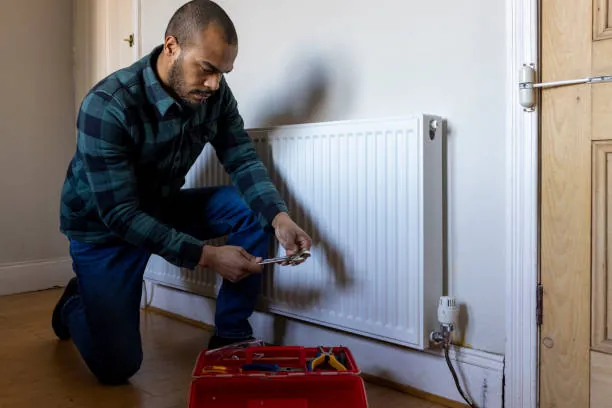
Converting radiators to forced air is worth it only when the house is already being gutted, or when the hydronic piping itself is failing. In a finished two-and-a-half-storey brick house, new ducts cost closets, ceilings and plaster, and most owners who want air conditioning get a better result by keeping the boiler and adding ductless or an attic air handler for cooling. If the walls are staying closed, do not convert.
Where Ducts Go in a Two-and-a-Half-Storey Brick House
Ducts have to run inside the house, because a solid brick wall has no cavity to hide them in. Pre-war houses in lower Hamilton, old Oakville, downtown Burlington and west Toronto have double-brick exterior walls with plaster over thin strapping. Every supply and return has to find an interior route from the basement to the second and third floors, and each route costs a finish.
- Closets: the usual riser route runs up through a stacked pair of closets, and each one gives up a corner or a full depth of shelf.
- Boxed chases: where closets do not line up, a framed and drywalled chase climbs a room corner and shows on every floor it passes.
- Bulkheads: branch ducts cross rooms under the joists, so ceilings gain dropped bulkheads that cut through crown moulding and plaster medallions.
- Basement trunk: the main supply and return trunks hang below the joists and take headroom from a basement that is often low to begin with.
- Floors and walls: every room needs a supply register cut into hardwood or baseboard, and the return air needs openings as well.
The third-floor half-storey is the hard part. Knee walls and sloped ceilings leave little room for a riser, and air pushed up from a basement furnace arrives weak. A conversion that works usually ends up as two systems: one in the basement for the lower floors and an air handler in the attic or knee wall for the top.
What You Give Up Along With the Radiators
You trade quiet, even radiant heat for moving air. Cast-iron radiators hold heat and release it slowly, there is no blower noise, and each room can be trimmed with its own valve. Forced air heats faster and adds filtration, humidification and central cooling through the same ducts, but supply registers in a retrofit rarely land in the ideal spot under the windows.
Resale cuts both ways. Some buyers want central air on the listing; others look for intact plaster and working radiators. Neither is a reason to convert a boiler system that heats the house well.
The Alternative Most Owners Choose: Keep the Boiler, Add Cooling
Keeping the boiler and adding a separate cooling system gives you air conditioning without opening the main-floor walls. There are three ways to do it.
- Ductless mini-split: one outdoor unit and wall or ceiling heads in the rooms that need cooling. Single-zone systems run $4,000–$7,000 installed, dual-zone $7,500–$11,000, and three to four zones $10,000–$16,000+. Cold-climate models also heat, which takes load off the boiler in spring and fall.
- Attic air handler: a cooling coil and blower in the attic or third-floor knee wall, with short insulated ducts to ceiling registers in the second-floor rooms. Cool air falls, so ceiling supplies suit cooling well. The main floor gets what drifts down the stairs unless a second zone is added.
- High-velocity small-duct system: flexible 2-inch supply tubes that snake through joist bays and closets with far less demolition than sheet-metal ducts. See high-velocity AC installation.
If the boiler itself is the worry, replace the boiler, not the whole distribution system. The radiators and iron pipes usually outlast several boilers. Our guide to air conditioning without ductwork compares the cooling options in more detail.
Free quotes, written pricing.
Asbestos, Gas and the Chimney: What Removal Involves
Removal starts with a test, not a saw. White or grey wrap on old boiler pipes, and the insulating jacket on some old boilers, may contain asbestos. Ontario Regulation 278/05 sets out how asbestos must be handled on construction and repair work, so no contractor should cut out wrapped pipe until a sample has been tested and, if it is positive, a trained abatement contractor has removed it.
- Gas: the boiler's gas line is disconnected and capped by a TSSA-licensed gas technician under the CSA B149.1 gas code. This is not a handyman task.
- Water: the system is drained, and the feed line, backflow preventer and expansion tank are removed or capped.
- Radiators and pipe: cast-iron radiators are heavy enough to need two or three people and floor protection on the stairs, and pipe runs through floors leave holes to patch.
- Chimney: if the boiler shared a masonry chimney with a gas water heater, removing the boiler leaves the water heater alone on a flue that is now too large for it. That flue has to be checked and often relined.
The new duct system is a building-permit job. Unlike a like-for-like furnace swap, a first-time forced-air system needs a permit from your municipal building department (the City of Hamilton, City of Toronto, Town of Oakville or City of Burlington, for example), with a heat-loss calculation and a duct design attached.
What Drives the Cost of a Full Conversion
There is no honest price band for a radiator-to-forced-air conversion, because the furnace is the small part of the bill. The equipment sits in familiar ranges: a high-efficiency furnace install runs $4,500–$7,500 and central air on existing ducts $3,500–$7,500. The ductwork, carpentry, plaster repair, abatement and boiler removal around them are priced house by house.
- How many floors need ducts, and whether the closets stack
- Whether the basement is finished
- The asbestos test result and how much pipe is wrapped
- One system or two
- How much plaster, trim and hardwood restoration you expect afterward
That is why we quote these only after walking the house with you, and why the written quote separates ductwork installation from equipment, abatement and finishing. Typical equipment figures are on our pricing page.
Verdict: When Converting Is the Right Call
Convert when the walls are open anyway; otherwise keep the radiators.
- Convert if you are doing a full gut renovation, the hydronic pipes are leaking inside walls, or radiators have already been removed from much of the house.
- Keep the boiler and add ductless or an attic air handler if the heat works and what you want is cooling.
- Replace the boiler and keep the radiators if the boiler is old but the piping is sound.
ZK Mechanical works on both sides of this decision: boilers and radiators, and new duct systems. Tell us which rooms are too hot in July and how old the boiler is, and we will price the options side by side. Book a site visit.
Frequently asked questions
Can I keep my radiators and still get central air?
Yes. The boiler and radiators keep heating the house and a separate system handles cooling: ductless heads in the main rooms, an attic air handler with ceiling registers upstairs, or a high-velocity small-duct system. None of them touches the hydronic piping, and each needs far less patching than a full duct retrofit through finished floors.
Is the insulation on my old boiler pipes asbestos?
It may be. Corrugated or plaster-like white and grey wrap on heating pipes in houses built before the 1980s often contains asbestos, and you cannot tell by looking. Leave it undisturbed, do not sweep or vacuum debris from it, and have a sample tested by a lab before any work that would cut, strip or remove the pipe.
Do I need a permit to install ductwork in an old house?
A new forced-air system in a house that never had one requires a building permit under the Ontario Building Code, issued by your municipal building department. The application normally includes a heat-loss calculation and a duct layout. Gas piping changes are done by a TSSA-licensed technician, and any new electrical circuits fall under the Electrical Safety Authority.
Can a heat pump replace my boiler instead of a furnace?
Not directly with standard equipment. A ducted or ductless air-source heat pump heats air, not the water in your radiators, so it works alongside the boiler or replaces it room by room. Ductless cold-climate heads can carry much of the heating season and leave the boiler for the coldest weeks, which is a practical middle path in a radiator house.