
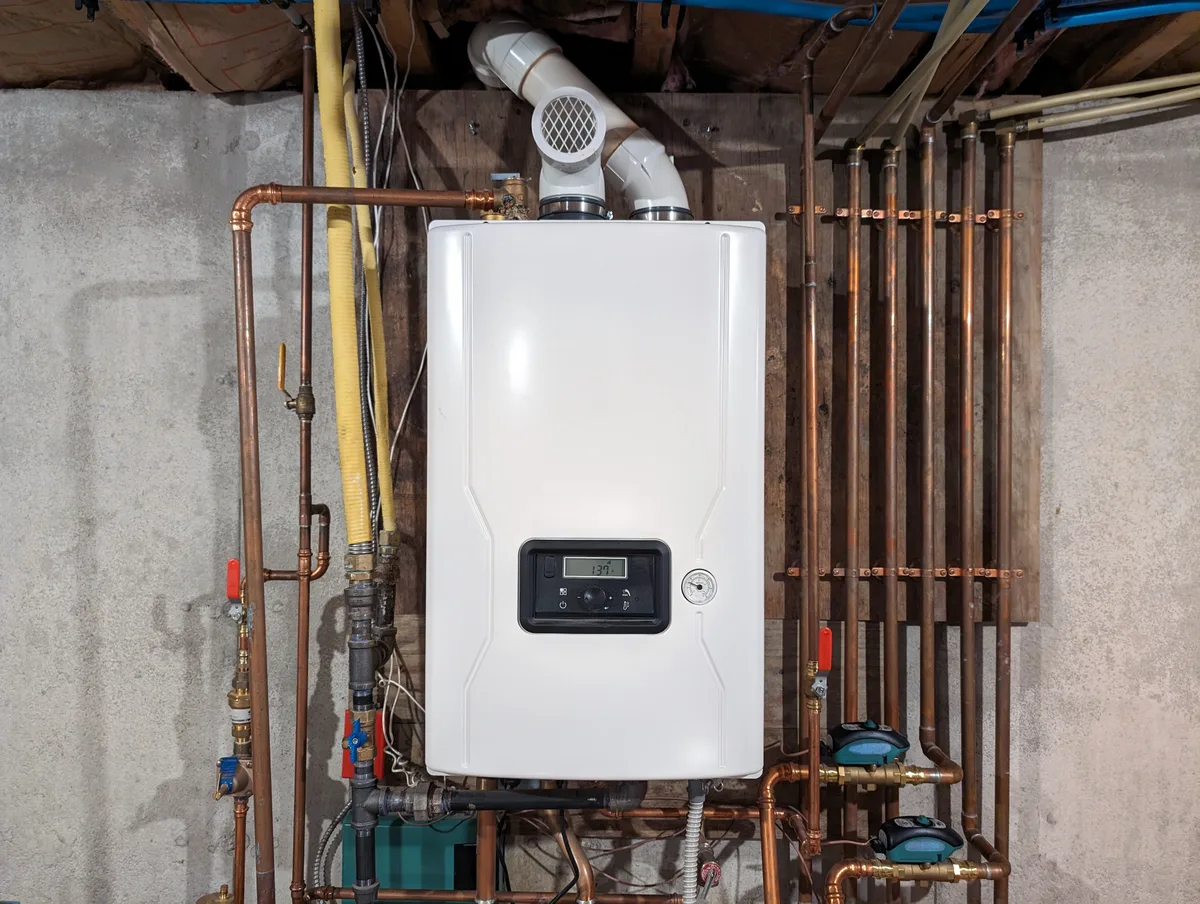
Tankless and air handler combo heating systems heat both the house and the taps from one gas appliance: a tankless or combi unit heats water, a circulator pump sends it through a hydronic coil in the air handler, and a blower pushes air across that coil into the ducts. When one stops heating, use this rule: hot taps but cool vents points to the heating loop (pump, air lock or coil), while no hot water anywhere points to the tankless unit itself. Most repairs land in the $150–$800 band after a $90–$150 diagnostic visit.
How a Combo System Works
A combo system replaces the furnace's burner with a hot-water coil. The thermostat calls for heat, the air handler starts its circulator pump, the tankless unit senses water flowing and fires, and hot water passes through the coil while the blower moves house air across it. The cooled water returns to the heater and goes around again.
There are two common layouts. In an open-loop system the water in the coil is the same potable water that feeds your taps, and many air handlers run the pump briefly on a timer through the summer so water does not sit stagnant in the coil. In a closed-loop system a combi boiler keeps the heating water separate behind a heat exchanger.
Either way the air handler has no flame, no gas valve and no vent. All combustion happens in the wall-hung unit, which is why one fault can leave you with no heat and no hot water at once.
Why Newer GTA Townhouses and Stacked Units Have Them
Builders use combos because one appliance and one vent fit in a closet. A stacked townhouse or a narrow three-storey unit in Milton, Brampton, Oakville or Mississauga has little heat loss and no basement mechanical room, so a compact air handler and a wall-hung heater stand in for a furnace, a water heater and two vent runs. If your mechanical closet holds a box on the wall with a fan cabinet beside or below it and pipes running between them, this is what you have.
The Usual Reasons a Combo System Stops Heating
Most combo no-heat calls are water-side faults, not blower faults.
- Scaled heat exchanger. Hard water in Halton and Hamilton leaves mineral scale inside the tankless heat exchanger. Output drops, the unit runs hotter to compensate and it begins to lock out on an overheat or flow code. A descale flush is both the fix and the prevention.
- Failed circulator pump. The pump sits idle for months, then seizes on the first cold night. The thermostat calls, the blower may run, and the air stays cold because no water is moving through the coil.
- Air-locked coil. After the system is drained for any plumbing work, air trapped at the top of the coil blocks flow. Gurgling in the air handler and a coil that is hot on one pipe and cool on the other are the signs. The cure is purging the loop.
- Flow sensor or inlet screen. A tankless unit fires only when its flow sensor sees enough water moving. A weak pump, a clogged inlet filter screen or a failed sensor leaves flow under the activation point, so the heater never lights on a heating call even though it works when a tap is opened.
- Mixing valve. A thermostatic mixing valve that sticks sends lukewarm water to the coil or to the taps.
- Hot-water priority. Many combi units and combo controls give domestic hot water priority, so the vents blow cooler while someone showers. That is normal behaviour, not a fault, unless the house cannot recover afterward.
Our answer on hot water but no heat from a combi goes through the diagnosis in order.
What to Check Before You Call
Five checks take ten minutes and tell a technician where to start.
Free quotes, written pricing.
- Open a hot tap. If the water runs hot, the tankless unit is working and the fault is in the heating loop.
- Read the display on the tankless unit and write down any code before resetting anything.
- Check the air handler's power switch and breaker, and change the filter if it is grey.
- Look at the isolation valves on the pipes between the heater and the air handler; the handles should sit in line with the pipe.
- Listen at the air handler during a heat call: a pump that hums and is hot to the touch but moves no water has likely seized.
Call now if you smell gas, see water dripping from the heater or the air handler cabinet, or the unit shows a code that returns immediately after a reset. Do not open the sealed combustion cover.
What Combo System Repairs Cost
Combo repairs fall in the same bands as tankless and air handler work, because those are the two machines involved.
- Diagnostic visit: $90–$150, folded into the repair if you proceed
- Most repairs, including pumps, sensors and valves: $150–$800
- Annual descale flush: $150–$300
- Replacing the tankless unit: $3,500–$6,500 installed, depending on venting and gas-line work
A replacement coil or a complete air handler is quoted after inspection, because access in a townhouse closet varies so much. Yearly descaling matters more on a combo than on a tap-only tankless, since the heater runs for space heating all winter; see our note on hard water and tankless units in Hamilton and Halton.
Rental Equipment: Check the Contract Before Replacing Anything
Much of this equipment was installed by the builder under a rental contract, and the rental company, not you, owns it. Look for a rental line on the Enbridge Gas bill or a separate monthly statement, and for a provider's sticker on the heater. If it is a rental, repairs to that unit usually go through the provider, and replacing it yourself means a buyout first. Our water heater rental buyout page explains how that is calculated and what to ask for in writing.
Replacement Choices and Our Verdict
When the heater and the air handler have both reached old age, you have three routes.
- Like-for-like combo: a new tankless or combi unit on the existing air handler, or both replaced together. Lowest disruption, same closet, same vent path.
- Furnace conversion: a gas furnace plus a separate water heater. It needs floor space, a second vent, a larger gas line and a condensate drain, which many stacked units cannot provide.
- Heat pump air handler: an outdoor heat pump with a matching air handler, either with electric backup or with a hydronic coil kept as the backup so the tankless covers the coldest hours. It adds efficient cooling, and it needs a place outside for the unit plus condo approval where the exterior is a common element.
Verdict: keep the combo design in a stacked or closet-mechanical unit. Repair the failed part, descale every year, and when the equipment reaches the end of its life replace like for like or add a heat pump with the hydronic coil as backup. A furnace conversion makes sense only in a townhouse with a real basement mechanical room.
We service the tankless side and the air handler side on the same visit. See tankless water heater repair and hydronic air handler repair, or book a diagnostic.
Frequently asked questions
Why does my combo system blow cold air when someone is in the shower?
Because the heater is giving the shower priority. A tankless or combi unit has a fixed maximum output, and when a large hot-water draw starts, many systems send that output to the taps and let the heating coil cool. Heat should return shortly after the shower ends. If it does not, the unit may be scaled and short of capacity.
Is a combo heating system as good as a furnace?
In a small, well-insulated townhouse or stacked unit, yes: the heat is even and the equipment takes little space. The weak points are that heat and hot water share one appliance, so one failure takes out both, and that the system depends on yearly descaling in hard-water areas. In a large or draughty house a furnace or heat pump is the better fit.
How often should a combo system be serviced?
Once a year, before the heating season. The visit should include descaling the tankless heat exchanger, cleaning the inlet screen, checking the circulator pump and mixing valve, purging air from the coil loop and changing the air handler filter. Homes on hard water in Halton and Hamilton should not skip a year, because the heater works for space heating as well as taps.
Can I add a heat pump to a tankless and air handler system?
Often, yes. Some hydronic air handlers accept a refrigerant coil, and others are replaced with a heat pump air handler that keeps a hot-water coil for backup. The heat pump then carries most of the season and the tankless covers the coldest hours. The outdoor unit location and, in a condo townhouse, the corporation's approval decide whether it is practical.