
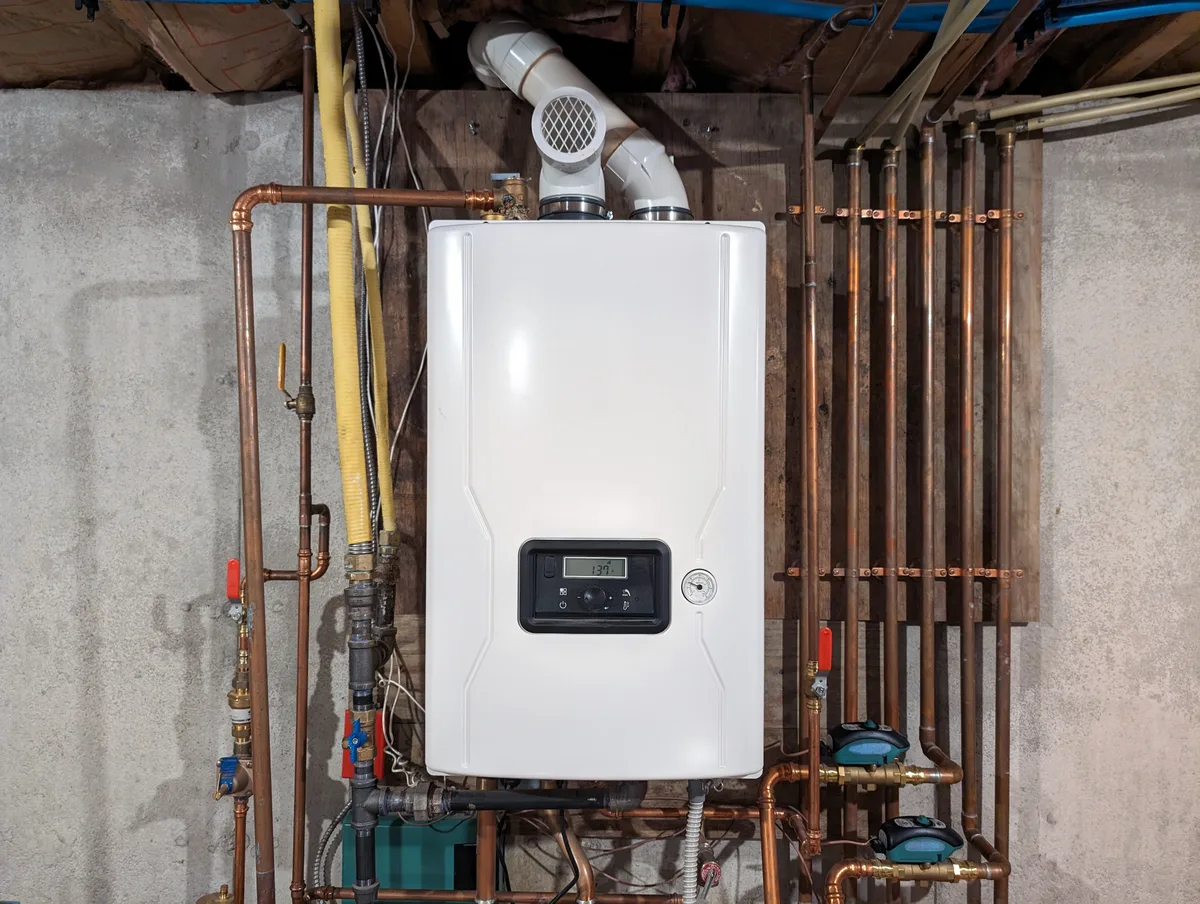
Quick answer
A combi boiler that gives hot water but no heating is most often stuck on its hot-water side: the diverter valve has seized in the domestic position, so the burner's heat never leaves the boiler for the radiators or floor loops. Rule out three simpler causes first: no heating call from the thermostat or zone valve, summer mode left on, or heating-loop pressure below about 12 psi.
When a combi boiler gives hot water but no heating, the burner, gas supply, venting and main heat exchanger are all proven good, because the taps use every one of them. That narrows the fault to the parts only the heating side uses: the call for heat, the diverter valve, and the water moving through the radiators or floor loops. Work through them in that order, cheapest first.
The diverter valve: stuck in the hot-water position
The diverter valve is a motorized three-way valve inside the boiler, and it is the classic reason a combi heats taps but not rooms. A combi gives hot water priority: when a tap opens, the valve swings boiler water through a small plate heat exchanger, and when the tap closes it should swing back to the heating loop. Scale from hard Halton and Hamilton water, or a worn actuator motor, leaves it parked on the hot-water side.
The telltale is a boiler that fires on a heating call, runs for a minute or two, shuts down and repeats, while the heating supply pipe leaving the boiler stays cool. The heat has nowhere to go except around the boiler's own short internal loop. A valve stuck the other way gives the opposite complaint: radiators that warm up whenever someone runs a shower, and lukewarm taps.
No heating call: thermostat, zone valve or summer mode
If the burner never fires for heating and the display shows no fault, the boiler has not been asked for heat. Most combis have a season or mode setting that turns space heating off for summer and leaves hot water on, and it is easy to forget in October. Many also read an outdoor sensor and refuse to heat above a set outdoor temperature (warm-weather shutdown), which catches people testing the system on a mild fall day.
- Thermostat: set to Heat, setpoint a few degrees above room temperature, fresh batteries.
- Boiler display: heating mode on, no summer or hot-water-only icon, no fault code.
- Pressure gauge: about 12 to 15 psi with the system cold.
- Hot taps: all closed, and any hot-water recirculation pump off, for five minutes. A constant hot-water call holds the boiler in priority and heating never gets its turn.
- Zone valves: on the common lever-type valve, the lever moves freely once the motor has opened it. A valve can open and still fail to signal the boiler if its end switch has burned out.
Low pressure or an air lock in the heating loop
Low pressure starves the top of the heating loop before it stops the hot water. The plate heat exchanger sits inside the boiler on a loop about a metre long; the upstairs radiators sit several metres above it, and it takes roughly 1 psi to lift water every 0.7 metres. A system that has drifted well below 12 psi can still make hot water while the upper radiators hold nothing but air. An air lock does the same thing at normal pressure: a bubble parked at a high point stops circulation in that loop.
Bleeding the radiators and bringing the pressure back to 12 to 15 psi cold often restores heat; how to bleed a radiator has the steps. Pressure that keeps falling is a leak or a failed expansion tank, covered in why a boiler loses pressure. Most combis lock out completely once pressure drops far enough, so hot water will be the next thing to go.
Circulator faults, sludge and the error codes that separate them
When the boiler fires for heating and then trips on an overheat or flow fault, water is not moving through the heating loop. On most combis the internal pump is proven by the hot water, so the suspects sit outside the cabinet: a seized system or zone circulator, a closed valve, or sludge. Old cast-iron radiators shed black iron oxide that plugs the heating return strainer, the dirt separator and, in time, the narrow passages of the heat exchanger.
- Navien NCB series: E302 is low water pressure in the heating loop; E016 is heat exchanger overheating, which in heating mode points to poor circulation.
- No code, burner never fires on a heating call: thermostat, zone valve end switch, summer mode or warm-weather shutdown.
- No code, burner fires then short-cycles with a cool heating pipe: diverter valve.
- Overheat, high-limit or flow fault only during heating: circulator, closed valve, air or sludge.
Codes differ by model and firmware, and the legend in the manual or on the label inside the front cover wins. Our guides to Navien combi error codes and Viessmann boiler codes list the common ones.
What the repair involves, and when to call
- Call now: the fault code returns after one reset.
- Call now: water is dripping from the boiler or the pressure gauge will not hold.
- Call now: the house is cooling quickly with freezing weather outside, because heating pipes on outside walls are at risk.
- Can wait a day: hot water works, the weather is mild and nothing is leaking.
A diverter valve can sometimes be revived by replacing only its actuator motor or cartridge; a scaled valve body means draining the boiler and swapping the assembly. Neither job has a flat price because parts differ by brand, so the visit starts with a $90–$150 diagnostic, folded into the repair if you proceed, and a written quote. On a combi past about 15 years with a scaled plate exchanger as well, compare that quote against replacement.
ZK Mechanical's TSSA-licensed technicians diagnose combis as part of boiler repair in Burlington, Oakville, Milton and Hamilton. Phone (647) 801-1252 or book online, and have the fault code and the gauge reading ready.