
Quick answer
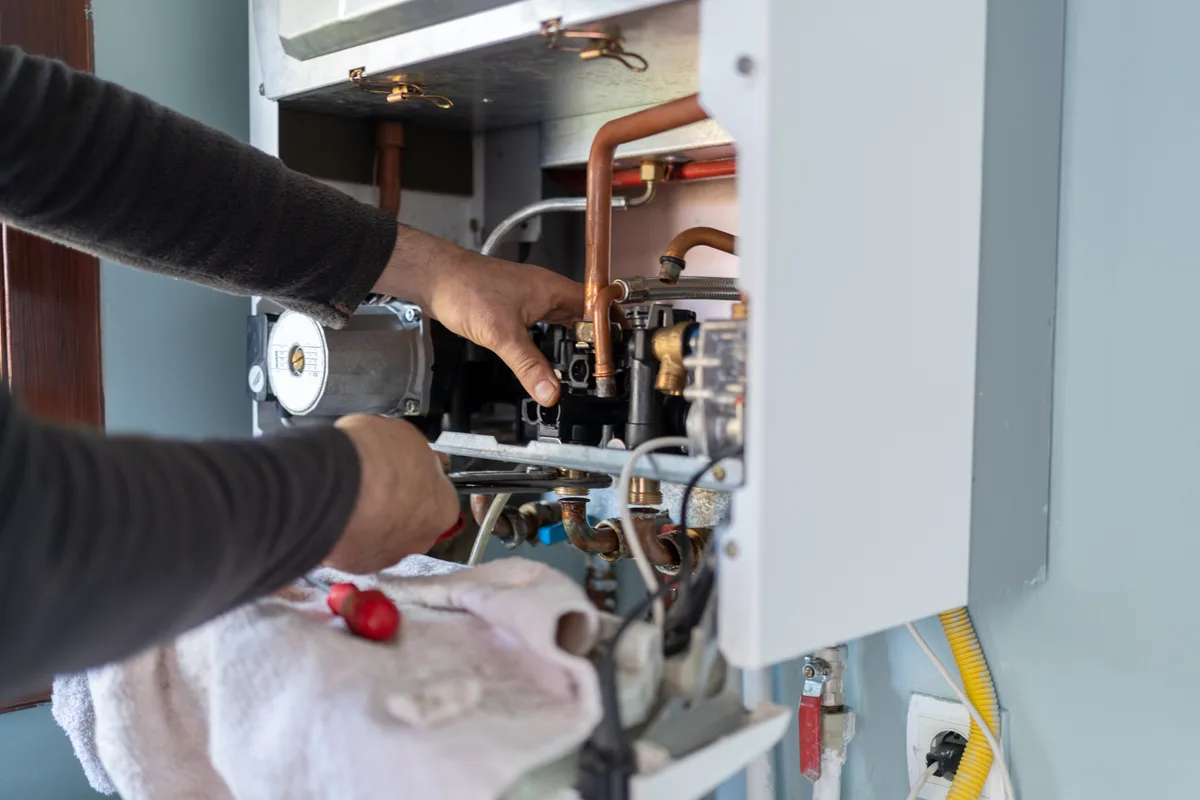
A boiler leaking water is usually leaking from one of five places: the relief-valve discharge pipe, a circulator flange or seal, the automatic air vent, a pipe joint, or the condensate drain on a condensing boiler. Water at the discharge pipe means pressure reached the valve's 30 psi setting. Water from under the jacket of a cast-iron boiler usually means a corroded section and a replacement decision.
A boiler leaking water is telling you one of two things: a part bolted to the system has worn out, or the system pressure climbed high enough to open the relief valve. The exception is water coming from the boiler body itself, which on an older cast-iron unit usually ends in replacement. Where the water shows up tells you which case you have, so find the source before you mop.
Where a boiler leaks, and what each spot means
- Relief-valve discharge pipe: the pipe that runs down the side of the boiler and ends near the floor. Water here means system pressure reached the valve's setting, which is 30 psi on most residential boilers. The usual causes are a waterlogged expansion tank or a fill valve that no longer shuts off, and why boiler pressure climbs too high covers both.
- Circulator flange or seal: the pump bolts between two flanges, each with a gasket that hardens with age. Look for a rust trail or green-white crust below the pump body. Older three-piece circulators also leak at the shaft seal between the motor and the pump housing.
- Automatic air vent: a small brass can with a cap, usually on top of the air separator. Its float sticks open with scale and it dribbles from the cap. Screwing the cap down stops the drip and also stops the vent from doing its job.
- Pipe joints and valves: threaded iron fittings, unions, the boiler drain and the packing nuts on old gate valves. Many weep only when the system is cold and the metal has contracted, then seal again once it heats.
- Condensate on a condensing boiler: a high-efficiency boiler makes acidic water as it runs and sends it through a trap and tube to a drain or pump. A blocked trap, a slipped tube or a failed pump puts clear water under the cabinet.
System water or condensate? The pressure gauge tells you
The pressure gauge separates the two fastest. System water is under pressure, so a real leak drags the gauge down over hours or days, or the automatic fill valve hides the loss by topping up constantly. Condensate never touches the pressurized side: if the gauge holds at its usual 12 to 15 psi cold and a puddle keeps returning under a wall-hung condensing boiler, the drain path is the suspect.
First steps when you find water at the boiler
- Switch the boiler off at the service switch on or near the unit, or at its breaker.
- Close the make-up water valve, the small shut-off on the cold line feeding the boiler's fill valve. That stops fresh water from pouring through the leak and stops the fill valve from masking how much is escaping.
- Write down the gauge pressure and temperature, and whether the boiler was hot or cold when you read it.
- Put a bucket under the drip and photograph the wet spot and any rust trail; the trail often dries before a technician arrives.
- Leave the relief-valve discharge pipe open. Never cap it, plug it or thread a valve onto it.
With the make-up valve closed, do not restart the boiler until the leak is found. A boiler fired short of water can crack a section or burn out a heat exchanger.
Water from under the jacket: when a leak means a new boiler
Water appearing from under the boiler's sheet-metal jacket, rust streaks running down the iron sections, or hissing and white vapour at the flue when the burner fires all point to the boiler body. On a cast-iron boiler that is a cracked section or a failed seal between sections. On a condensing boiler it is a pinholed heat exchanger, which often shows as water running from the condensate line while the burner is off.
A workable repair-or-replace rule by age: a leak at a bolt-on part (relief valve, circulator, air vent, expansion tank, a fitting) is worth fixing at any age. A leaking section or heat exchanger is a replacement conversation once a cast-iron boiler is past about 25 years or a condensing boiler is past about 15, because the labour to split the boiler approaches the cost of a new one. Under those ages, check the heat-exchanger warranty before deciding. Whether to repair or replace a boiler works through that decision.
Why old radiator systems in Hamilton and Burlington leak the way they do
Pre-war brick houses in Westdale, Dundas, downtown Burlington and Toronto's west side often still run cast-iron radiators on piping that was sized for gravity circulation, so the system holds far more water than a modern loop. More water means more expansion, and an undersized or waterlogged expansion tank sends the relief valve dripping every time the boiler heats up. Halton and Hamilton water is also hard. Every litre of fresh make-up water a slow leak pulls in carries dissolved oxygen and minerals, which is how a weep left for a few winters turns into a corroded section.
Call now, or book a visit?
- Call now: water is spraying, or the discharge pipe runs in a steady stream instead of a drip.
- Call now: the gauge reads 30 psi or higher, or has fallen to zero.
- Call now: water is reaching the burner, the controls or any wiring, or a carbon monoxide alarm sounds.
- Can wait for a booked visit: a slow drip from an air vent, a valve stem or a flange with the gauge holding steady. Keep a bucket under it and read the gauge daily.
A diagnostic visit runs $90–$150 and is folded into the repair if you go ahead. Boiler parts vary too much by make and piping layout for a flat figure, so the technician finds the leak and prices the fix in writing before any work starts; the bands we do publish are on our pricing page. ZK Mechanical's TSSA-licensed technicians handle boiler repair across Burlington, Oakville, Hamilton and Mississauga. Call (647) 801-1252 or book a visit online.