
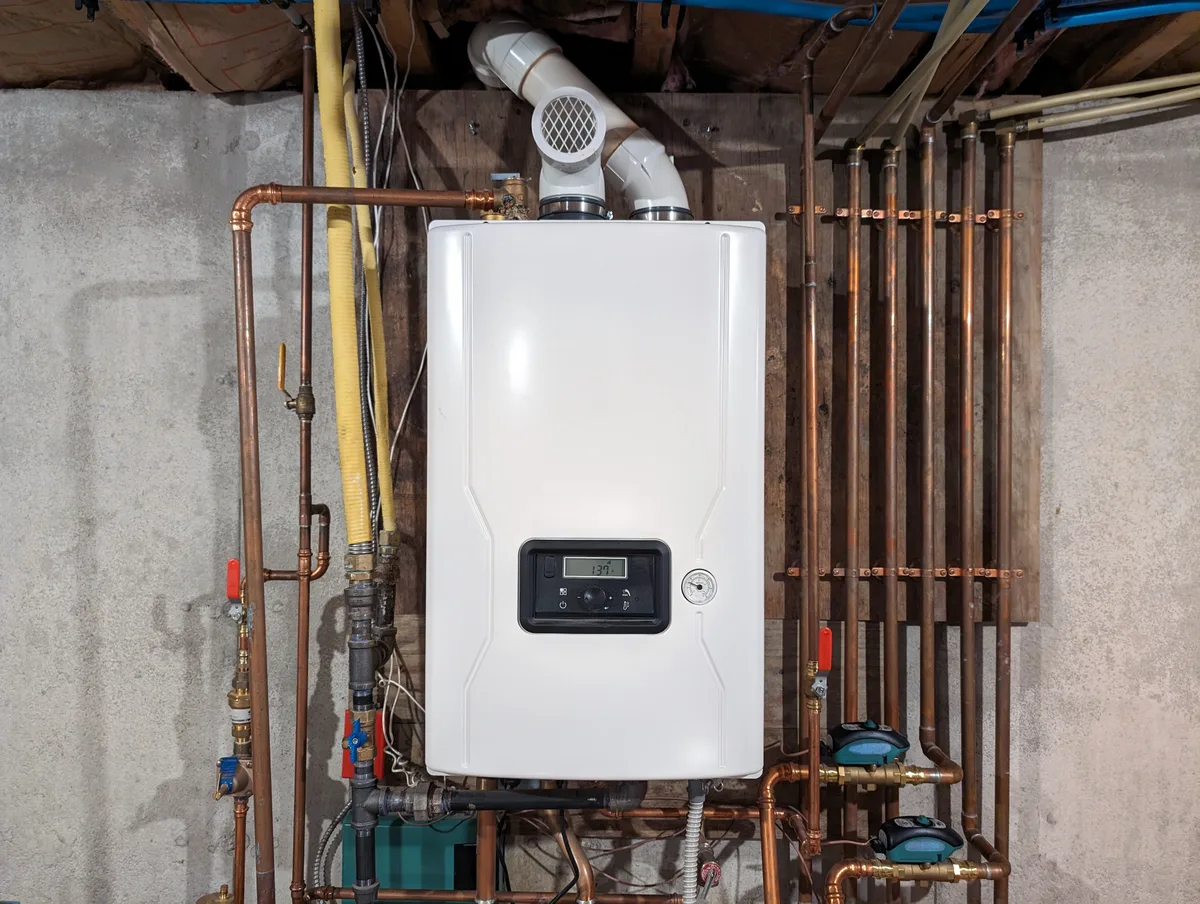
A combi boiler vs boiler and separate water heater is decided by hot water, not by heating. A combi makes hot water on demand and is limited by flow: with winter inlet water near 5 °C, a 120,000 BTU combi delivers about 10 to 11 litres per minute and a 199,000 BTU unit about 17. If two showers running at once is normal in your house, choose a boiler with an indirect tank or the largest combi. If it is one shower at a time and floor space is tight, a combi is the better buy.
The Hot Water Limit: Flow Against Stored Volume
A combi is sized by litres per minute at a given temperature rise, and an indirect tank is sized by litres stored. That is the whole difference in how they fail you. A combi never runs out but can only do so much at once; a tank does a lot at once and then runs out.
The winter math is what matters. City water drawn from Lake Ontario arrives at around 5 °C in February, so heating it to 50 °C is a 45 °C rise. Every litre per minute at that rise takes about 3.1 kW of burner output.
- One shower: roughly 8 L/min at the showerhead, of which about 6 L/min is hot water after mixing. Any combi handles it.
- Two showers at once: about 12 to 13 L/min of hot water. That is beyond a 120,000 BTU combi in winter and within reach of a 199,000 BTU one.
- Two showers plus the dishwasher or a kitchen tap: at the limit of the largest residential combi. Someone gets a cooler shower.
- A soaker tub: a combi fills it at its flow limit, slowly but without running out. A tank fills it fast, then needs time to recover.
An indirect tank has no burner of its own; the boiler heats it through a coil, like one more heating zone. It delivers the stored volume at full household flow, and a condensing boiler reheats it quickly. For three or more people who shower back to back or at once, that is the more forgiving setup. Our page on indirect water heater installation explains tank sizes.
The Sizing Mismatch: A Hot-Water Burner on a Small Heating Load
Combi burners are sized for hot water, typically 120,000 to 199,000 BTU, and that is several times what the house needs for heat. A semi-detached or a bungalow with radiators may lose 30,000 to 50,000 BTU per hour on the coldest night and far less in October. The number that decides whether a combi can heat such a house gracefully is its turndown ratio.
- A 199,000 BTU combi with 10:1 turndown can fire as low as about 20,000 BTU. That suits most houses through most of the season.
- The same size with 5:1 turndown bottoms out near 40,000 BTU. On a mild day it fires, overshoots, shuts off and repeats.
- Small zones make it worse. One loop of fin-tube baseboard for a single bedroom may need only a few thousand BTU, well below any combi's minimum.
Short-cycling wears igniters and fans and wastes gas. Cast-iron radiators help because they hold a lot of water and absorb heat slowly. Low-mass baseboard and small zones may need a buffer tank. Ask for the minimum firing rate on the quote and compare it with a heat-loss calculation for the house, not with the old boiler's nameplate.
A heat-only boiler with an indirect tank avoids the mismatch. The boiler is sized to the heating load, often well under 100,000 BTU, and the tank covers the hot-water peaks from storage.
Hot Water Priority: Heating Pauses While the Tap Runs
A combi does one job at a time. When a hot tap opens, a diverting valve sends the boiler water through a plate heat exchanger and the radiators get nothing until the tap closes. In a brick house with cast-iron radiators you will not notice a fifteen-minute shower, because the iron keeps giving off heat.
You may notice it in a draughty house with fin-tube baseboard or a hydronic air handler on a January evening when three people shower in a row and the laundry runs. An indirect tank is usually wired with priority too, but it recovers in a short burst and the stored water covers the draw, so the heating interruption is brief.
Free quotes, written pricing.
Hard Water and the Plate Heat Exchanger
Halton and Hamilton water is hard, and a combi's plate heat exchanger is where the scale collects. The passages are narrow and the plates are hot, so minerals drop out there first. The symptoms are hot water that swings between warm and scalding, lower flow at the tap, or hot water that never reaches full temperature while the heating works normally.
- Plan on a descaling flush of the domestic side as a regular service item, yearly on untreated hard water.
- Insist on isolation and flush valves under the combi at install. Without them, descaling means draining and dismantling.
- A water softener upstream reduces the frequency. On a private well in rural Caledon or Flamborough, have the water tested first.
For a sense of scale, the same flush on a tankless water heater runs $150–$300. An indirect tank is less sensitive: the boiler water inside its coil is a closed loop that does not keep bringing in new minerals, and scale on the outside of the coil settles in a large tank instead of blocking a narrow passage.
Space, Venting and What Happens When One Part Fails
A combi is one wall-hung box with one vent, and it frees the floor where a tank stood. In a small pre-war semi where the boiler shares a corner with the laundry, that can decide the matter. The trade is a single point of failure: when a combi locks out, the house has no heat and no hot water until it is repaired.
A boiler with an indirect tank takes more floor and has more parts, including an extra pump or zone valve, and the tank still depends on the boiler. The most independent arrangement is a boiler plus a stand-alone gas water heater. If either fails, the other keeps working, at the cost of two burners, two vents and two appliances to maintain.
A large combi can also need a bigger gas line than the old boiler had. The gas piping must be sized under CSA B149.1 by a TSSA-licensed technician. Condensing units of either type need a condensate drain.
What Drives the Price of Each Option
We do not publish a flat price for boiler replacements, because the pipework varies too much from house to house. What moves a quote is predictable: the venting route to an outside wall, gas-line size, near-boiler piping and pumps, the number of zones, whether a tank or buffer tank is added, and the condition of the old system water. A stand-alone tank water heater, if you keep or add one, is $1,200–$2,500 installed. Our pricing page shows how a written quote is itemized.
Verdict: Who Should Choose Which
- Choose a combi if one or two people live in the house or showers rarely overlap, space is tight, the heating system has enough mass or zone size to match the boiler's minimum firing rate, and you will keep up with descaling.
- Choose a boiler with an indirect tank if three or more people shower close together, there is a soaker tub or two full bathrooms in regular use, the heating load is small or split into small zones, or the water is hard and untreated.
- Keep or add a stand-alone water heater if the existing tank is recent, or if you want hot water to survive a boiler failure.
- Whichever you choose, get the minimum firing rate, the winter hot-water flow at a 45 °C rise and the heat-loss figure in writing.
If the boiler you have is failing now, a repair may buy the time to decide properly. Our boiler repair service covers both combi and conventional boilers across Burlington, Oakville, Hamilton and west Toronto. For model choices see the best combi boilers for Ontario homes, for the boiler type itself see cast iron vs condensing boilers, and contact us for a written quote on either layout.
Frequently asked questions
Can a combi boiler run two showers at the same time?
A 199,000 BTU combi can, in most Ontario winters, as long as nothing else is drawing hot water. Two showers need about 12 to 13 litres per minute of hot water at a 45 °C rise, and the largest residential combis deliver about 17. Smaller combis in the 120,000 BTU range cannot hold two showers at full temperature in February.
Does a combi boiler need a water softener in Burlington or Hamilton?
It is not mandatory, but hard water shortens the interval between descaling flushes and is the most common cause of hot-water complaints on combis here. A softener ahead of the boiler's cold inlet protects the plate heat exchanger. Without one, budget for a yearly flush and make sure service valves were fitted at installation.
Can I keep my existing water heater when I replace the boiler?
Yes. A heat-only boiler can be installed alongside a tank water heater you already own, and many homeowners do that when the tank is only a few years old. Check how the tank vents first. If it shared a chimney with the old boiler, the chimney may need a liner once the new boiler vents through the wall.
Will a combi boiler lower my gas bill compared with a boiler and tank?
A little, in the right house. A combi has no stored water losing heat all day, which saves some gas. That gain disappears if the boiler short-cycles because its minimum firing rate is too high for the heating load. A correctly sized condensing boiler with a well-insulated indirect tank runs close to a combi on fuel.