
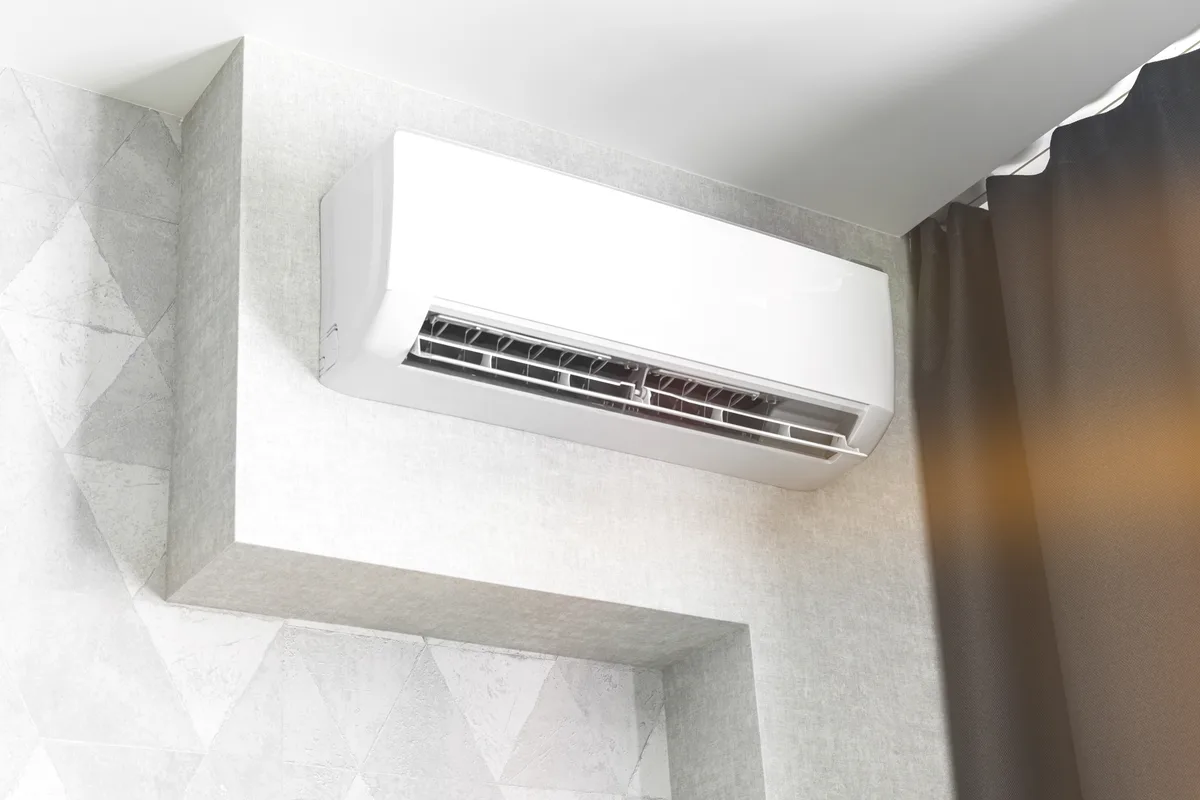
Ducted vs ductless heat pump: which fits your home comes down to one test. If the house has ductwork that can move 350 to 400 CFM of air per ton of heat pump at a static pressure the blower can live with, go ducted and keep everything the ducts already do for you. If the house has no ducts, or the problem is one or two rooms the ducts never served well, go ductless. A house with radiators or electric baseboards is almost always a ductless job; a 1980s subdivision house with a furnace is almost always a ducted one.
The Duct Suitability Test: 350 to 400 CFM per Ton
A heat pump moves more air than the furnace it replaces or joins. It delivers heat at a lower temperature, so it needs volume: roughly 350 to 400 CFM for every ton of capacity. A 3-ton unit wants 1,050 to 1,200 CFM through ducts that may have been laid out for a furnace that was content with less.
The check is a static pressure reading. A technician drills two small test ports, one before the filter and one after the coil, and measures the resistance the blower is pushing against with a manometer. Most residential blowers are rated to deliver their airflow at 0.5 inches of water column. A reading well above that means the ducts are restricting flow, and a heat pump will make it worse.
- Usual culprit: return air. One undersized return grille and a one-inch filter choke more systems than the supply trunk does.
- Common fixes: a second return, a wider media filter cabinet, sealing leaky joints, or a short section of larger trunk at the furnace.
- Sign the ducts are too small for the unit proposed: the quote has a tonnage on it but no static pressure number.
No ducted heat pump should be quoted before that reading is taken. Our answer on whether a heat pump can use your existing ductwork covers what the numbers mean, and the glossary explains static pressure in plain terms.
What Only a Ducted Heat Pump Lets You Keep
A ducted system treats all the air in the house at one point, and four things depend on that.
- Whole-home filtration: every cubic metre of air passes through one media filter at the furnace or air handler. Ductless heads have washable screens that catch lint, not fine dust.
- A furnace-mounted humidifier: it needs a supply plenum and a return duct to work. Ductless heating has no place to put one, and a Halton winter is dry.
- HRV or ERV integration: most ventilators in local houses are tied into the return duct and rely on the central blower to distribute fresh air.
- A gas furnace as hybrid backup: the heat pump coil sits on the furnace, and the furnace takes over on the coldest nights without any electric heater.
You also keep one thermostat, clear walls and registers you already have. If the ducts pass the test, those are strong reasons not to abandon them.
Where a Ductless Heat Pump Is the Better Tool
Ductless wins when there are no ducts to use, or when the ducts are the problem. Each indoor head is its own zone with its own setpoint, and no heat is lost through duct runs in an attic, a garage ceiling or a crawlspace.
- Pre-war brick houses with hot-water radiators in lower Hamilton, Dundas and west Toronto: ductless adds cooling and shoulder-season heat without tearing into plaster.
- 1970s townhouses on electric baseboards: a ductless system cuts the heating bill and the baseboards stay as backup.
- Additions, sunrooms and rooms over the garage that the furnace never reached properly.
- A finished attic or third floor at the far end of the duct run.
The costs are real. A head heats and cools the space it can see, so every bedroom with a closed door needs its own head or goes without. There is no central filtration and no humidifier.
Free quotes, written pricing.
Each head also needs a condensate drain and a line set, which usually run down an outside wall in a cover. The choice between one outdoor unit per room and one shared unit is covered in single-zone vs multi-zone mini-splits.
The Middle Option: A Compact Ducted Unit for One Floor
Some houses need both answers. A slim ducted air handler from a mini-split line can hide in an attic or a bulkhead and feed three bedrooms through short duct runs, each with a ceiling register. It gives closed-door rooms conditioned air without a head on every wall.
These units have small blowers that tolerate little resistance, so the runs must be short, straight and properly sized. They suit a second floor in a radiator house or a bungalow with attic access. They do not replace a full furnace duct system for a whole two-storey house.
Cold-Weather Heating and Backup for Each Type
Both types are sold in cold-climate versions that keep heating well below -15 °C, and both need a backup plan. Where they differ is in what the backup is.
- Ducted with a furnace: the furnace is the backup. Nothing else to buy.
- Ducted all-electric: an electric heater kit in the air handler, which needs panel capacity and an ESA notification for the new circuit.
- Ductless: whatever heated the house before. Leave the boiler or the baseboards in working order.
One ductless caution for February: a head in the hallway will not keep a closed bedroom at the far end warm. Plan the heads around doors, not floor area.
What Each Type Costs Installed in the GTA
- Ducted cold-climate heat pump, whole home: roughly $6,000–$16,000 installed before rebates, depending on capacity, brand tier and electrical work
- Ductless, single zone (one indoor head): $4,000–$7,000 installed
- Ductless, dual zone: $7,500–$11,000 installed
- Ductless, three to four zones: $10,000–$16,000+ installed
- Cold-climate ductless models add roughly $500–$1,500 per zone
Whole-house ductless costs as much as ducted once you count a head for every room. Duct repairs, where needed, are quoted separately after the static pressure test. Heat pump rebates run through the Home Renovation Savings Program and need approval before the work starts.
Verdict: Ducted or Ductless by House Type
- 1970s to 1990s subdivision house with a furnace: ducted, usually as a hybrid. Fix the return air first if static pressure is high.
- 2000s and newer build with a furnace, humidifier and HRV: ducted. You would lose too much by going around the ducts.
- 1950s or 1960s bungalow on the Hamilton Mountain or in Aldershot with small ducts: ducted if the static test passes after return-air work; otherwise a compact ducted unit or ductless.
- Radiator or baseboard house with no ducts: ductless, with the old system kept as backup.
- Any house with one room that is always wrong: a single-zone ductless unit for that room, and leave the central system alone.
- Rural house on propane or oil with ducts, in Campbellville, Carlisle or rural Caledon: ducted cold-climate, with the existing furnace kept for the coldest nights where it qualifies.
We measure static pressure and count the closed doors before recommending either. Our heat pump installation service covers ducted and hybrid systems, ductless mini-split installation covers the rest, and a free written quote will show the reading we took.
Frequently asked questions
Can I have a ducted heat pump and a ductless unit in the same house?
Yes, and it is often the right design. A ducted or hybrid heat pump handles the main floors through the existing ducts, and a single ductless head takes care of the room the ducts never served well, such as an addition or a room over the garage. The two systems are independent, each with its own outdoor unit and control.
Is a ductless heat pump more efficient than a ducted one?
Often on paper, because there are no duct losses and small units carry high ratings. In a house whose ducts run inside the heated space, the real gap is small. Efficiency should not decide this. Coverage should: a ductless system that leaves three closed bedrooms cold is not saving energy, it is failing to heat.
Do my ducts need to be replaced for a heat pump?
Rarely replaced, sometimes modified. Most forced-air houses need at most a larger return path, a better filter cabinet and some sealing to carry heat pump airflow. Full replacement is only on the table when the trunk is far too small for the house. The static pressure reading taken before the quote tells you which case you are in.
How much maintenance does each type need?
A ducted system has one filter to change and one coil to keep clean. A ductless system has washable screens in every head that need rinsing every few weeks in heavy use, and each head's coil and blower wheel need a deep cleaning periodically or they grow mould and lose airflow. More heads means more upkeep.