
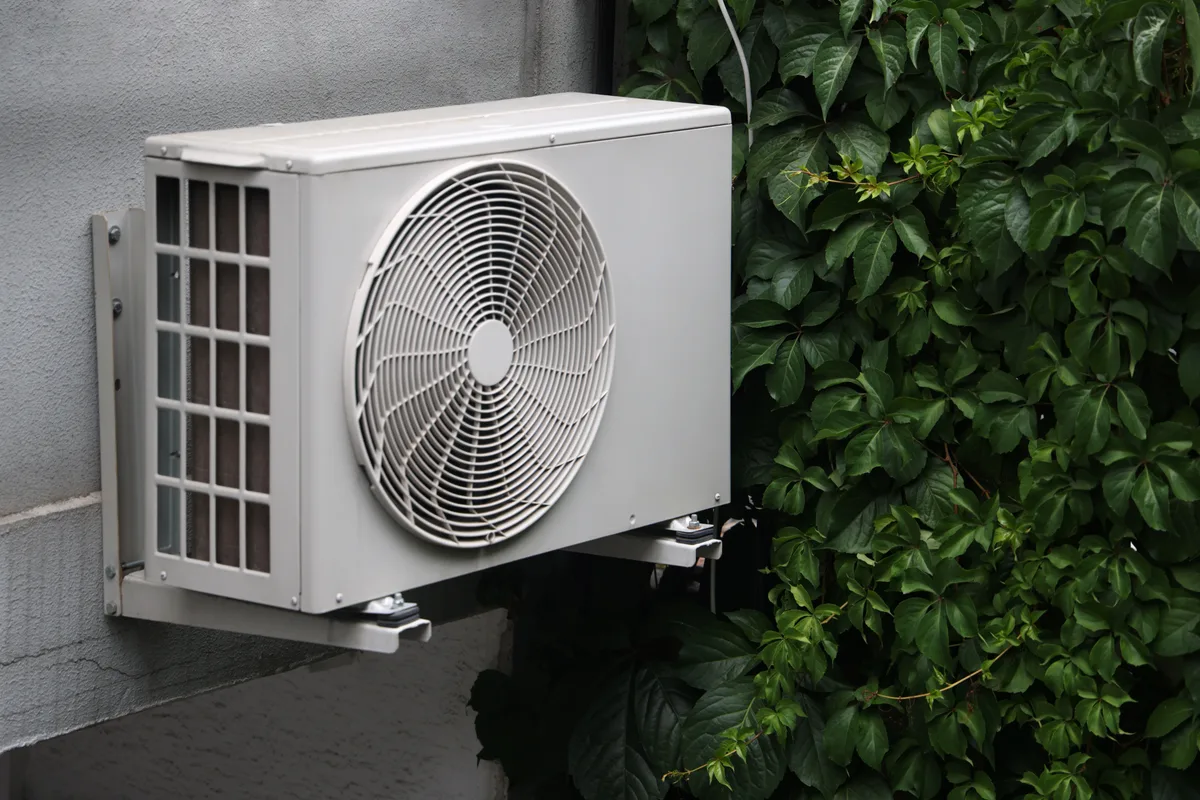
Bosch vs Mitsubishi heat pumps: ducted systems compared on published numbers are closer than the price gap suggests. Bosch says its IDS Ultra delivers up to 100% of heating capacity down to -15 °C and keeps running to -25 °C; Mitsubishi lists Zuba Central at 100% heating capacity at -15 °C with a heating range to -25 °C. The decision turns on what is in your basement. Keeping a gas furnace points to a Bosch IDS on a 24 V thermostat, and going all-electric makes it a contest between Zuba Central and IDS Ultra that sizing and your electrical panel will settle.
Published Cold-Weather Capacity for Each System
Both flagship systems hold their full rated heat at -15 °C, which is colder than most winter nights along Lake Ontario. The useful differences are in sizes and in what each maker publishes.
- Bosch IDS Ultra: up to 100% heating capacity down to 5 °F (-15 °C) at a COP of 2.1, with operation continuing to -13 °F (-25 °C). Sold in 3-ton to 5-ton sizes, on R-454B refrigerant.
- Bosch IDS Premium Connected: a fully modulating inverter unit rated up to 9.5 HSPF2. Bosch's product page does not make a low-temperature capacity claim for it, so ask for the capacity table at -15 °C before treating it as a cold-climate unit.
- Mitsubishi Zuba Central: four sizes from 24,000 to 42,000 BTU/h of cooling, with maximum heating at -15 °C of 26,000, 32,000, 38,000 and 48,000 BTU/h. COP at -15 °C is listed at about 2 on the smaller sizes and 1.8 on the larger. Heating range is listed to -25 °C, with a note that units can run to -30 °C depending on conditions.
Sizes matter more than the headline. A small Burlington townhouse with a heat loss near 25,000 BTU/h fits the smallest Zuba Central, while IDS Ultra starts at 3 tons. A large detached house in Ancaster or Caledon with a heat loss above 48,000 BTU/h is past the biggest Zuba Central and inside the Bosch range.
Controls: A 24 V Thermostat or Mitsubishi's Own Controller
Bosch IDS is designed to run on a conventional 24 V thermostat. The outdoor unit modulates on its own readings, so the thermostat only has to say heat, cool or off. You can keep a smart thermostat you already own, and any technician who understands 24 V controls can troubleshoot it.
Zuba is a Mitsubishi system from end to end: a PUZ outdoor unit, a PVA air handler and Mitsubishi's own controller talking to both. That link is part of why it modulates so smoothly. The cost is that a third-party thermostat needs Mitsubishi's interface module, and service calls need someone who works on the brand.
Pairing With a Gas Furnace as a Hybrid
For a hybrid on a furnace you already own, the Bosch IDS is the simpler fit. It pairs a cased coil with most existing gas furnaces and a dual-fuel thermostat handles the switchover. One caution: Bosch presents the IDS Ultra as a fully electric system with its own Ultra Series air handler, so if a contractor proposes an Ultra on a furnace, ask for the AHRI certificate showing that combination.
Mitsubishi's answer is Zuba Hybrid, a PAA coil that sits on an existing furnace with a PUZ outdoor unit in three sizes. Mitsubishi puts conditions on the furnace, and they rule out more houses than people expect.
- The furnace must be certified to ANSI Z21.47 / CSA 2.3, and oil and drum-type furnaces are excluded.
- Supply air temperature at the coil must not exceed 93.3 °C.
- Furnace output must not be more than 300% of the coil's rated heating capacity. On the smallest coil, rated 25,400 BTU/h, that caps the furnace at roughly 76,000 BTU/h of output.
That last limit matters in 1970s to 1990s subdivisions, where a 100,000 BTU furnace sits on a house that needs half of that and is too large for the smallest coil. Our post on the Mitsubishi Zuba heat pump looks at the Zuba family by itself.
Free quotes, written pricing.
Backup Heat and What It Asks of Your Electrical Panel
An all-electric install of either brand needs an electric heater kit in the air handler for defrost and for the coldest hours, and that kit, not the heat pump, is what strains a panel. Both makers list kits in several kilowatt sizes. The arithmetic is the same for any of them.
- A 5 kW heater draws about 21 A at 240 V.
- A 10 kW heater draws about 42 A.
- A 15 kW heater draws about 63 A.
- A 20 kW heater draws about 83 A.
- The outdoor unit is on top of that: Mitsubishi's table lists minimum circuit ampacity from 17 A on the smallest Zuba Central to 36 A on the largest.
On a 100 A service that already feeds an electric range and a dryer, a heat pump with a 15 kW heater rarely passes a load calculation. The options are a smaller heater sized to the real shortfall, a 200 A service upgrade, or a hybrid that keeps the furnace and needs no heater at all. A service upgrade involves your utility, whether Burlington Hydro, Oakville Hydro, Alectra or Hydro One, and all of the wiring is done by a licensed electrical contractor under an ESA notification. Our guide to an electrical panel upgrade for a heat pump explains the load calculation.
Refrigerant, Warranty and Service Access
Current Bosch IDS models use R-454B, one of the newer A2L refrigerants. Mitsubishi's most recent Zuba brochure lists R-410A, so ask which refrigerant the unit on your quote uses and whether the installer is equipped for it. Both makers advertise up to 10 years on parts, with conditions: Mitsubishi's term on Zuba depends on installation and registration by one of its certified installers.
Service access leans toward Bosch, because 24 V controls are familiar to every furnace and air conditioning technician. Mitsubishi diagnostics run through its own controller and fault codes. Refrigerant work on either requires an ODP card, and ZK Mechanical services both brands.
What a Ducted Cold-Climate Heat Pump Costs
A 3-ton cold-climate heat pump installs for $9,500–$15,000 in the GTA, inside a wider range of $6,000–$16,000 for ducted systems before rebates. Zuba Central with its own air handler tends toward the upper part of that range, and a Bosch IDS on an existing furnace toward the lower part, because the furnace stays. Electrical work is the wild card on any all-electric quote.
Rebates run through the Home Renovation Savings Program, with approval before installation and an installer on the participating list. The amounts depend on how the house is heated today; see heat pump rebates in Ontario.
Verdict: Which Ducted Heat Pump for Which House
- Keeping a working gas furnace: Bosch IDS on a 24 V dual-fuel thermostat. It is the least disruptive route and needs no panel work in most houses.
- All-electric, heat loss under about 48,000 BTU/h, 200 A service: Zuba Central. Mitsubishi publishes the more complete capacity table of the two, and the smaller sizes fit townhouses and bungalows.
- All-electric, larger house: Bosch IDS Ultra in the 4-ton or 5-ton size, with the heater kit sized from a heat-loss calculation, not a guess.
- Rural house on propane or oil with ducts, in Caledon, Kilbride or Campbellville: either flagship works. Zuba Hybrid is out if the existing furnace is oil-fired.
- 100 A panel and no appetite for an upgrade: a hybrid, whichever brand.
Start with a heat-loss calculation and a look at the panel, and the brand question mostly answers itself. Our heat pump installation service includes both checks, and you can book a free written quote that names the outdoor unit, the indoor unit and the heater size.
Frequently asked questions
Which is quieter, Bosch IDS or Mitsubishi Zuba?
Mitsubishi lists outdoor sound for Zuba Central between 49 and 53 dB(A) in cooling, depending on size. Bosch lists sound levels as low as 60 dBA for the IDS Premium Connected. Published figures are not always measured the same way, so treat them as a guide. Placement matters as much: keep either unit away from a bedroom window and off a wall that resonates.
Can I keep my smart thermostat with a Bosch or Mitsubishi heat pump?
With Bosch IDS, usually yes, because it accepts conventional 24 V signals. For a hybrid the thermostat must also support dual fuel. With Zuba, the system is built around Mitsubishi's own controller, and a third-party thermostat needs a Mitsubishi interface module that some features do not pass through. Check compatibility before you buy the thermostat.
Do Bosch and Mitsubishi heat pumps qualify for Ontario rebates?
Eligibility is decided by the specific outdoor and indoor model combination, not the brand. The Home Renovation Savings Program requires approval before installation and a contractor on its participating list. Ask for the AHRI number of the matched system on your quote and have it checked against the program's requirements before you sign anything.
Will either heat pump work without backup heat in Burlington or Hamilton?
A correctly sized cold-climate unit can carry a well-insulated house through most of the winter, but we would not recommend a ducted system without some backup. Defrost cycles need tempering heat, and a failure in January needs a fallback. The backup can be a small electric heater kit or the existing gas furnace in a hybrid.